20 October 2026, 15:34
Loading...
Range Rover Hybrid (Supercharged): a perfect and majestic all-rounder
Tomáš Jirka
20 January 2016, 16:54
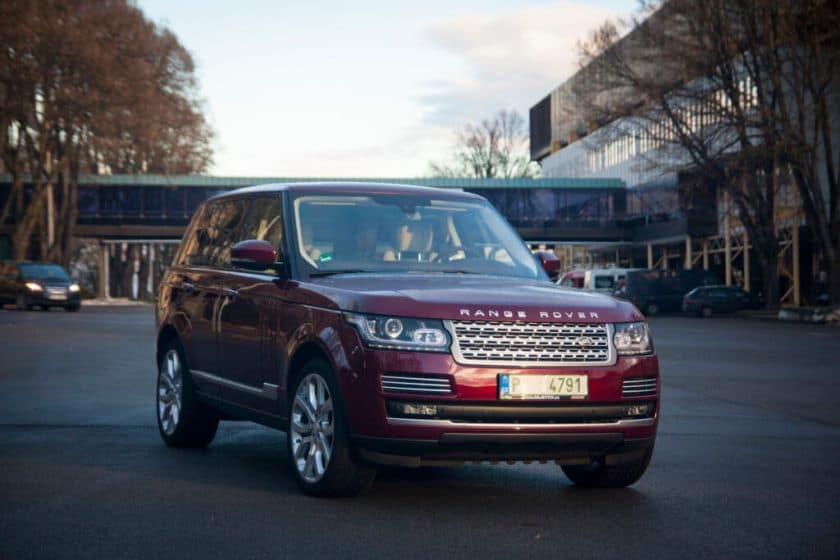
The Range Rover is one of the most versatile (in the large SUV category) and most luxurious vehicles on the market, which is also the problem with this test. Apart from the BMW X5 (F15 3.0d, which is actually quite far removed from the Range Rover), I have little experience with these vehicles and, moreover, I am not particularly fond of SUVs.
I approached the car as a giant whose main purpose was to complement its owner's image. But the Range Rover truly convinced me that these vehicles make sense, although versatility without major compromises comes at a price.
Roadshow in Most and the complicated story of the test
I came across the Range Rover more or less by chance – on Friday afternoon in the office, a colleague found out that he would not make it to a Saturday event and, after a brief conversation, we got to whether someone could go in his place, that it could be arranged, and so I started looking into what it was: BEST OF BRITAIN – JAGUAR & LAND ROVER ROADSHOW 2015.
Jaguar and Land Rover organise day-long events at various circuits and on nearby roads to whet the appetite of potential customers. I could not pass up the chance to drive an F-Type, so my Saturday plans were settled. Given the weather forecast and the assumption that I would not be working over the weekend, I did not even take my camera as unnecessary baggage, and by chance my phone was being repaired under warranty, so I set off without any recording device for the border between the beautiful landscape of the Czech Central Highlands and the lunar landscape of the coal basin (already reclaimed into lakes and the aforementioned circuit), to Autodrom Most.
The weather forecast was accurate only in terms of temperature (which meant nothing unusual in November); all-day rain turned into occasional showers, just enough to ensure the asphalt never dried out and the off-road track had the right clayey slipperiness, while the sun shone between them, so a roaring red F-Type V6S lapped with its roof down and produced one smile after another ????
The second big dream fulfilled was trying the outgoing Defender off-road. Its two-millionth unit had recently been produced, and its successive facelifts essentially make up the brand's history, but more on that later.
Besides the complete (truly interesting) Jaguar model range, Land Rovers and Range Rovers were also available, and given the presence of the Range Rover Hybrid, I decided to „work“ for at least some of the time and drove it on the circuit, off-road and around Most, but through my own fault I had no opportunity to take pictures…
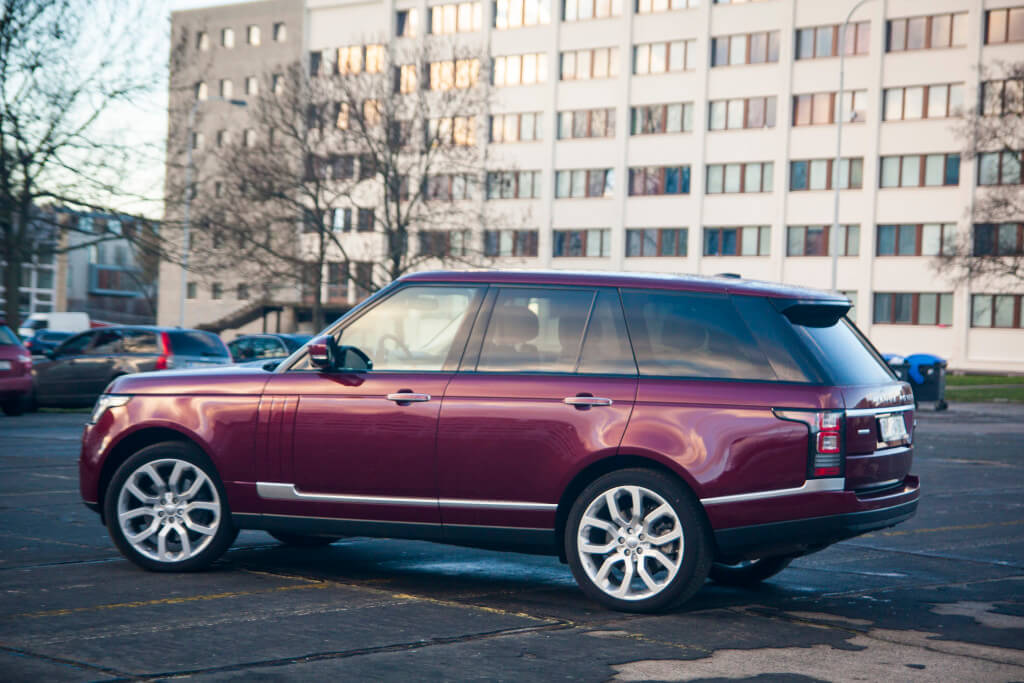
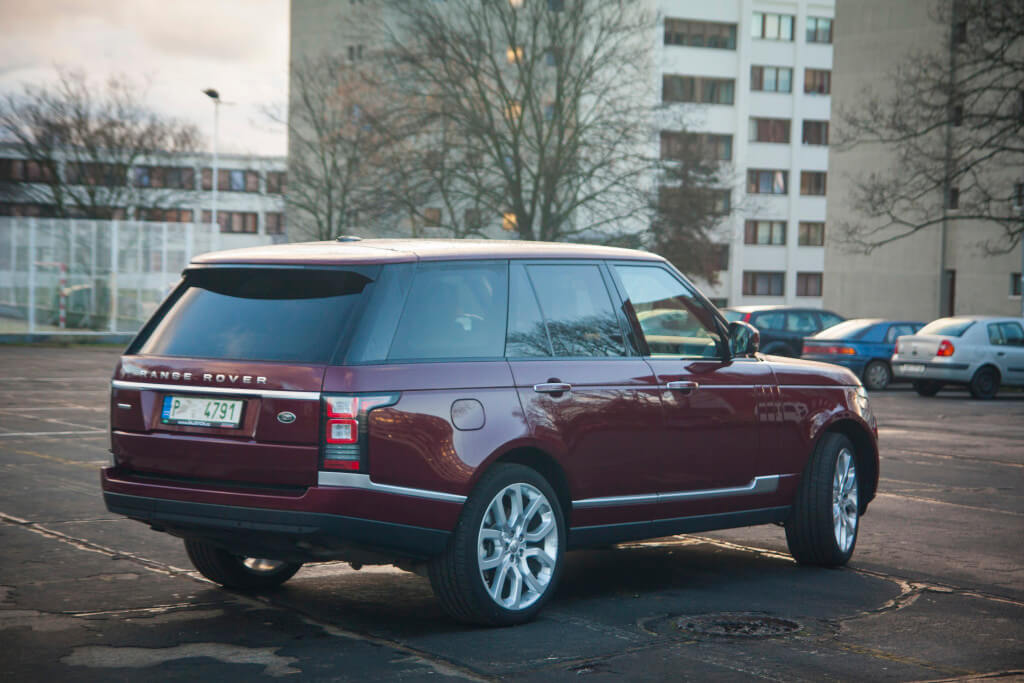
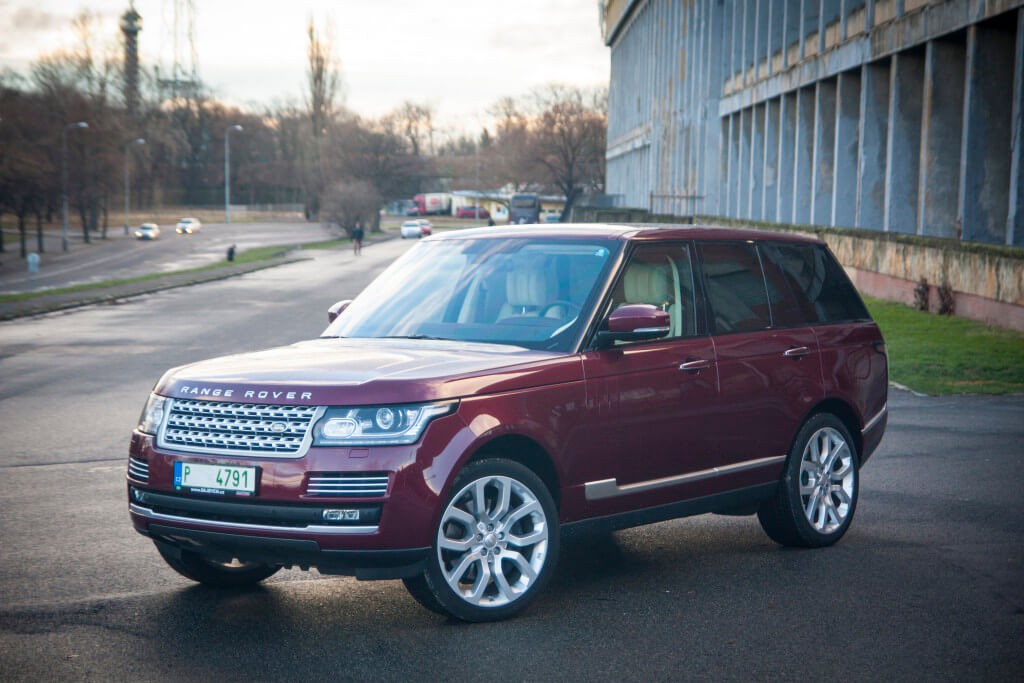
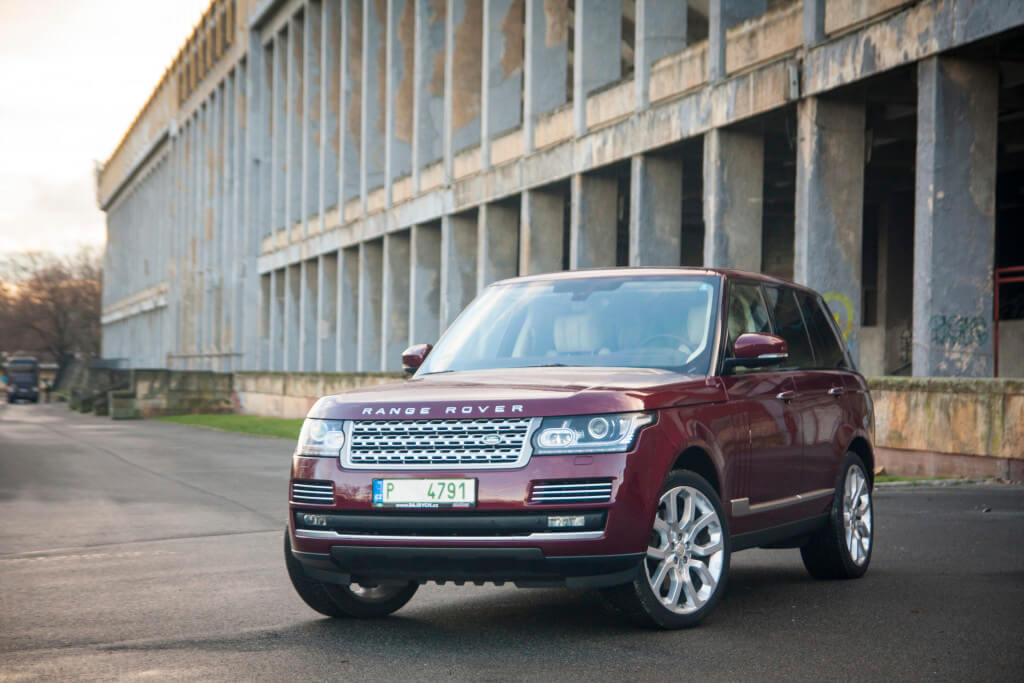
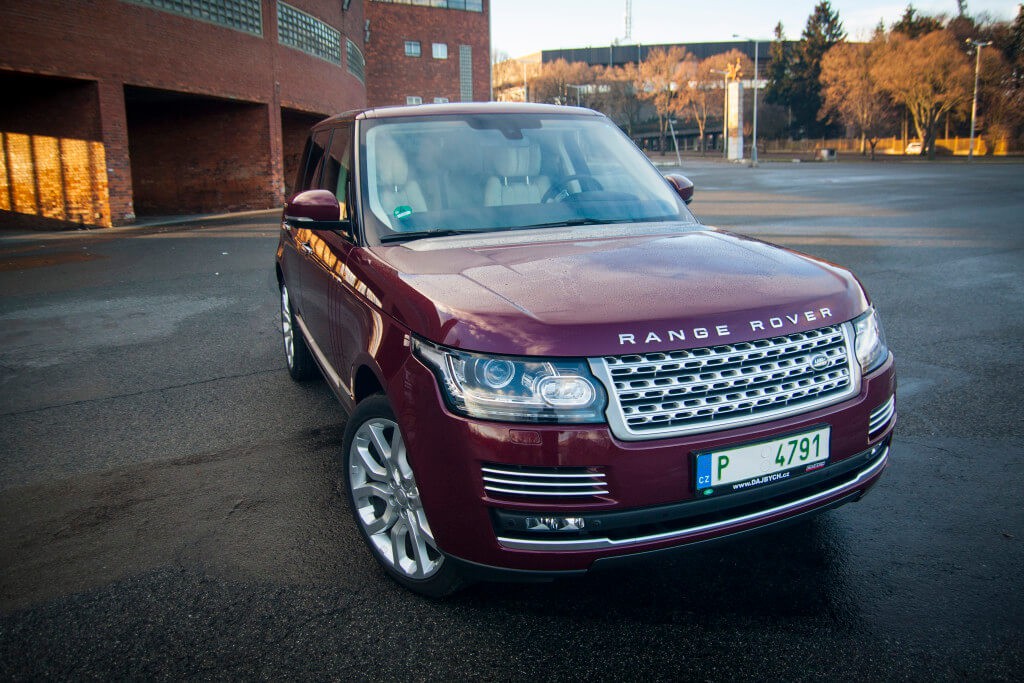
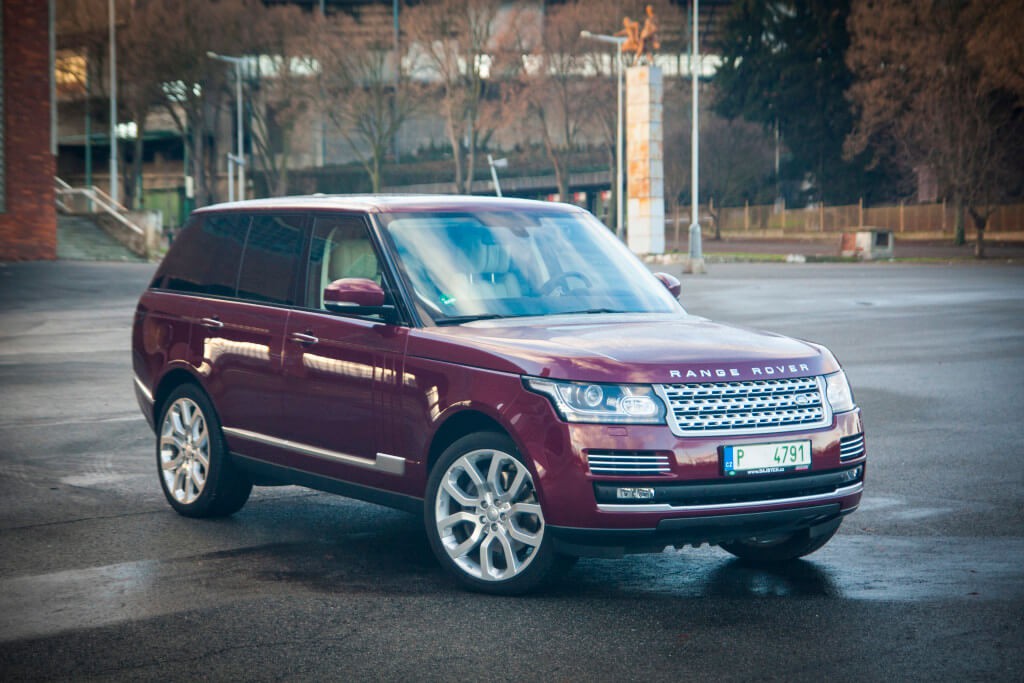
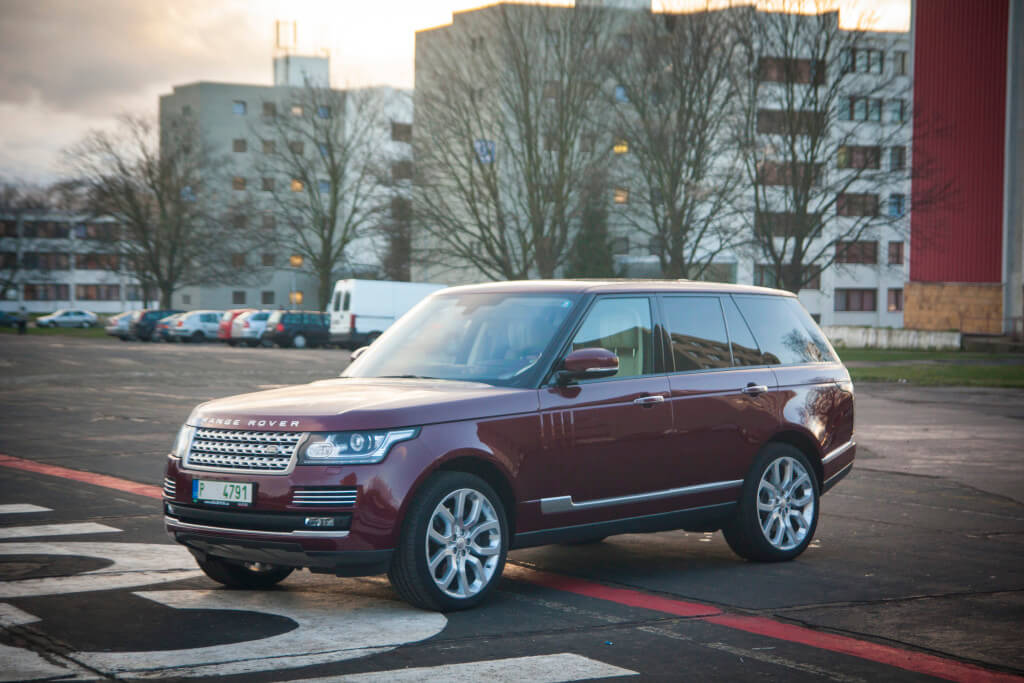
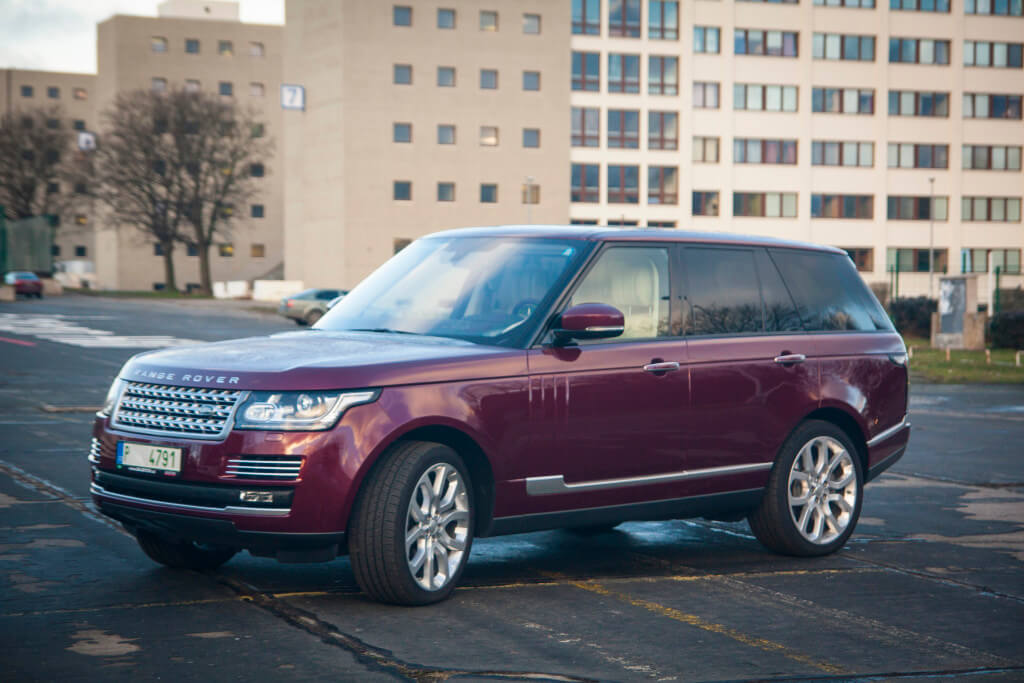
Thanks to the willingness of the authorised Prague Jaguar and Land Rover dealer Dajbych s.r.o., which celebrated 20 years this year, I had the opportunity to drive it briefly again in Prague for photography purposes, and because the Hybrid is no different from the others in bodywork, the Supercharged in gorgeous deep red with a light interior, in Autobiography trim, „fell“ to me.
Range Rover
Land Rover's Range Rover model line came to market in 1970 and remained in production for a long 26 years, although the subject of its reliability even made it into the popular show TopGear. It must be added, however, that the reliability of all new, cutting-edge technology tends to have its flaws, and that second and subsequent owners often fail to give cars the necessary care.
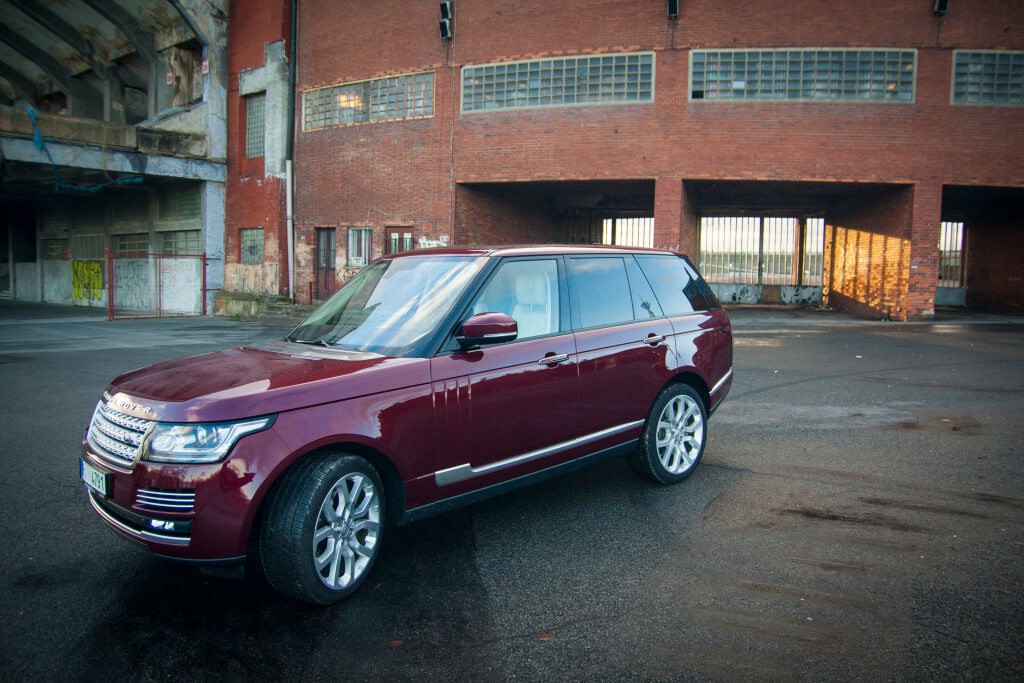
From the outset it was intended as a luxury SUV, an affluent and capable alternative to the working Defender. Its fourth generation (produced since 2012 and carrying design features of the smaller Evoque, the first model developed entirely under its new owner, Indian company Tata Motors, and a major success) takes these qualities to perfection, combined with a subjectively beautiful and majestic design that retains key details of the preceding generation and is clearly identifiable as a conservative British car of considerable dimensions.
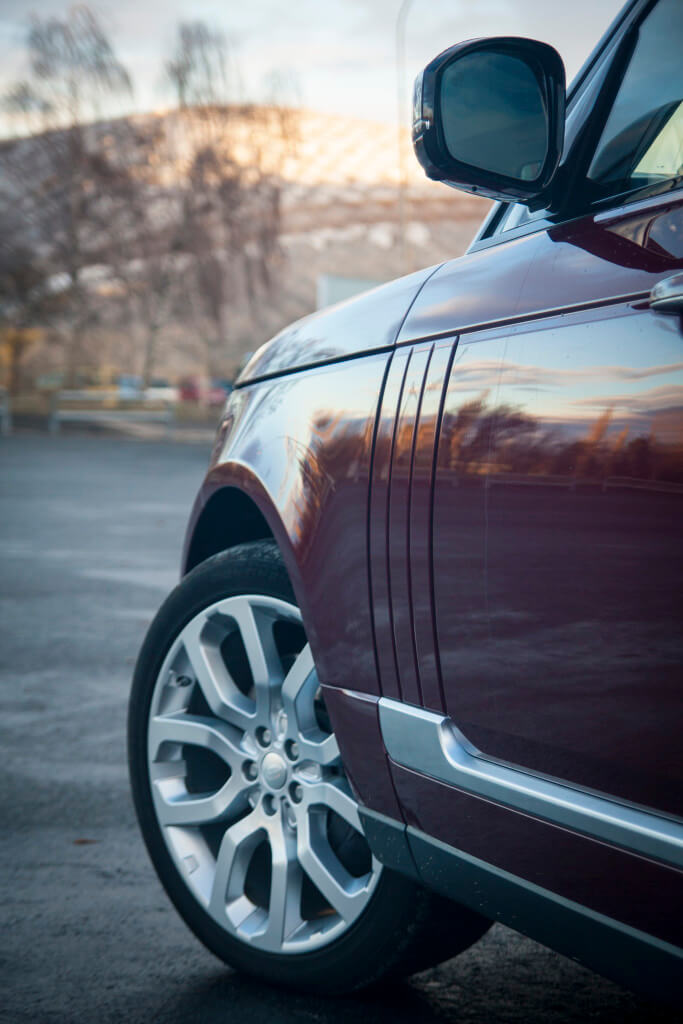
Before launching the new generation, the company asked customers what they would like changed about the car, and it turned out that the answer was nothing – merely improve it slightly and retain its traditionalist, imposing appearance. This says much about the predecessor's qualities, and that is precisely what happened. The Range Rover remained an „enormous box“ with a great deal of style and luxury, one that works absolutely perfectly.
It should also be said that under new owner Indian carmaker TataMotors, which bought the British carmaker from US company Ford in 2008, the brand is truly flourishing. Sales rose from 194 thousand units in 2009 to 381 thousand in 2014 [1], although this is far more due to the „small“ (when I sat inside, I was surprised by its space; naturally it is smaller, but I would probably call it fully sufficient for family use) and more affordable Evoque than the large Range Rover.
Range Rover Hybrid
With emissions standards tightening and many people seeking a green image, one hybrid after another is coming onto the market. The question is what purpose individual models serve – whether they are merely for obtaining purchase subsidies (which can be relatively high), access to city centres and meeting emissions standards.
Range Rover developed hybrid technology for the large Range Rover and smaller Range Rover Sport alongside their own development work (it also has a 400-strong team for this), and so the hybrid technology does not restrict customers in any way, including in terms of the phenomenal off-road abilities discussed later.
The Range Rover Hybrid is a full hybrid powered by an SDV6 diesel V6, assisted by a 35kW electric motor with 170 Nm of torque integrated into an eight-speed ZF automatic transmission. Combined maximum output is 250 kW and torque is 700 Nm, enabling it to reach 100 km/h in a respectable 6.9 seconds.
The battery has a capacity of 1.7 kWh and is located in the floor [3], and this is where the vehicle's problem lies. Officially, it can drive on electricity (the vehicle offers an all-electric mode activated by the EV button) up to 48 km/h and cover 1.6 kilometres, but during testing I drove electrically only in the car park, and only provided I barely touched the accelerator…
The electric motor therefore helps the 2.4-tonne car (the hybrid system adds 120 kg) achieve the performance of the SDV8 V8 (unfortunately I cannot compare their consumption; reviewers who have had this opportunity write that there is a difference, albeit not as large as the tables state), but in the true sense it is not a full hybrid vehicle – it can drive solely on electricity, but does not do so for most of the time, precisely because of the vehicle's high weight.
If the Range Rover Hybrid were to be a proper full hybrid, it would need a larger battery and more powerful electric motor, ideally also with the option to plug it into a socket overnight and drive a few dozen kilometres on electricity with limited performance – in other words, to have it as a plug-in hybrid. Then it would truly be perfect, and the relatively substantial surcharge of 150 thousand compared with the V8 would also be more justified.
The Hybrid is also unavailable in entry-level HSE trim, so its base price is a considerable 3.5 million Kč, though it must be said that this is the price of a literally incredible vehicle.
Luxurious in every stitch
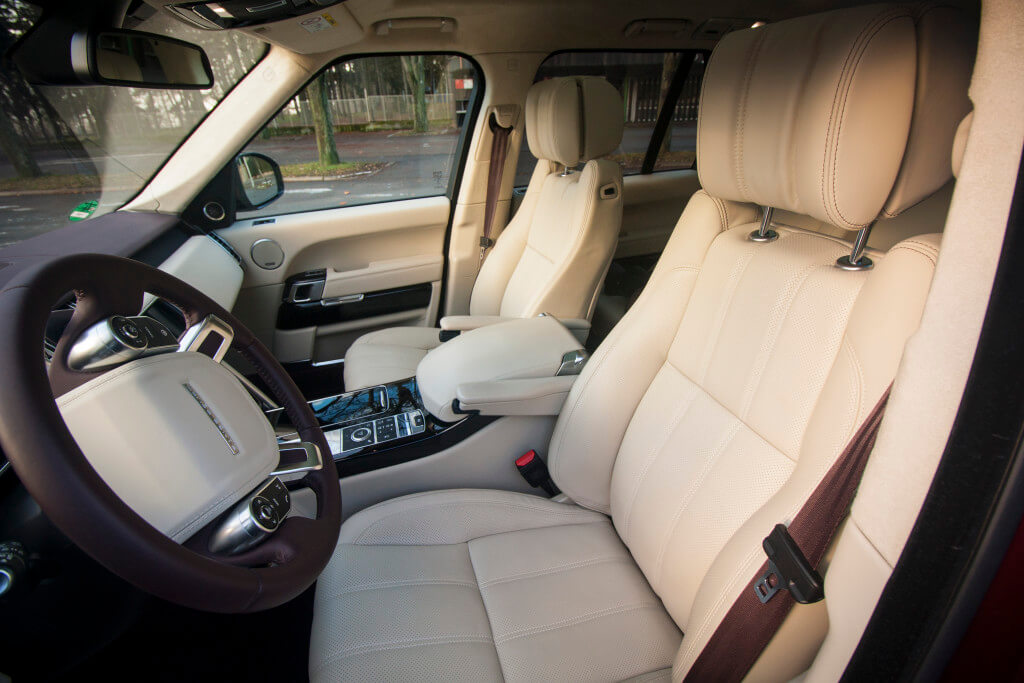
Given the Range Rover's base purchase price of more than two and a half million crowns, I expected luxury, and I have to say I felt somewhat out of place in it, somehow insufficiently aristocratic.
As expected, the interior contains only the finest materials (I had the opportunity to sit in the relatively similar Hybrid and top-spec Autobiography trims). You simply close the substantial doors and everything is ready to pamper passengers like on a yacht, in comfortable armchairs with leather as far as the eye can see. Nevertheless, there are areas where competitors take the lead, such as gesture control in the new BMW7.
When getting in, one thing I still do not understand about SUVs was confirmed. Are they popular because of their higher seating position and easier entry? At 191 cm tall, I would not count myself among the short, yet I have to climb quite considerably into every large SUV (the Range Rover can automatically lower its suspension for entry and exit, which is an absolutely excellent feature, although I found getting into the Evoque slightly easier). With the suspension raised at the Most proving ground, I literally felt as though I were climbing into a truck cab; when getting out afterwards, I more or less fell out of the car rather than elegantly alighting like a British gentleman, although this situation presumably will not arise often for customers.
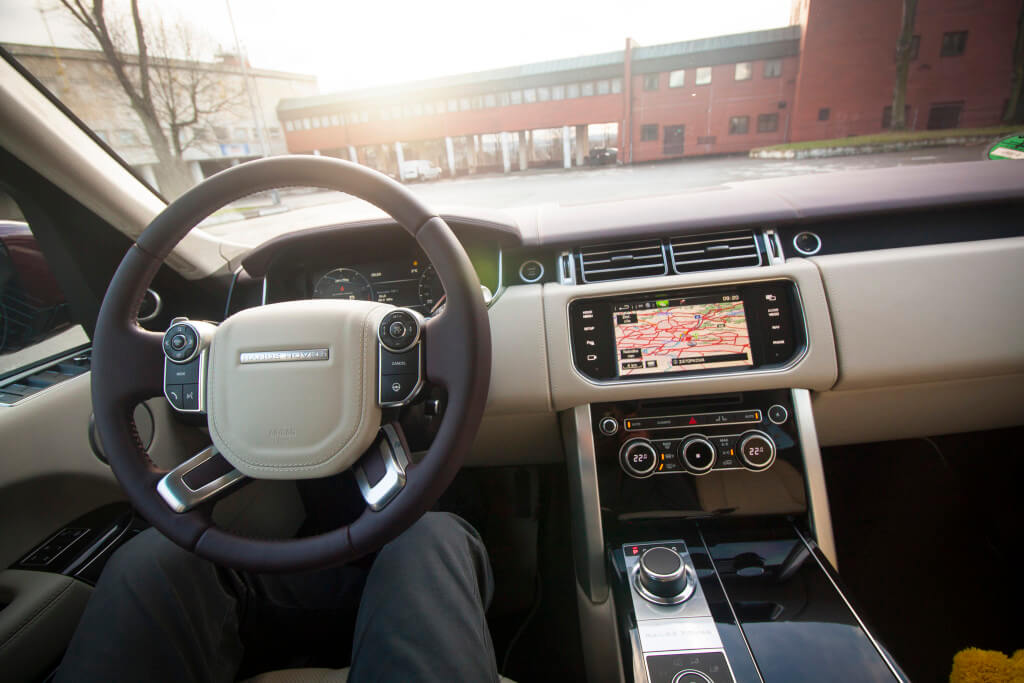
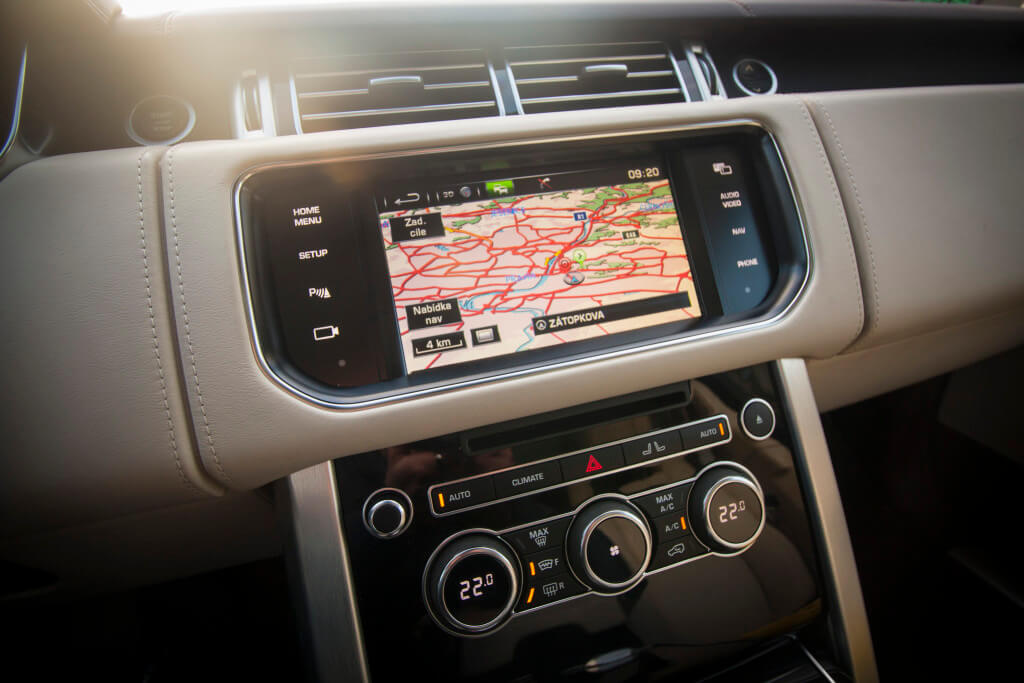
I switched to the tested Range Rover from a Nissan LEAF and, as expected, the infotainment system works far better here, without the slightest hitch, whether it is the audio system, navigation or cameras, including the option to zoom individual views. Audi's MMI reportedly works better, but unfortunately I have no comparison.
I must admit, however, that although large displays look very good and can show a great deal of information with easy switching between screens (eliminating the huge number of buttons with which luxury-car interiors still abounded a few years ago), using them always requires lowering one's gaze (here, quite considerably downward), while climate-control buttons and seat heating or ventilation controls can be found by touch. The other point is that ordinary controls are directly on the steering wheel, and for more extensive navigation work one needs to stop anyway.
I was struck by the fact that the hybrid version is designed so the driver notices nothing. No growing little trees as in the LEAF, no information about whether you are driving electrically or how environmentally friendly your driving is. The Hybrid is simply set up to do its job without bothering anyone about it.
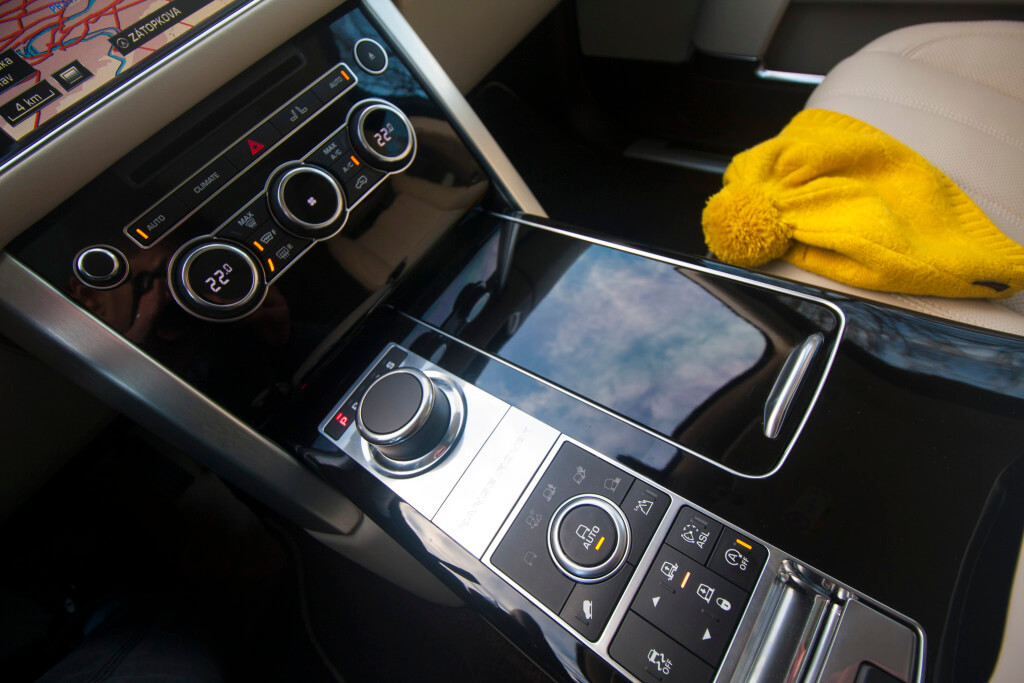
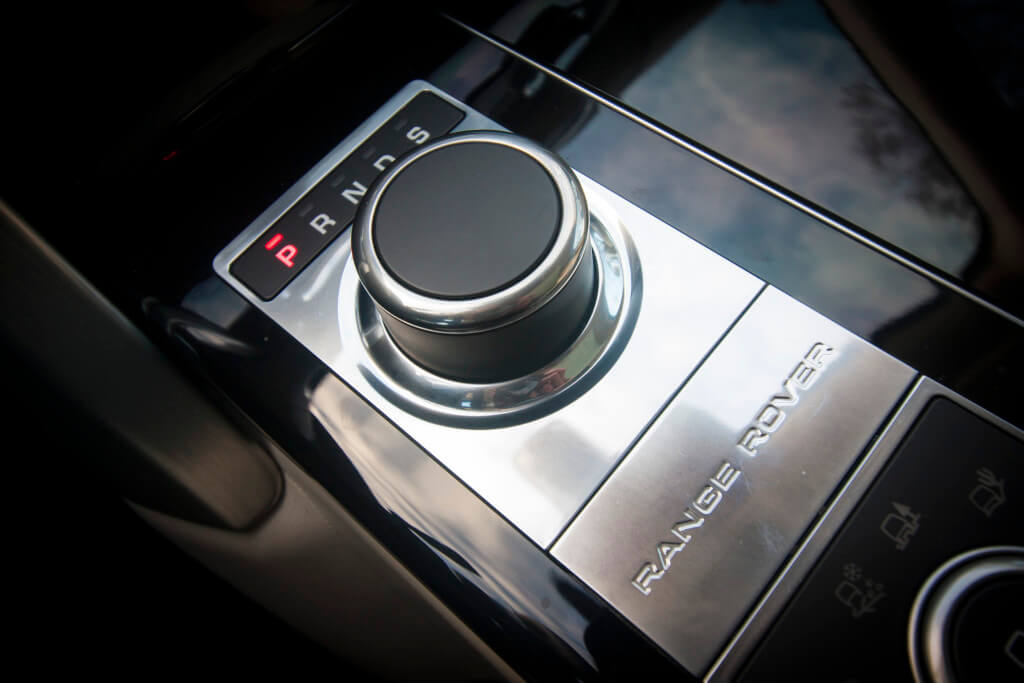
On the centre tunnel there is a very elegantly designed automatictransmissionselector, which rises when the vehicle is started. This is also currently used in Jaguars, and I would personally call it one of the best details in the entire interior.
The days when automatic transmission selectors literally disfigured interiors are gone, but I still do not understand why some groups use enormous levers to select forward or reverse, though that is not the case with the tested Range Rover.
Behind the automatic transmission selector are the off-road driving mode selector (TerrainResponse2), activation for automatic braking when descending steep slopes, and genuinely enormous storage compartments.
Among other things, there is also a control for the ride height of the air suspension, one part of whose presentation greatly surprised me (it involved a Discovery 4): to attach a trailer (weighing up to 3.5 tonnes), no second person is needed, because the reversing camera allows you to drive the towbar directly beneath the trailer coupling and raise the vehicle, then get out and simply latch it on.
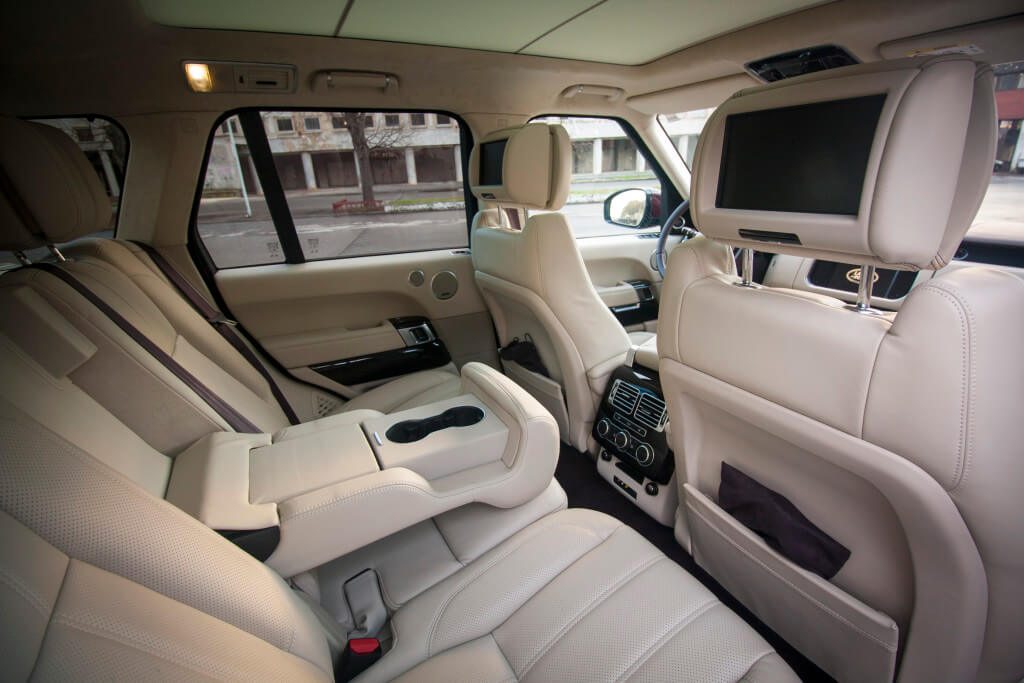
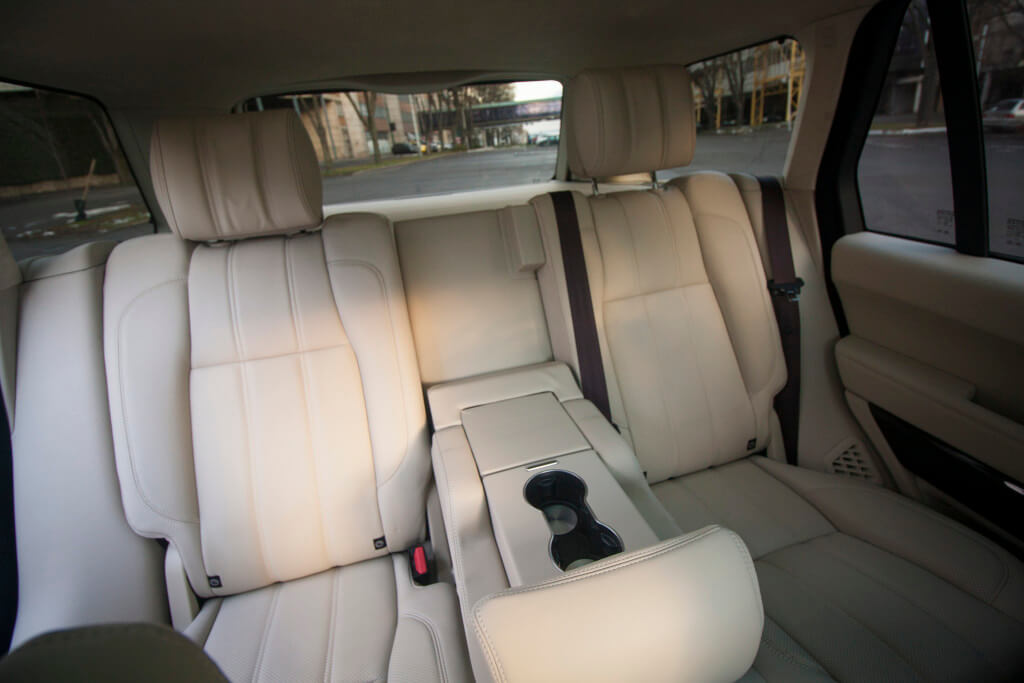
The Range Rover is available with a standard wheelbase or one extended by 186 mm, which brings the vehicle to almost 5.2 metres. It must be said, however, that the 150-thousand-crown surcharge is not enormous given the car's price, and personally, at my height, I was not quite as comfortable sitting behind myself as, for example, in the JaguarXJ.
Although neither the Range Rover nor the XJ (in Portfolio trim with the standard wheelbase) has a conventional rear bench but rather two separate seats with an armrest (proper individual armchairs with massage capability are optional on the extended versions in both cases), I would say the XJ is somewhat more focused on accommodating two rear passengers, as its seats were more comfortable and deeper even in the „standard“ version, although knee room was only just sufficient…
Phenomenal off-road capabilities thanks to Terrain Response 2
Weather at the Most proving ground was ideal for off-road driving – showers, so everyone enjoyed mud to their heart's content. For my first inspection of the track, I chose the small Evoque, which could not complete part of it because of deep mud. Nevertheless, I was literally amazed by its capabilities: this Baby Range Rover handled the entire course, which subjectively seemed quite challenging for vehicles with ordinary tyres due to its surface (I truly have no off-road driving experience), with complete composure, hats off.
I subsequently got into the large RangeRover, from which I already expected this composure. Although many owners of these vehicles never leave the road, their off-road capabilities are truly exceptional. Owing to its high weight, the Range occasionally slid sideways, but the electronics monitor absolutely everything, including the maximum water depth you are fording, so it does not exceed the 900 mm limit. This value also applies to the Hybrid, as do the approach angles and maximum adjustable ground clearance of 300 mm. The Hybrid differs from the conventional Range off-road only in its greater weight; all-electric driving is not possible in this mode at all.
The only problem on the entire track was descending a steep slope, which gradually became more like sledding as the rutted tracks became increasingly slippery. Later I sat in the Range Rover's rear seat just to try how the other occupants of its colossal space felt, and when descending this slope I was no longer even sitting, but hanging from the seatbelt and hoping it would work out this time too.
The common denominator of all these abilities is the TerrainResponse2 system, which Land Rover has developed through its long experience with four-wheel-drive vehicles. Although there are many different settings, automatic mode was sufficient for our use at the proving ground, so it was not all that demanding, but it was fully sufficient for the presentation and to leave passengers with a deep impression.
I saved the Defender for the final drive, as it was the last opportunity and a boyhood dream. A 110 version was available with a 2.5-litre diesel engine, reworked for maximum low-rev torque. Combined with a six-speed manual transmission (whose sixth gear was inserted even below first) with a reduction gear, it meant the vehicle simply did not care about anything.
At the start I was instructed to engage second gear, and from then on we surged through the terrain without needing to touch the accelerator at all, even on steep climbs. Its incredible capabilities even without electronics were due to its considerably lower weight, but especially its tyres with 8 mm tread, which the other cars could only dream of.
On a steep climb before the aforementioned descent, where ultimately nothing interesting happened, I had the opportunity to test the „mechanical Stop&Start system“: stop on a hill with a gear engaged and switch off the engine, then touch nothing and turn the key, which I made sure to ask about again to ensure I understood correctly. The Defender calmly and without hesitation resumed its slow movement, and we continued with the nose pointing skyward towards the end of the test day. According to the instructor, this way of setting the vehicle in motion is far safer than pedal acrobatics, and if not, it is certainly very impressive.
Yes, electronics cannot replace the Defender's off-road capabilities, but one must account for the fact that its riveted bodywork creaks persistently and that the pedal position is markedly unergonomic. So, as an experience and a workhorse, it is an incredible machine, but the Range Rover's versatility is absolutely phenomenal: you can sit in it in a suit, listen to Beethoven, while outside things can happen as if in an action film. The Defender is a fine example of the old school, whereas the Range Rover is a modernist full of technology, though on the other hand it is somewhat boring. Its main purpose is to be a luxury means of transport that gets you anywhere, and it fulfils that with top marks.
The suspension smooths out roads around Most and Prague superbly, but Hybrid or Supercharged?
The Range Rover is an SUV by focus, but its luxury competes with limousines, and its suspension and perfect sound insulation are tuned accordingly. Even so, aerodynamic noise from the „box“ is considerably higher than in the XJ, despite its closable grille intended to improve aerodynamics.
The ride comfort of the two rivals seemed comparable to me, with the difference that in the Range Rover, its comfortable suspension does not particularly tempt you to attack corners, whereas in the low-slung XJ it does, and it cannot be called unwieldy. While the high-riding Range Rovers resist wild driving somewhat, the XJ is smaller and lighter after all, and more entertaining for the driver.
The hybrid version is excellent in that it does not bother or restrict the driver in any way through its hybridity, while its briskness is very interesting and fully sufficient even in such a bulky vehicle – not once did I think it needed a little more power. In addition, with smooth driving, consumption can fall below 10 litres of diesel per 100 km, which is not a bad figure.
Many car enthusiasts would prefer the V8 simply for its sound, although this is not audible except in the Supercharged version. Its performance is absolutely sufficient, wild driving is ruled out by the weight anyway, and so although the 405 kW Supercharged (5.0 V8) version impressed me, I would choose the weaker version without hesitation, because the top version's rebelliousness does not suit an aristocrat.
My overall impression from road driving was that it is a motorway cruiser with extraordinary luxury on board, which, should you wish, can nevertheless drive through anything its owner's courage permits. Even with the entry-level engine (TDV6), it will move very convincingly and carry anything without you being overly aware of its speed.
All versions are fitted with an eight-speed automatic transmission and, although my experience with BMW is rather dated, not for a moment did I think that the transmission was bothering me or that it was simply shifting most of the time. It worked flawlessly, exactly as it should in a true gentleman's car.
So is there another alternative?
The Range Rover is an incredibly versatile vehicle. The Defender surpasses it off-road and the F-Type on the circuit, both through their fun and specialisation, but no other single vehicle can do what the Range Rover can.
When needed, it is a luxurious and prestigious limousine for long journeys across Europe; in Supercharged form it presses you into the seat so hard that you will be amazed, it carries anything, and on top of all that it looks damn good. The only problem is the purchase price – versatility without compromise costs money, but when you have no competition…
The only question remains whether a hybrid version designed in this way has any purpose other than obtaining subsidies in countries devoted to environmentalism. Fuel savings are most likely not enough to cover the price difference, and the hybrid system does not have capabilities as good as it could in such an expensive vehicle, unfortunately – there are better hybrids on the market in terms of propulsion, but none comes remotely close to the Range Rover in what it is as a whole.
Sources:
[1] JAGUAR LAND ROVER REPORTS STRONG FULL YEAR SALES FOR 2014. Available at: http://www.jaguarlandrover.com/gl/en/investor-relations/news/2015/01/12/jaguar-land-rover-december-1415-sales/
[2] Land Rover – Wikipedia. Available at: https://en.wikipedia.org/wiki/Land_Rover
[3] Range Rover Hybrid heading to Frankfurt – AutoBlog. Available at: http://www.autoblog.com/2013/05/07/range-rover-hybrid-heading-to-frankfurt/
Bonus photo gallery

Translation disclaimer
This article is a machine translation of the Czech original and has not yet been fully reviewed. In case of any doubt, please refer to the Czech version.
Sdílejte článek prostřednictvím:
You might also like


20 October 2026, 12:55
20 October 2026, 10:49
20 October 2026, 06:13