20 October 2026, 15:34
Loading...
Tesla Model S (part 2): P90D is incredibly fast, but is it really perfect?
Tomáš Jirka
4 July 2016, 23:51
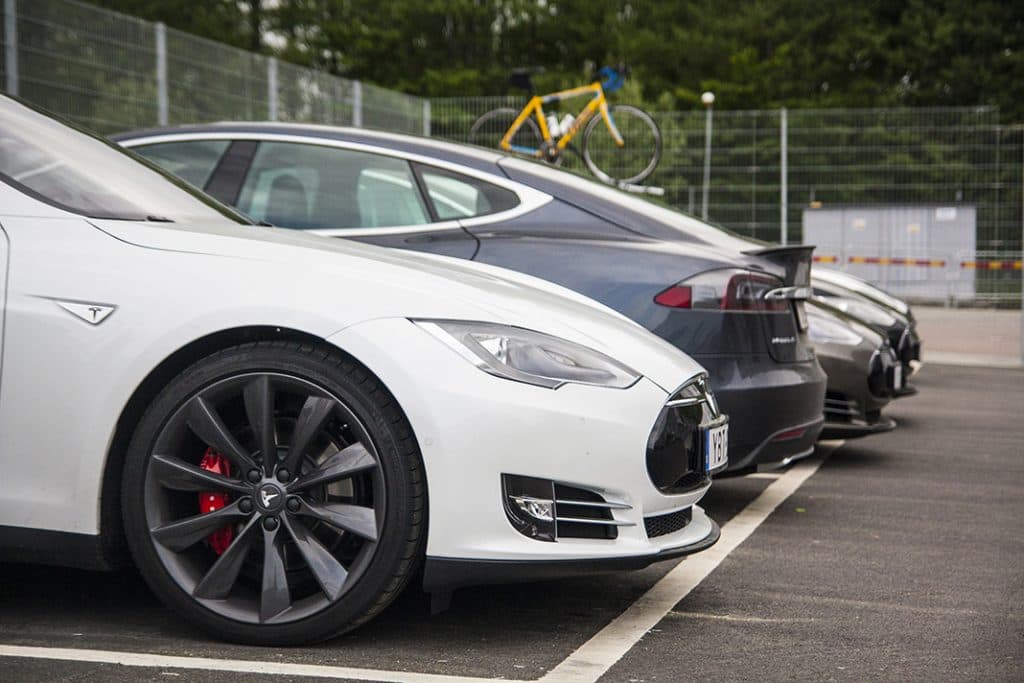
Everyone is literally enchanted by Tesla. It has been on the market for 4 years, yet it still looks like a concept car. Its low, wide-set and long silhouette, enormous wheels and flush door handles are features that often do not make it from concepts into production cars. Yet it was a disappointment to me because of overblown expectations and its aura of exceptionalism and perfection.
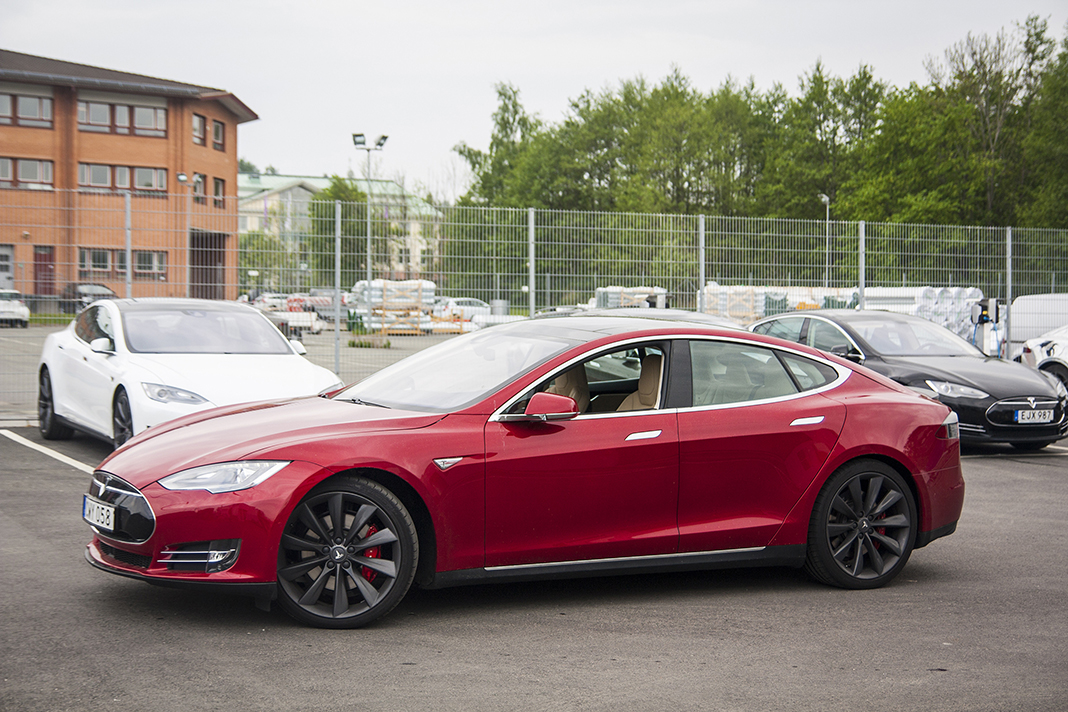
The Model S is perhaps even bigger in person than it appears on paper. This 497 cm-long (296 cm wheelbase), 144.5 cm-high and 196.4 cm-wide (excluding mirrors) liftback, with its highly dynamic silhouette and wheels up to 21 inches, is hard to miss in traffic anywhere other than Oslo.
Its design is more like that of a concept car, even more so after the latest facelift, which we covered in the first instalment. Although it is a concept-like car, its design is fairly conservative, as it targets wealthier customers. Its competitors could be the Porsche Panamera or Audi A7, although customers reportedly most often consider buying a BMW. Perhaps its greatest competitive advantage is the image it has gained as an environmentalist and visionary, in the mould of Elon Musk.
Porsche is reportedly planning an electric Panamera, Audi is making promises too, and BMW has at least launched a plug-in hybrid 7 Series, but there is no all-electric car that can be directly compared with Tesla. This brings us to the same problem I had when testing the Range Rover – how can I compare it with anything when none of its competitors really comes close? With Tesla, this is due to its drivetrain (and running costs); putting that aside, it is a luxury liftback, or if you prefer a four-door coupé, with a conservative but certainly not boring design and a very good reputation and name.
Thanks to its fame, attempts regularly emerge to discredit Tesla Motors in financial or reliability terms. The latest rumours involved brake problems in Canada (I can imagine that in a car where motor recuperation is used most of the time, the brakes may seize up over winter and on salted roads, and that the repair cost is not the same as for an Octavia), unconfirmed problems with suspension ball joints (the Model S is, after all, quite a heavyweight), and most recently the fatal crash involving a Model X with Autopilot, which will be discussed at the end of the article.
The Model S has a reputation as an exceptional car with tremendous rolling acceleration, especially at low speeds, thanks to its asynchronous electric motors. Many even call it unrivalled in its perfection. I admit that it was my dream to try a Tesla too, but my enthusiasm waned considerably because of many unfinished details. So let us look at why.
Versions and other technical data for the Tesla Model S
One of the interesting features of the Model S is its aerodynamics. As with its other models, the carmaker focused in its design on minimising the aerodynamic drag coefficient, helped by the absence of a radiator grille. The resulting 0.24 was for some time one of the best values, subsequently surpassed by Mercedes-Benz with the CLA model and a Cd value of 0.22.
However, independent measurements by Car and Driver confirmed 0.24 for Tesla and measured 0.30 for the CLA, raising questions over how Mercedes measured it in what was then Europe’s most advanced wind tunnel.
The Model S is now once again offered with a 60 kWh battery and rear-wheel drive, as it was at the start of production. The sole reason is to lower the purchase price of the entry-level version. It is in fact the standard 75 kWh version (until recently 70 kWh), but with battery capacity limited by software.
Both the 60 and 75 kWh versions can be ordered with rear-wheel drive (235 kW, 441 Nm, 5.8 s, range of 400 and 480 km respectively under the NEDC test cycle) or all-wheel drive (386 kW, 525 Nm, 5.4 s, range of 408 and 490 km respectively). The largest battery currently available to order has a capacity of 90 kWh (the successor to the 85 kWh version) and is available only with all-wheel drive. Its 90D and P90D versions differ in the size of the asynchronous electric motor mounted on the rear axle. The 90D again has the manufacturer-rated output of 386 kW, but accelerates to 100 km/h in 4.4 s. The P90D, with 515 kW (568 kW with the Ludicrous package), reaches 100 km/h in 3.3 seconds (3.0 seconds).
The batteries (Panasonic 18650 type) are always located in the floor, substantially increasing body rigidity and lowering the centre of gravity. The Model S therefore has a reputation as one of the safest vehicles on the market. It also has luggage space not only at the rear but at the front. Dealers use the new term „frunk“ for this (the luggage compartment is normally called a „trunk“ in English), but it is linked to one of my criticisms.
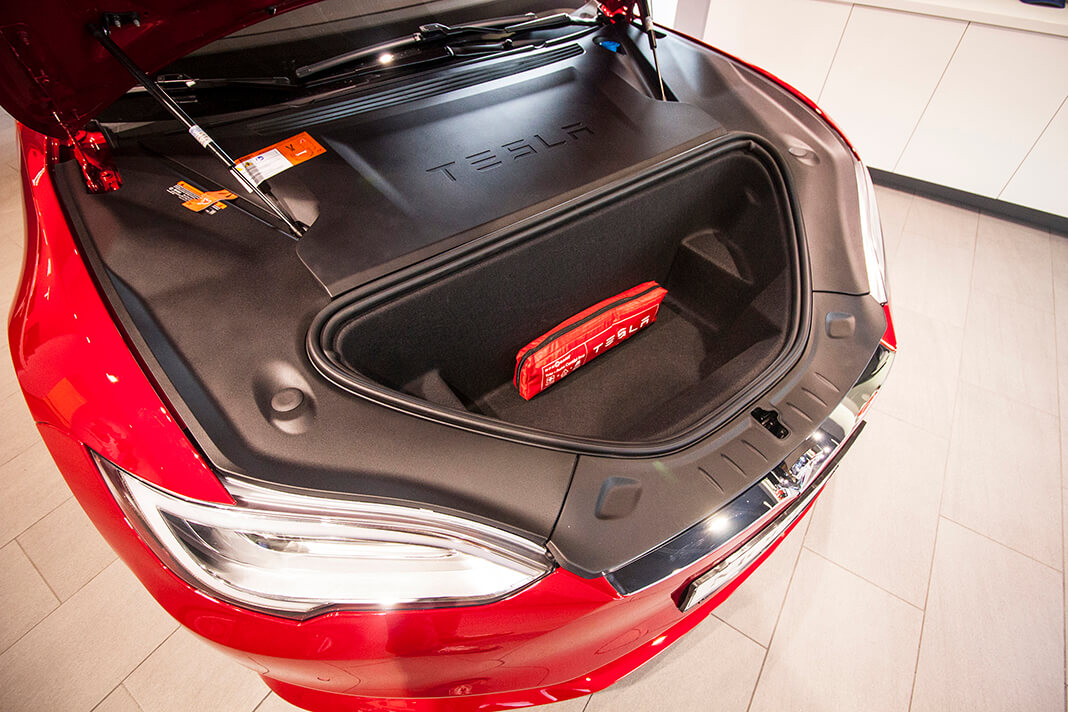
Why is it not electrically operated like the rear one, why does it make a sound when closing as if I had broken it, and why is it made of such dubious sheet metal that I was afraid of denting the bonnet? If I only had to access it once in a long while, as with conventional cars, it would be tolerable, but as it is a luggage compartment, I would expect electric opening given the vehicle’s purchase price.
Charging – the well-known Superchargers
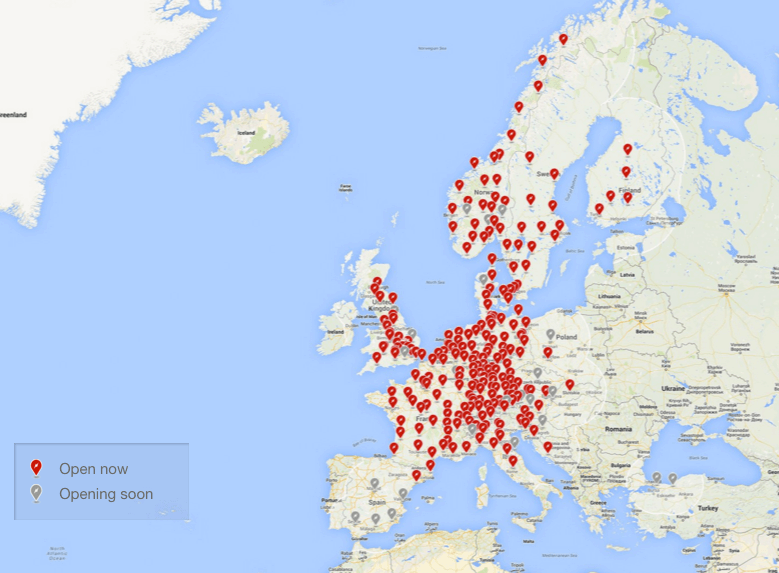
As is already well known, Tesla is developing its own network of charging stations: Tesla Supercharger and Tesla Destination Charger. Until recently, there was a clear boundary between eastern and western Europe on their map; now there is also a station in Czechia, at Vystrkov near the D1 motorway.
This is the greatest advantage when travelling in a Tesla: the ability to charge its battery in half an hour, as with other electric cars, but with the possibility of driving 400 km or more for free (at least for now).
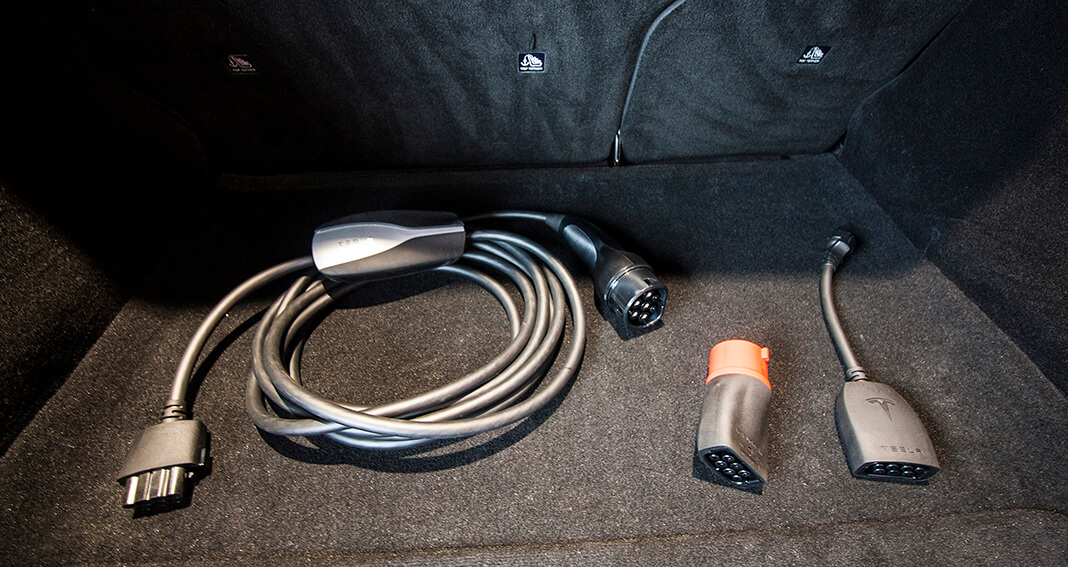
However, electric cars are not charged only on the road; they are mainly charged at home overnight, and Tesla is prepared for this with an onboard charger in Europe capable of charging from a three-phase 400 V/16 A socket or a single-phase 40 A socket. There is no need to have several charging cables; an adapter is enough, for which Tesla clearly deserves great credit.
The battery warranty is 8 years with unlimited mileage, or 8 years/200,000 km for the 60 kWh version. Important information is the existence of a liquid circuit to maintain the optimal temperature and extend battery life. In 2015, InsideEVS published data on the decline in Model S battery capacity depending on mileage, and it appears that the decline is around 6 % per 100,000 km (chart here), which is very good news.
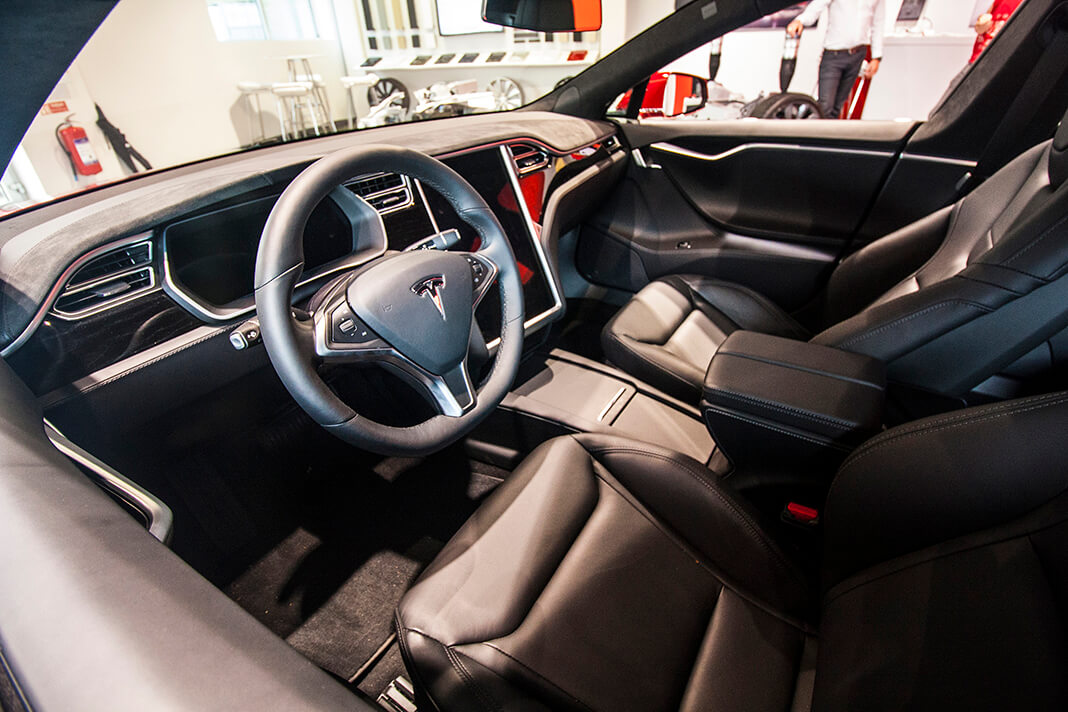
Interior with the familiar oversized iPad
The minimalist interior design is my biggest problem. It starts when getting in: when the doors with their stylish frameless windows close, they make a sound that left me unsure whether they had shut or whether there was a lock fault. The Jaguar XJ managed to close its doors almost silently, so there is considerable room for improvement here, as there is with both luggage compartments. With a purchase price always exceeding Kč 2 million, these rattles are a genuinely noticeable shortcoming, though they may be attributed to the carmaker’s youth.
The interior otherwise has a classically American feel – imitation wood trim (fortunately, other options have been available since the facelift), heated leather seats as standard, no centre tunnel, and a gear selector below the steering wheel. Personally, I find it unnecessarily austere. What struck me as strangest was the absence of a centre tunnel and transmission selector. Clearly, Tesla has no transmission, but neither did the LEAF, yet it had a forward and reverse selector on its battery-containing centre tunnel. Perhaps I am simply too conservative, but I did not get the impression that I was in a car carrying a price tag of more than Kč 2 million.
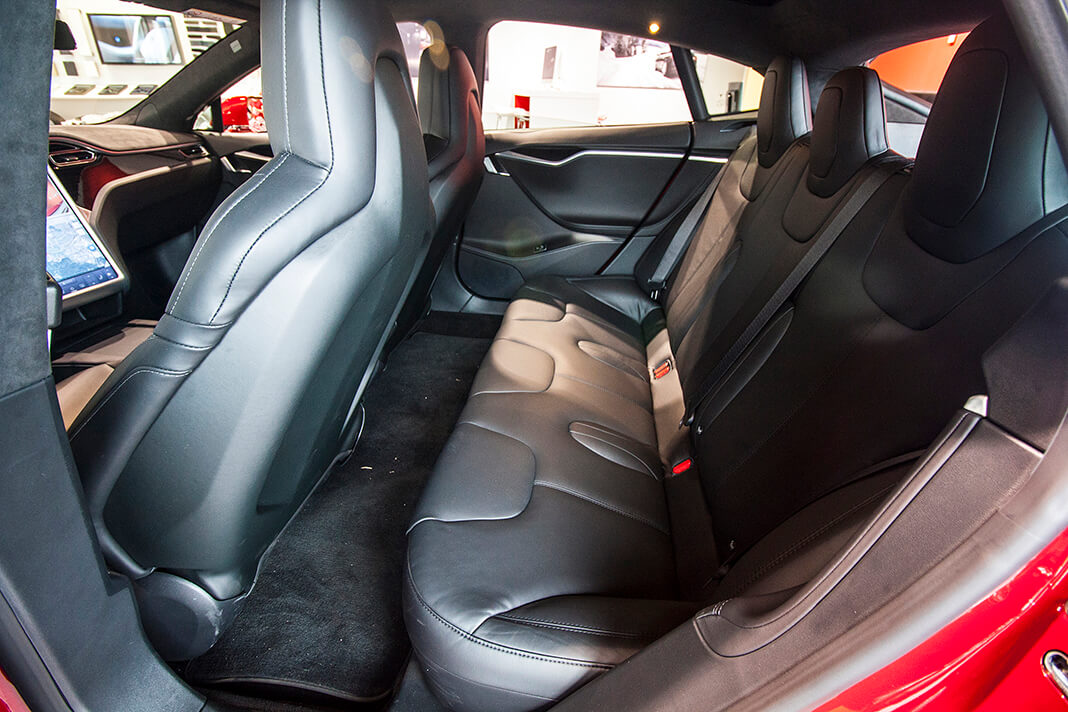
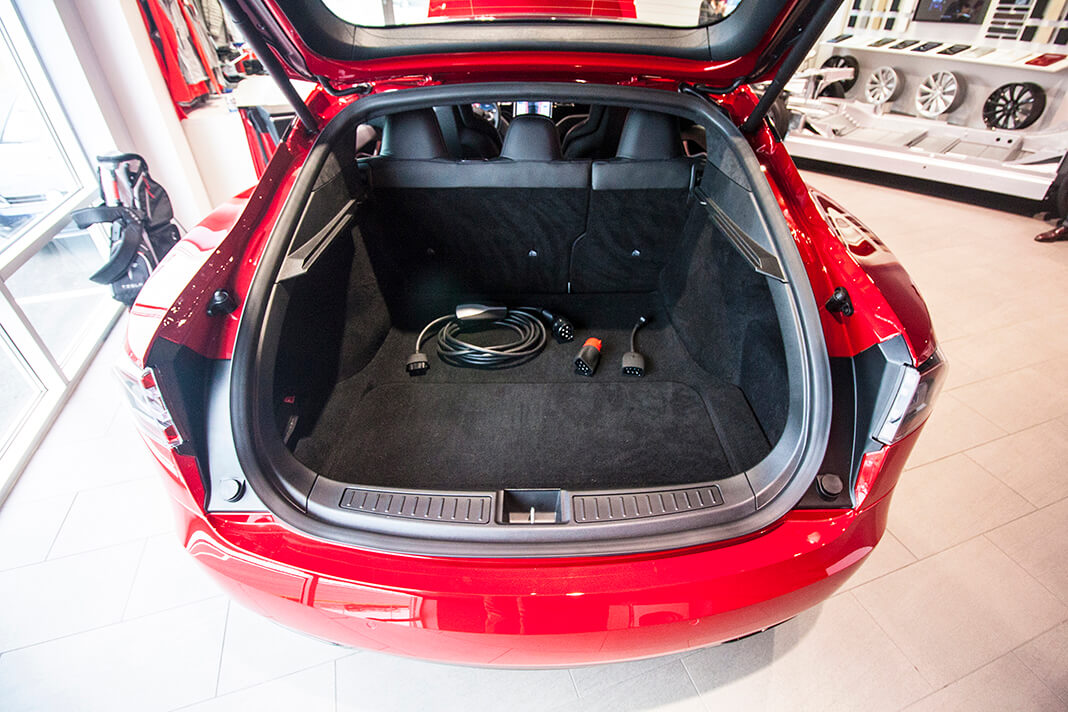
The interior’s spaciousness otherwise surprised me quite a bit. I could only fit into the rear seats thanks to the panoramic sunroof, which increased headroom by around 2 cm, but given the dynamic silhouette I had expected worse. For cars conceived this way, though, I significantly prefer a „four-seat“ interior layout, as found in the previously mentioned Panamera or Jaguar XJ, where a third passenger is only accommodated in an emergency. After all, given the car’s aggressive character, the lateral support of the seats is useful – when sitting in the rear, I missed some support during sharper turns or harder acceleration. Tesla can therefore carry 5+2 passengers, but I would not really regard that as an advantage. Moreover, the rear seats fold not individually but 60/40, and have no armrest.
The luggage compartment is truly enormous, although the claimed 800 litres are hard to believe – it depends on the measurement method and whether the front luggage compartment is included. If it is true, then Škoda is no longer alone with its favourite claim of having the „largest luggage compartment in its class“.
The interior also lacks many solutions common in Europe, at least for me – door pockets and other storage spaces. Everything is concentrated only in the middle, while the design of the interior door panels did not appeal to me either.
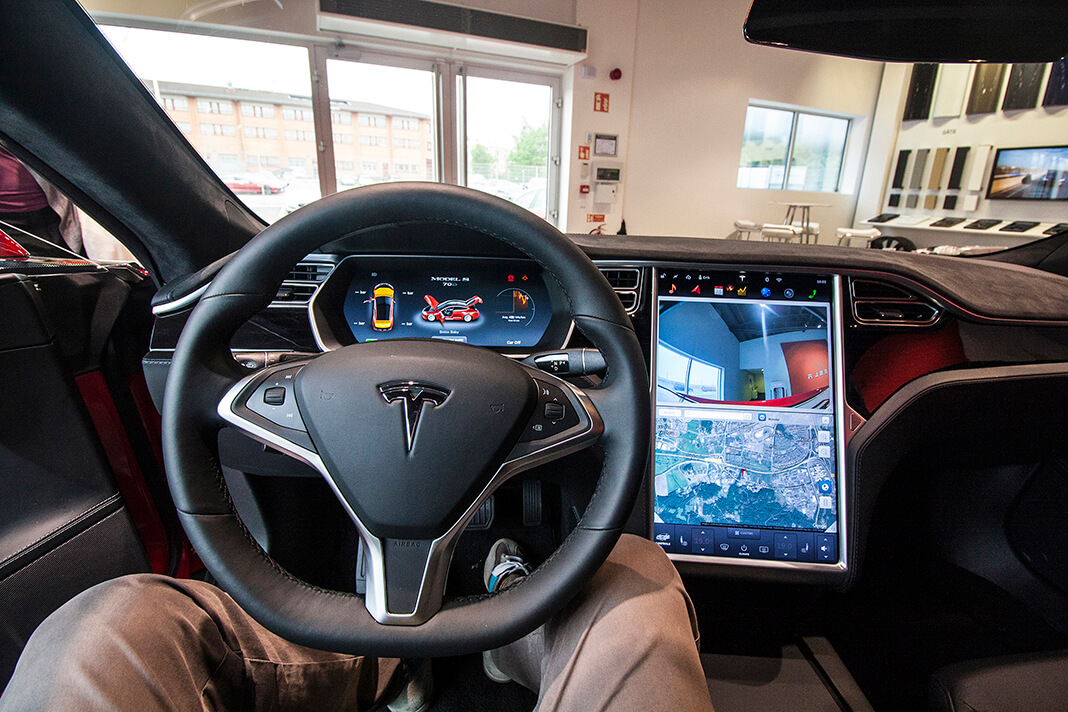
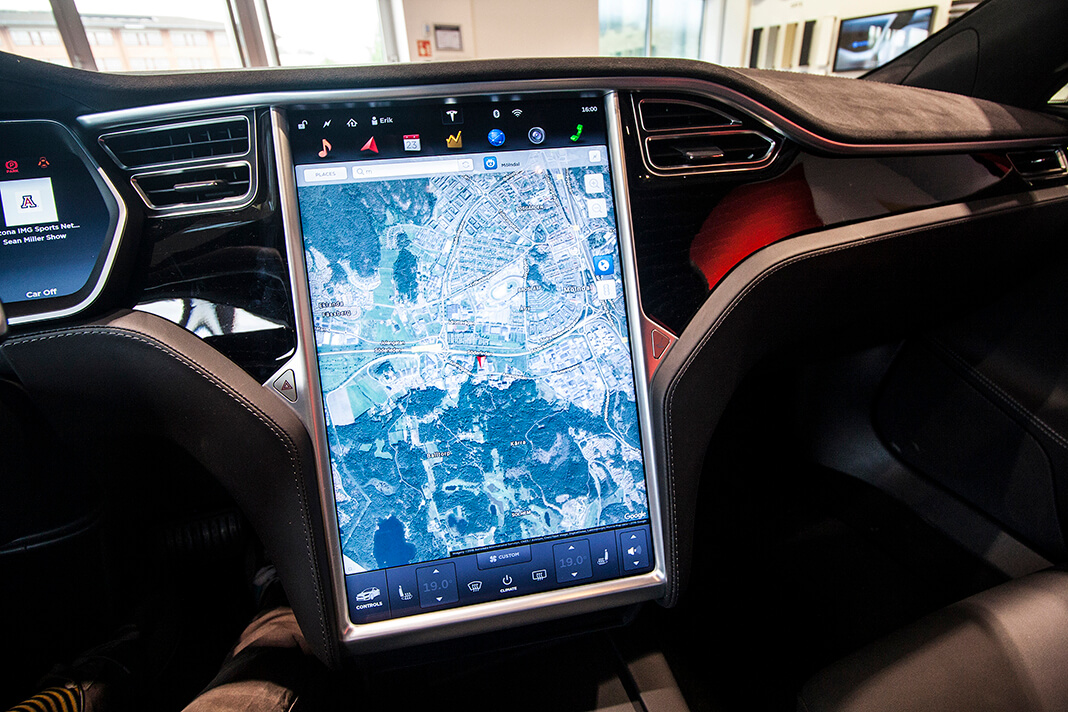
The 17-inch central display contains all vehicle settings. The upper and lower sections (climate control and seat heating controls) are „fixed“, while the middle section can be changed using the options at the top according to requirements (music, camera, map, vehicle energy data, navigation, phone, vehicle settings), or the display can be split into two halves. The reversing camera can even be switched on while driving.
Getting used to its controls would require more practice, so it is pointless to complain that practically everything is located on it and that I have to search for things and take my eyes off the road for longer than necessary. In my view, however, its lower section is positioned too low for me still to keep the road in my peripheral vision while operating it (perhaps my head is simply too high…). Its size is ideal for map searches and the touchscreen feedback is exemplary. But its graphics sometimes strongly reminded me of Apple user interfaces (which I understand given the clientele), and at other times of Bootstrap. That again rather lets down a Kč 2 million car. Moreover, an „enormous tablet“ does not visually fit into the dashboard for me, and worsens my already poor impression of it.
Driving the Tesla Model S P90D, or: roller coasters are boring!
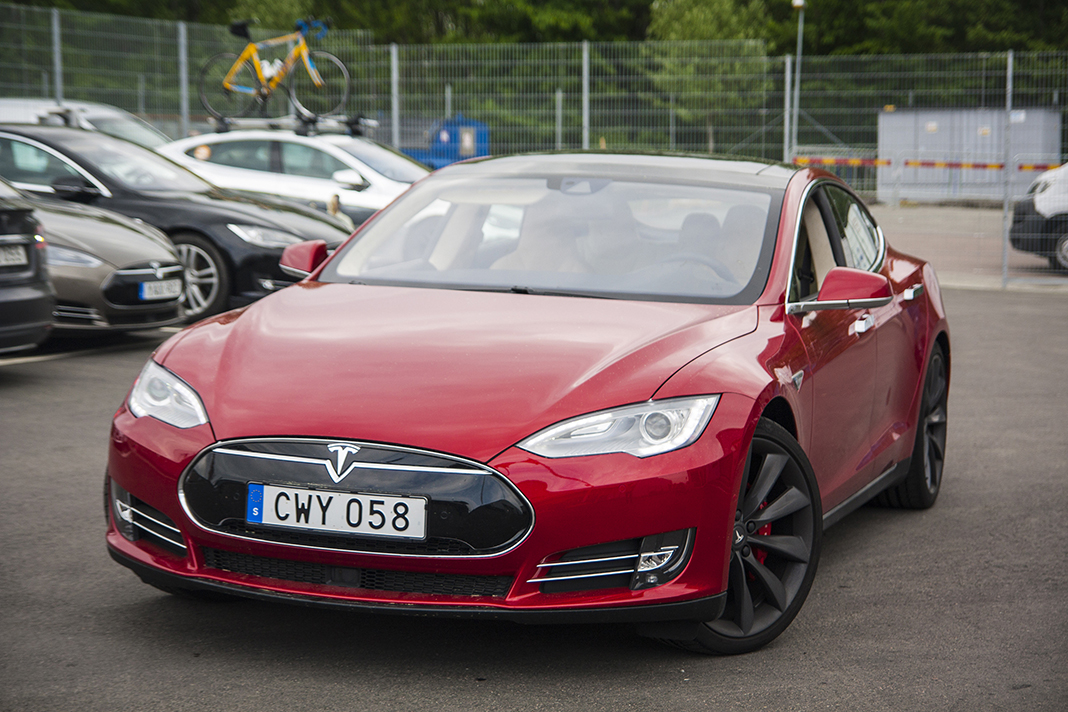
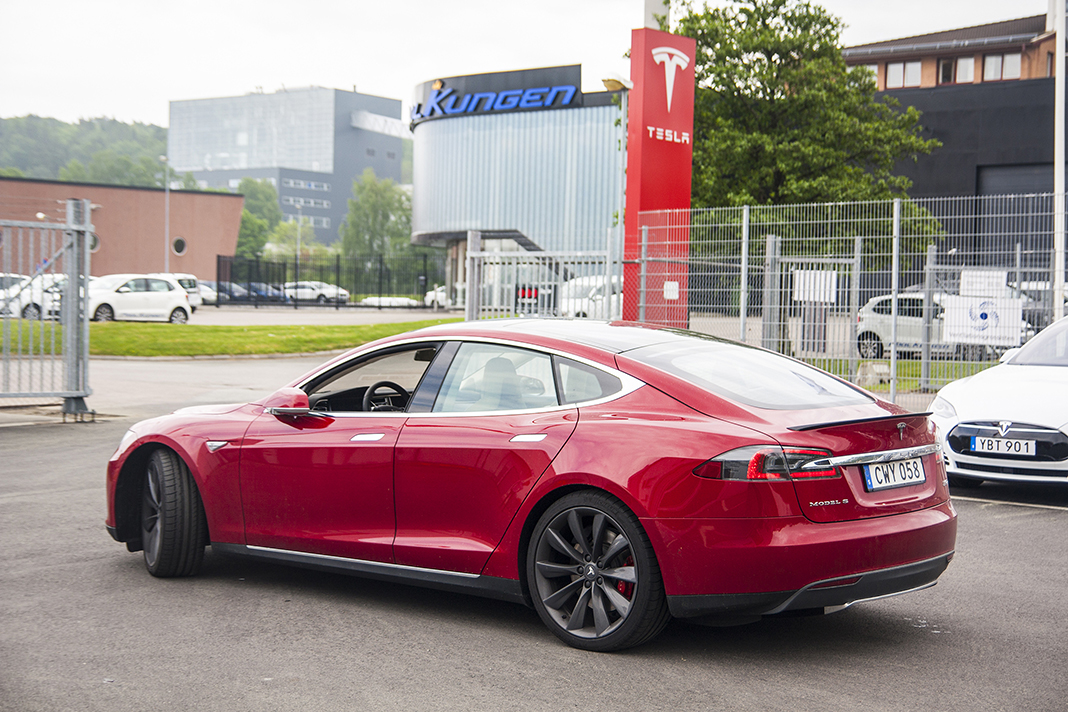
I was lucky: on Monday afternoon, an almost fully charged P90D – the most powerful electric car on the market – was waiting for me in the car park outside the Tesla Store Gothenburg, so naturally I was excited like a little boy. Tesla itself gives a „combined“ output (yes, this term is deliberate here, but we will get to that later) of 691 hp (515 kW, 967 Nm). This enables the hefty liftback to accelerate to 100 km/h in 3.3 seconds, an impressive figure. Its top speed of 250 km/h is standard and, given speed limits and traffic, difficult to use anyway.
Tesla will not beat every supercar, as is often claimed. If it has all-wheel drive (like Tesla) and launch control (like Tesla), it is quite an even contest, and if the race continues far beyond 100 km/h, supercars have the upper hand. This does not change the fact that the Tesla S P90D is incredibly fast for its size, but the claim that it will leave any supercar behind is not entirely true (here, for example, against a McLaren 650S).
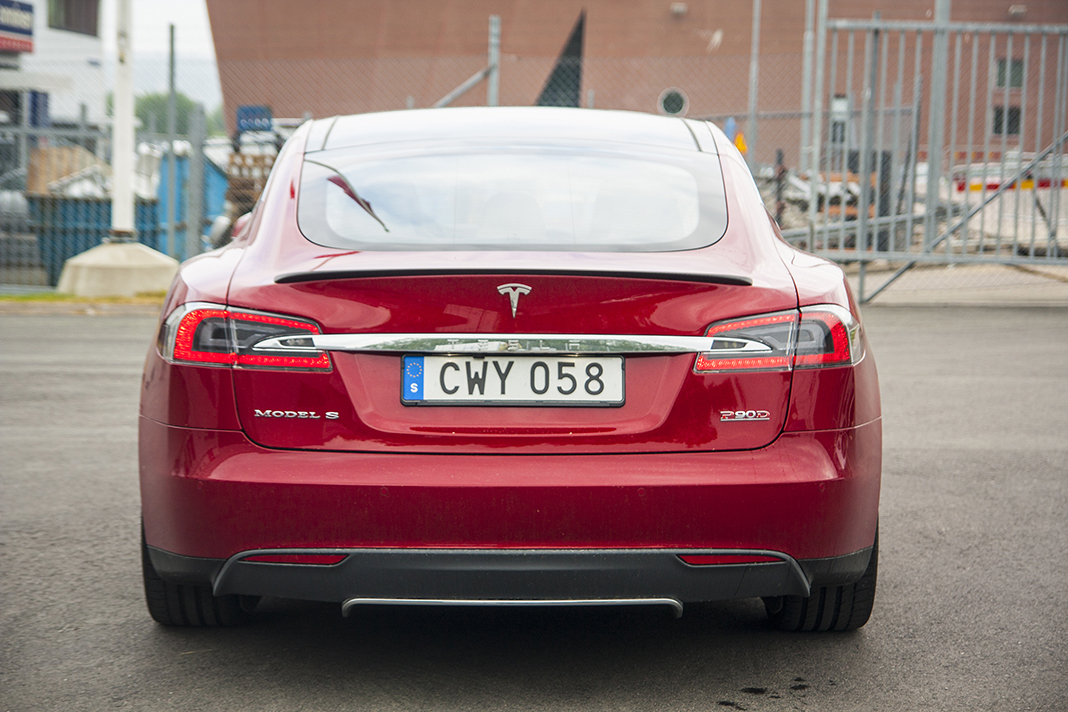
The second issue is a current problem in Norway, where Tesla will have to pay compensation for incorrectly stating the output of the Model S P85D. The claimed 691 hp was never measured on a dynamometer, and the carmaker argues that it stated the „combined“ output of the two motors in the P85D (P90D), rather than the vehicle’s total output, as everyone would expect.
But enough static discussion: the most interesting thing about the P90D is its acceleration. An article by František Kubiš has become fairly well known, at least among people around me. He mentions that when overtaking in a Tesla, he unintentionally scares oncoming drivers, who do not believe he can make it. It should be added, however, that this concerns a P85. So when we stopped at a motorway entrance with the intention of testing the P90D’s full acceleration, my heart was pounding in my throat, and we had not even moved yet.
It is a truly incredible experience that is very difficult to describe. When I first pressed the right pedal all the way to the floor, my passenger shrieked and I let out something unpublishable in the Ostrava dialect, despite being from the Krkonoše Mountains. The pull of the motors is genuinely unbelievable, although I can imagine that the sharp roar of a V12 would pump even more adrenaline through one’s veins. I cannot understand how there was absolutely no wheelspin: simply nothing, just instant flight straight ahead!
During the later Autopilot-assisted drive, which the next chapter covers, I wondered when I had experienced anything similar. The BMW i8 is fast, merely fast. Tesla offers an experience like the first time I flew in a large passenger aircraft as a little boy. A 737 lines up at the start of the runway, the pilot increases engine power, releases the brakes, and your insides get pushed somewhere towards your spine – or at least that is how I imagined it back then.
About two weeks later, however, an opportunity for comparison arose. My colleagues and I went to the huge Liseberg amusement park, with several award-winning roller coasters, of which Cannonball boasts acceleration from 0 to around 85 km/h in around three seconds. A yawn, except for the fact that you sometimes hurtle straight towards the ground or upside down. For an ordinary mortal, Tesla’s acceleration is incomparable. Perhaps I will change my mind once someone lends me a Lamborghini Aventador LP 750-4, but that will take some time.
Of course, the Tesla also has to be stopped somehow, so the P90D has Brembo sports brakes (355 mm at the front and 365 mm at the rear), and this was where I found the main problem. Logically, when you cannot hear the engine, you hear everything else. For my taste, the brakes squealed and creaked far too much, but above all, their engagement was clearly noticeable during braking when it was no longer just motor recuperation and the brakes joined in. It may have been a flaw of the hard-driven test car, but this, together with the rattles, really bothered me.
Otherwise, there is not a bad word to say about the drive. Diehard Tesla haters complain that it cannot even complete a full Nürburgring lap at maximum pace, while František Kubiš also mentions trying the Masaryk Circuit in Brno in a Tesla and being unable to drive flat out due to overheating, but the Model S is not built for that. It is a huge luxury liftback with air suspension that can even use GPS to remember its ride-height setting (from 120 to 163 mm) for different places, which impressed me greatly – I am not aware that the previously tested Range Rover could do this. Onboard comfort is exemplary when no noises are making themselves heard. I was surprised by the (poor) quality of Swedish roads, so I can say that the Model S air suspension smooths out unevenness very, very well.
Autopilot? Very relaxing, but not yet 100%
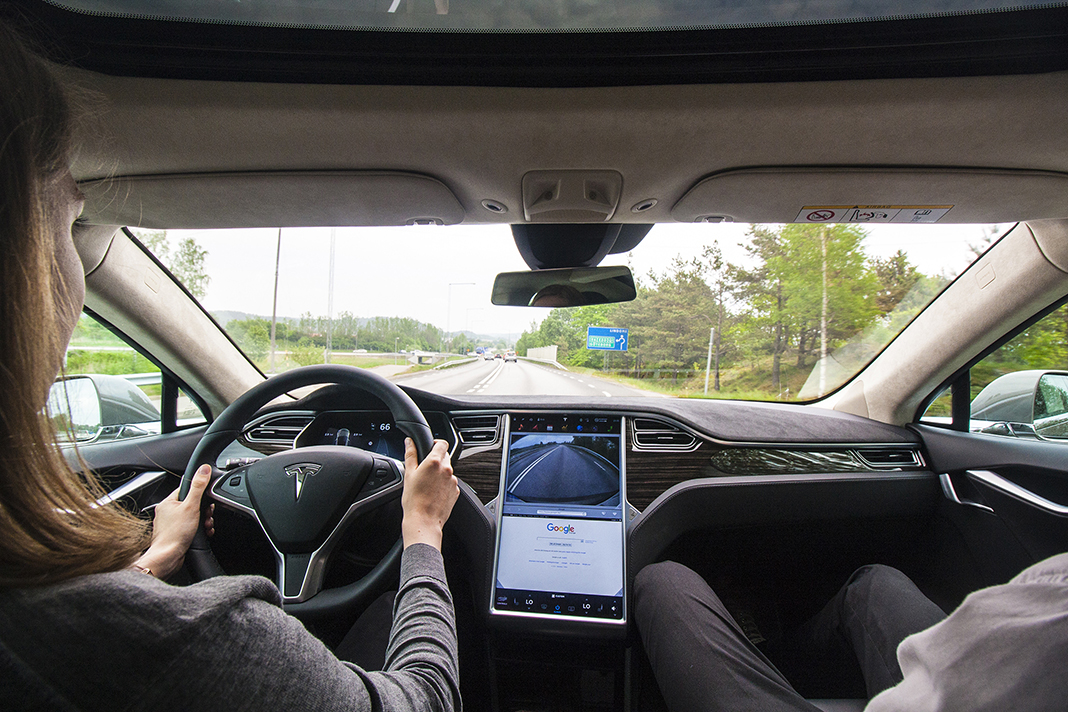
Of course, I was also interested in Autopilot. This feature costs USD 2,300 when ordering the car, or USD 2,800 for cars already built, and enables driving in parallel lanes with adaptive cruise control, where a simple stalk beneath the steering wheel can be used to set the distance from the car ahead. As several accidents have already shown (the question is whether they were actually caused by an Autopilot error; videos can also be found where Autopilot itself prevented a collision), the driver must remain alert, and Tesla itself warns that this is still not 100% autonomous driving. Unfortunately, the first fatal accident occurred in recent days, when a Model X collided with a truck turning incorrectly, so quite a few things will still have to change before autonomous driving can really be launched, quite likely including public opinion.
Since Ayman himself (an employee of the Tesla Store Gothenburg) is a Tesla enthusiast, he and his colleagues tested what Autopilot would do in real traffic and when. When prompted, the driver must place their hands on the steering wheel. If they do not, the car starts beeping and gradually increases the volume. If the driver still does nothing, the car pulls over to the roadside and stops completely.
I have to admit that I can really imagine travelling like this on European motorways. Motorway driving is boring anyway, so why not get a little rest this way? This looks like a bright future which, in the case of road trains, could also reduce energy consumption and increase the capacity of our transport arteries.
So why did the Tesla Model S disappoint me?
Driving the P90D is an incredible experience: it is the first vehicle in which I thought it was actually too fast. I can imagine that permission to drive similar cars would only be granted after several years of holding a driving licence, as is the case with powerful motorcycles. But unlike many wild supercars, Tesla does not „try to kill you“; it simply launches forward completely matter-of-factly. The range is sufficient and the design conservative but interesting, yet there are still several flaws that really bother me in a car costing more than Kč 2 million.
Perhaps I am demanding, but I really do not like the interior. European carmakers are still several major steps ahead of American ones, whether in terms of how it feels, ergonomics or simply its appearance. No lateral support in the rear seats, strange door design, and an overall impression that, to me personally, lacks cohesion. And that is not even mentioning the imitation wood in the pre-facelift version, to which I am literally allergic.
And then there are the rattles! When closing the doors, the luggage compartment, when closing the front luggage compartment manually for no comprehensible reason, from the brakes… If I had not experienced that it can be done without them, I might not say anything, but if Jaguar can do it, then the „most amazing carmaker in the world“ must be able to do it too, no excuses.
And the central display? A revolution in cars? In my view, it is positioned too low, and I would rather choose Audi’s solution, with a display in the instrument cluster as in the new TT, steering-wheel control buttons for everyday functions and a centre tunnel for settings.
There will certainly be people for whom Tesla is a dream come true and these are imperceptible quibbles from a nitpicker, but personally I would choose the drivetrain of a less powerful version in the body and with the behaviour of a Jaguar XJ. The feeling of driving it and being in its interior is miles away from Tesla, while the price is no different.
Other instalments in the Tesla Model S series:
- Tesla Model S (part 1): visiting the Tesla Store, chassis platform and facelift in person
- Tesla Model S (part 2): P90D is incredibly fast, but is it really perfect?
Translation disclaimer
This article is a machine translation of the Czech original and has not yet been fully reviewed. In case of any doubt, please refer to the Czech version.
Sdílejte článek prostřednictvím:
You might also like
20 October 2026, 12:55
20 October 2026, 10:49

20 October 2026, 06:13