
28 October 2026, 15:10
Loading...
More than 40 GW of battery storage added last year, but e-mobility is driving battery demand

Jan Budín
11 May 2024, 14:22
Newly installed battery storage capacity exceeded 40 GW last year, according to a report by the International Energy Agency (IEA), more than doubling year on year. However, e-mobility continued to account for the vast majority of battery demand in the energy sector, with demand in this segment rising by 40% year on year.
The International Energy Agency said that although lithium-ion batteries are still used in billions of consumer electronic devices, the energy sector—which also includes transport—accounted for 90% of lithium-ion battery demand last year. In 2016, when the lithium-ion battery market was roughly ten times smaller, according to the agency, the energy sector accounted for about half of demand.
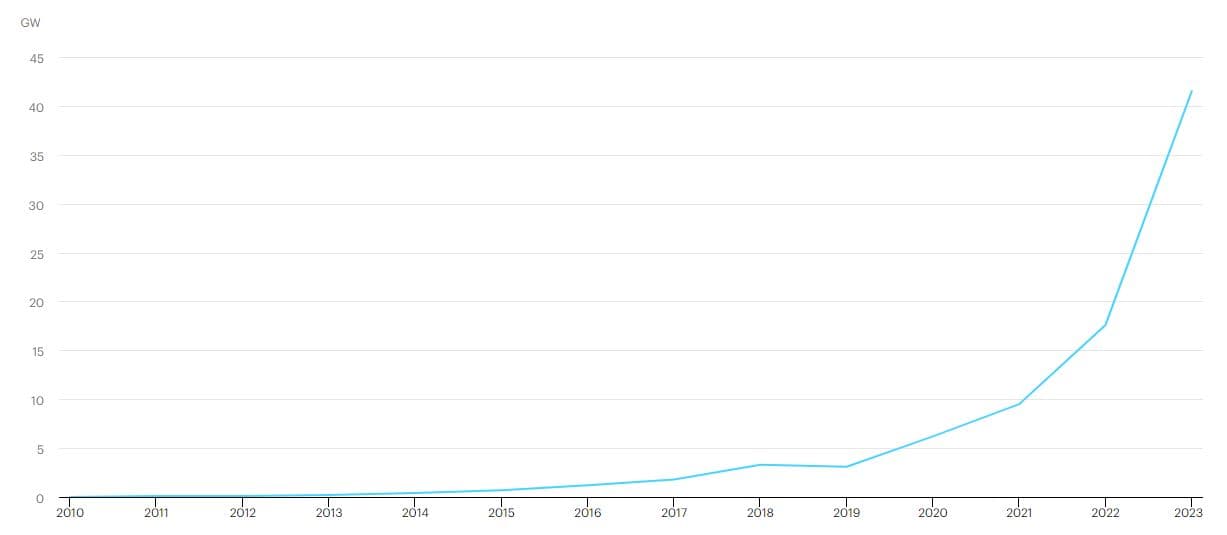
Annual additions to installed battery storage capacity. Source: IEA
A breakdown of lithium-ion battery demand in the energy sector shows that e-mobility accounted for the vast majority last year, at 770 GWh. Demand from large-scale battery storage was around 60 GWh, while the small residential battery sector added another 30 GWh.
China is the main driver
According to the IEA, China was the main driver of growth in global installed battery storage capacity, adding 23 GW last year. Two-thirds of this capacity came from large-scale battery systems, with the remaining third coming from smaller systems.
The United States added another 8 GW, with large-scale battery storage accounting for 90% of the total, while 6 GW of new battery storage was installed in the European Union. Last year, almost 90% of newly commissioned battery storage capacity was therefore concentrated in these three markets.
Translation disclaimer
This article is a machine translation of the Czech original and has not yet been fully reviewed. In case of any doubt, please refer to the Czech version.
Sdílejte článek prostřednictvím:
You might also like

28 October 2026, 13:08

28 October 2026, 11:10

28 October 2026, 09:08
