
17 October 2026, 13:09
Loading...
Plans for massive expansion of battery storage in Germany pose challenge for grid operators

David Vobořil
15 March 2025, 07:48
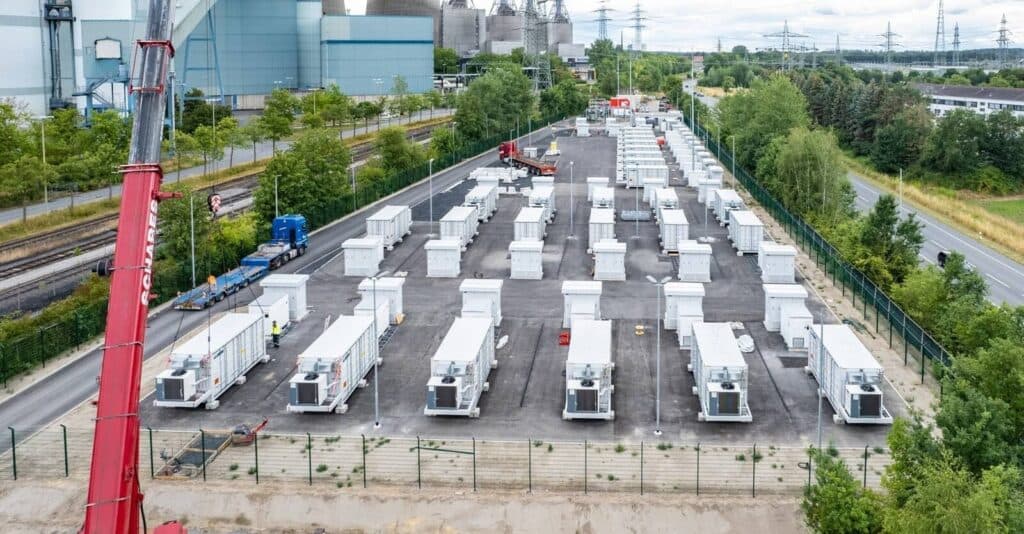
Growing interest in connecting large battery storage systems to Germany’s transmission grid could put grid operators in a difficult position, says the head of Germany’s largest distribution network operator. Many of the systems will not be usable to stabilize the grid; on the contrary, they could even make the situation worse.
Large battery projects with a combined capacity of 226 GW are seeking connection to Germany’s transmission grid—130 times the capacity of operational battery storage systems. More than 100 GW of additional storage is seeking connection to distribution grids. The boom in the sector is being driven primarily by rapidly falling battery prices and the opportunity to profit from fluctuations in electricity prices.
Leonhard Birnbaum, CEO of E.ON, the country’s largest distribution network operator, has criticized the fact that applications are often submitted without regard to the specific situation on the grid. For storage systems to contribute to grid stability, they would need to be located in the right places on the grid.
However, applicants have no incentive to consider whether their projects are compatible with the grid, Birnbaum said. He added that many developers use the company to test their chances of securing a connection.
“Prospective storage operators simply want to find out what their chances are of connecting to the grid. This ties up resources for us unnecessarily,” Birnbaum said.
Only a fraction of current applications can be expected to receive connection approval. Approval procedures usually take a long time and often result in approval for a lower capacity, or no approval at all.
Many of the projects are also at an early planning stage, making it difficult to predict how many will ultimately be built. Some developers have also submitted applications for several locations for the same project. Since approvals are most often granted on a “first come, first served” basis, it makes sense for developers to secure a grid connection at an early stage.
BNetzA’s unsuccessful attempt to harmonize capacity allocation
In response to the growing shortage of grid connection capacity, Germany’s Federal Network Agency (BNetzA) published a consultation paper late last year, putting forward a new model for allocating grid connection capacity for discussion.
Under the model, available grid connection capacity would be allocated at set times, either proportionally according to the capacity requested or in equal shares among all applicants. However, after reviewing feedback from market participants in February 2025, BNetzA abandoned further work on the position paper because the proposed model failed to win consensus.
As a result, responsibility for developing and applying a procedure for allocating grid connection capacity remains with each of Germany’s more than 850 distribution network operators. There is therefore no uniform approach among grid operators to allocating grid capacity, although “first come, first served” remains the most commonly used method.
Translation disclaimer
This article is a machine translation of the Czech original and has not yet been fully reviewed. In case of any doubt, please refer to the Czech version.
Sdílejte článek prostřednictvím:
You might also like




16 October 2026, 10:16