20 October 2026, 15:34
Loading...
What technologies provide electricity and heat in the Czech Self-sufficient House (2/2)?
Michal Klečka
21 September 2022, 07:30
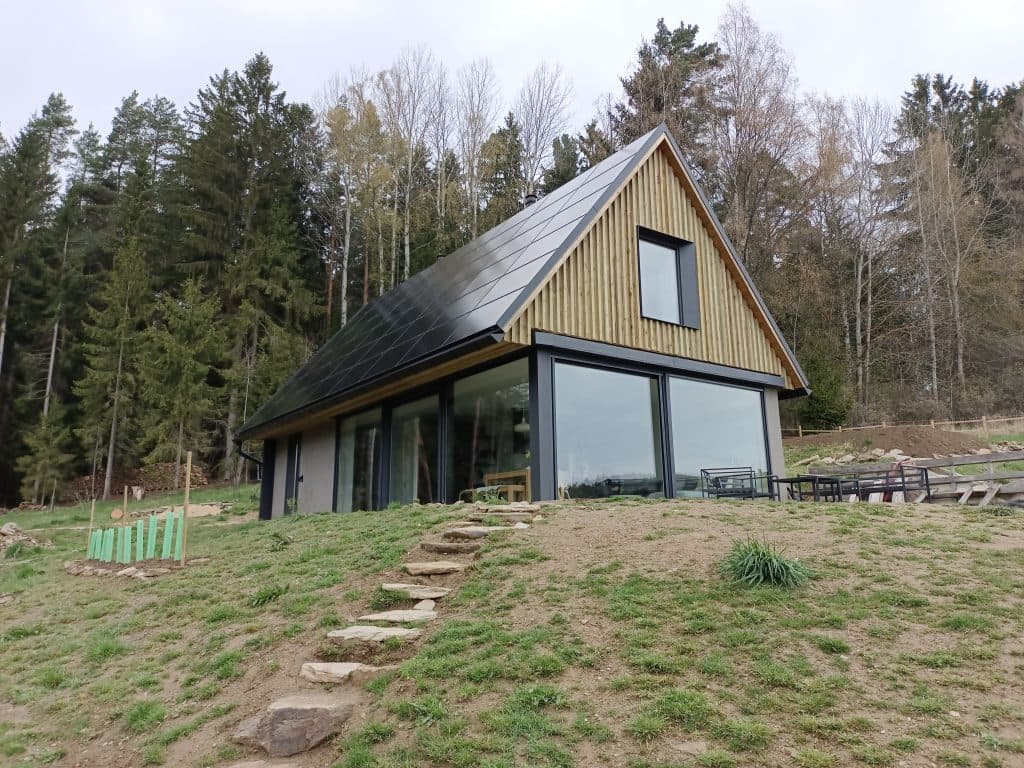
A continuation of the story of the Czech Self-sufficient House, told by the project initiator, Pavel Podruh. The technical perspective is provided by Michal Klečka, who is behind the designs for energy self-sufficiency.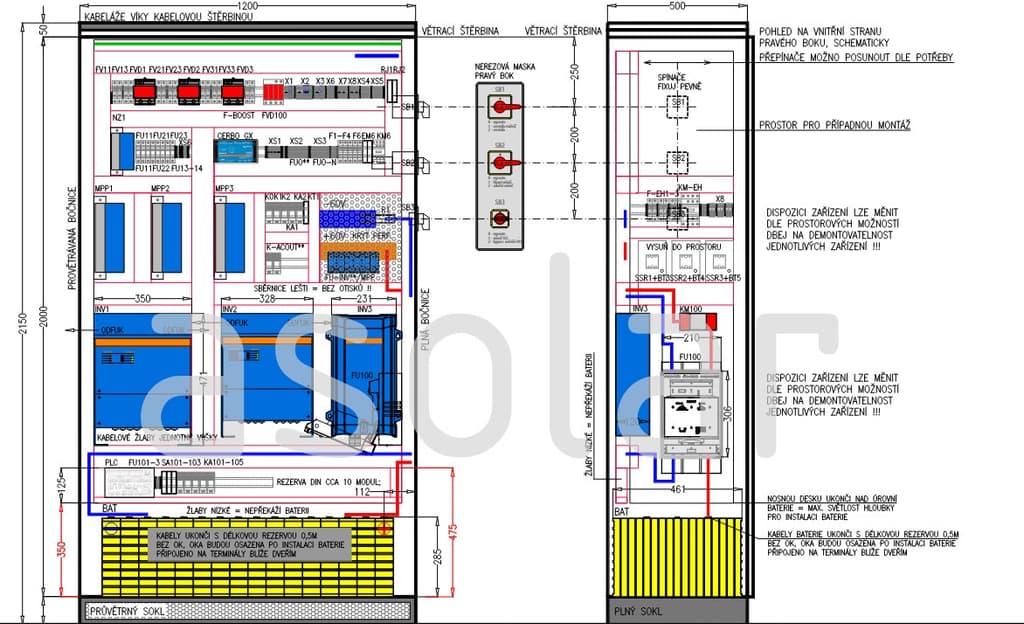
The final instalment of the series focuses on the details of the technologies used and the house’s technical solution – we will describe the DC switchboard used. We will explain how we heat the house and how we generate electricity for heating when the sun is not shining. We will also cover other interesting aspects of testing and fine-tuning the technologies used.
DC switchboard
The most interesting and, to some extent, unique feature of the technical room is the battery and DC switchboard. We managed to integrate both into a single compact metal cabinet. At the bottom are 16 cells with a capacity of 400 Ah. Above them is an ELERIX CPM module, which protects the battery against excessive discharge or overcharging, but deliberately does not continuously balance the battery. The reasons will be explained later.
The battery is connected to the rest of the system via fuse holders and an emergency disconnect switch. Everything has to be rated for direct currents of up to 300 A, which is no simple matter. When disconnected, direct current creates an electric arc that thermally stresses the contacts (scorching them). All disconnecting elements must therefore be fitted with so-called arc extinguishers, and standard circuit breakers and protections for 230 V alternating voltage cannot be used.
Behind the disconnect switch and fuses is a so-called measuring “shunt”, connected to a BMV-700 module (see below) to monitor energy flows to and from the battery, followed by common busbars (the DC bus), to which all three inverters and three charge controllers are connected.

Block diagram of the inverter and battery storage system. Source: ASOLAR
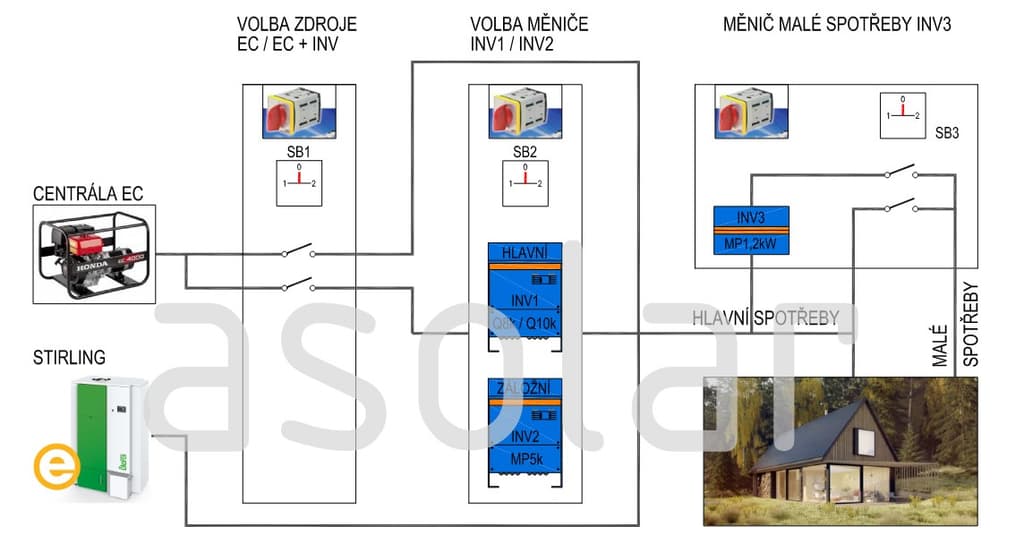
The output from the inverters (whether the two large ones or the single small one) already has standard grid voltage parameters, namely 230 V and 50 Hz. It is this output to which the Stirling engine is connected; operating in parallel with the inverters, it helps supply the house’s electrical circuits and, in the event of surplus electricity, can recharge the battery through the inverter thanks to the “AC Coupling” function.
We manually select between the large inverters (either 10 kW or 5 kW alone, or their parallel 15kW operation) using a lever switch; their shutdown and switchover to the backup 1200W inverter takes place automatically, with the option of overriding it. We wrote about the reasons for using three inverters in previous instalments, so just briefly – redundancy in the event of a fault and savings during winter standby operation).
In the event of a catastrophic failure of the entire system, there is another mechanical lever switch that can disconnect the entire DC switchboard and connect the house directly to a petrol generator with a 230 V output. This generator can even be used to charge the battery (again thanks to the AC coupling function).
For completeness, we should note that we do not count on using the generator in normal operation at all. Over two years of actual operation of the house, with visitors staying there continuously, it has not been necessary to start the generator even once. It is only there as a backup to the backup in the event of a catastrophic failure combined with extreme weather.
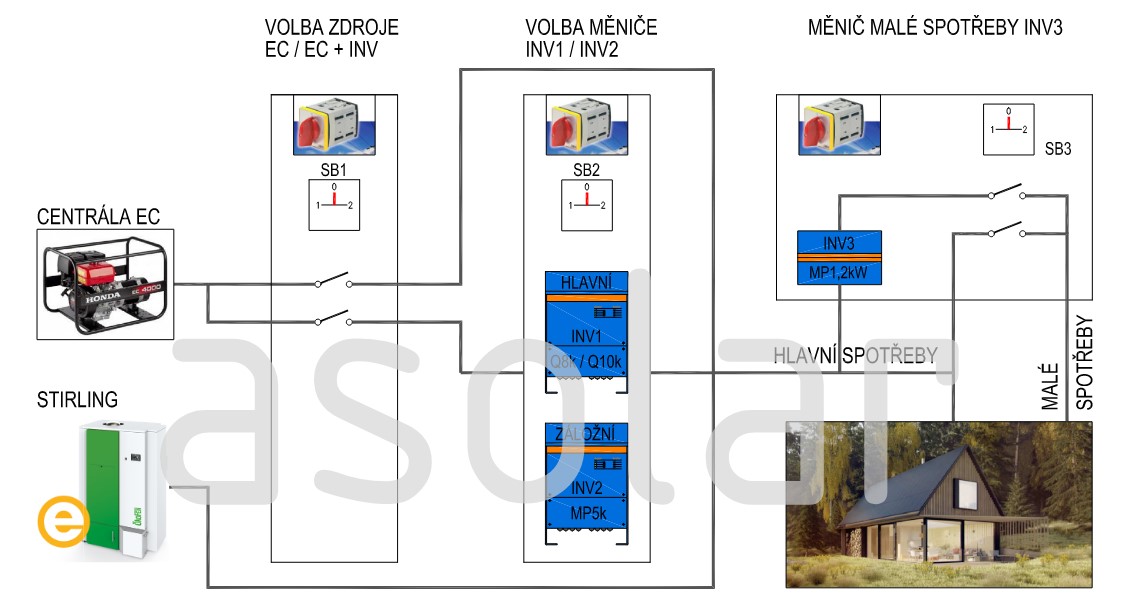
Block diagram of the generator, Stirling engine and inverter. Source: ASOLAR
Under normal conditions, the battery is charged by three MPPT controllers with a capacity of up to 15 kW. They are connected to the solar panels via DC circuit breakers. On a truly sunny day, we can recharge even a fully discharged battery in approximately an hour and a half. This energy reserve then lasts us around five days when the house is operated economically. Isn’t that great? An hour and a half of sunshine in exchange for five days of energy?
The actual amount of energy in the battery must be measured based on the difference between energy supplied and energy withdrawn. Unlike lead-acid, Li-Pol or Li-NMC batteries, the remaining energy in a LiFePO4 battery cannot be determined from its voltage. This is usually a good and desirable characteristic, but it is not particularly helpful for measurement. That is why we use the simple and inexpensive BMV-700 device from Victron Energy, which uses a measuring resistor (a so-called shunt) to measure the current flowing into or being drawn from the battery. By adding these two values together, the charge indicator can calculate at any time how much energy remains in the battery.
The battery state of charge (SoC = State Of Charge) is a fairly important parameter in an off-grid house, and it is good to know it. We control individual appliances in the house based on the SoC percentage. The inverters, controllers and SoC meter are interconnected with the main Victron Energy Cerbo unit, which collects information on the status of the individual components and can use it to control two basic events:
- switching the entire house from the large inverters (10/5 kW) to the small one (1,2 kW) when the battery energy reserve falls below 30 %
- switching on up to three heating elements in the buffer tank at SoC > 95 %
Heat source
Originally, we had planned to use a wood gasification boiler, but chance had it that the entire Czech Self-sufficient House project captivated Mr Stefan Ortner, co-owner of Austrian company ÖkoFEN. He decided to lend the house, free of charge and for an unlimited period, a top-of-the-range Pellematic pellet boiler fitted with a Stirling engine, which can generate up to 900 W of electricity during operation.
That was an offer we could not refuse, so it was clear – we would heat with pellets. A 900W electricity source would also come in very handy during the winter. We will return to this speciality later.
Aside from the additional Stirling unit, it is a conventional pellet boiler with a maximum output of 16 kW, an integrated pellet hopper for around one day of operation, automatic replenishment from an external storage tank, automatic ignition and integrated control of the house’s entire heating system.
By burning pellets, the boiler heats water in a 1000-litre buffer tank. It is divided into two sections – the lower approximately ⅔ serves as a water reserve for the heating system, while the upper ⅓ is a heat source for domestic hot water. A stainless-steel heat exchanger (essentially a pipe coiled into a spiral) carries cold water from the well through it and transfers heat from the tank to it.
Because we chose a combination of underfloor heating and radiators to distribute heat from the buffer tank throughout the house, the system also includes a three-way valve that regulates the water temperature supplied to the floor to a maximum of 36 degrees, while water of up to 60 degrees can be supplied to the radiators.
The buffer tank also includes the three aforementioned 50–60 V DC heating elements, powered directly from the battery without the involvement of an inverter. They switch on progressively according to the surplus of electrical energy, once the battery is charged to at least 95 %. The upper element switches on first (to heat the upper third of the tank for domestic hot water), followed by the lower and middle elements.
Experience has shown that the boiler needs almost no heating from the end of February until the beginning of December. The house has a heat loss of around 4 kW / -10 oC, so the sun, together with the 16 kWp solar panels, should comfortably heat it for the rest of the year.
Small wood-burning stoves in the main living room and kitchen area are also designed as a bivalent heat source. They serve mainly an emotional purpose (a fire in the room) and a safety function – the boiler, controller, charger and pump could all theoretically fail. But a stove always burns, and we can always find some wood in the inexhaustible surrounding forests. In an emergency, their output would be sufficient to heat the house on their own.
Stirling engine
It was a free loan, so we primarily wanted to accommodate our benefactor and test the use of this solution in off-grid operation. We acknowledge that it is rather an obstacle to replicating the entire project.
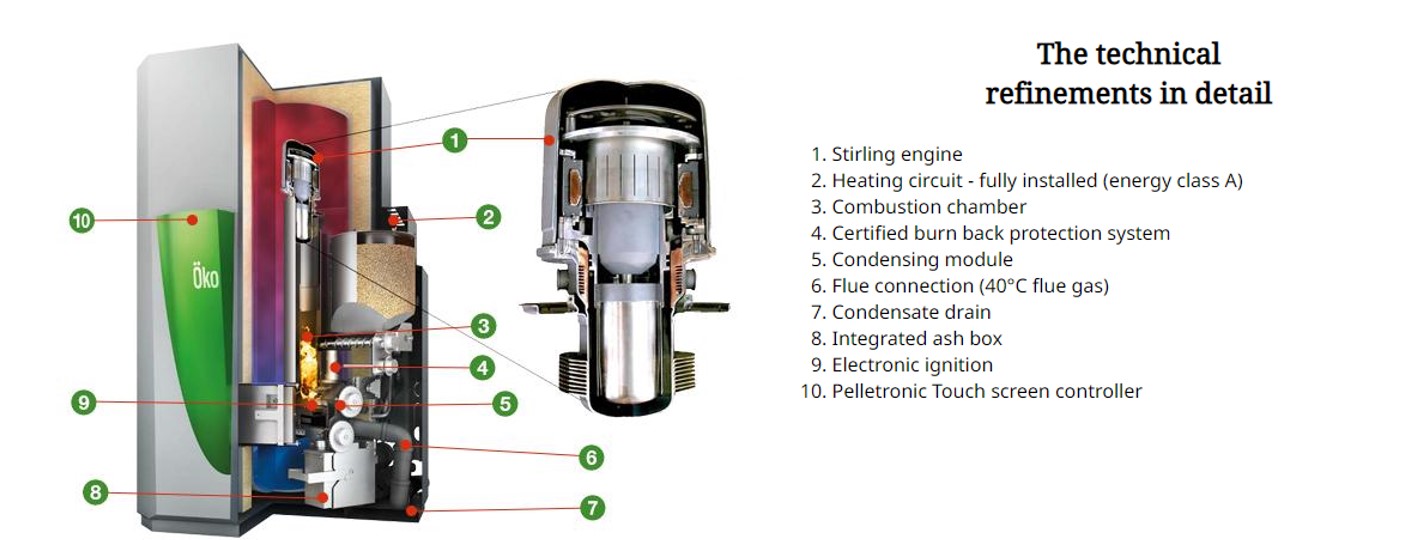
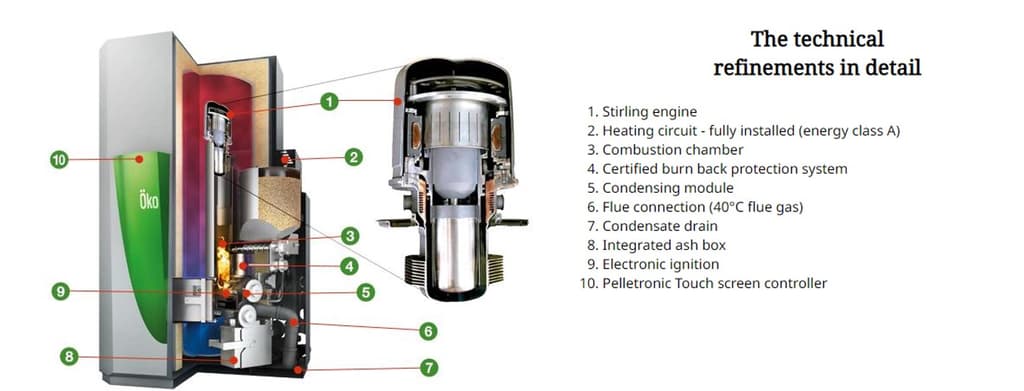
Schematic representation of the boiler and Stirling engine. Source: www.organicenergy.co.uk
A Stirling engine is similar to a steam engine – it uses the thermal expansion of gas (hot flue gases) and its contraction upon cooling, transforming this energy into mechanical energy. The specific version made by British company Microgen is installed on top of the pellet boiler and requires synchronisation with a 230 V / 50 Hz grid. Without a source of a rotating field (a sine wave), it cannot operate independently or off-grid.
This poses something of a challenge for our system, but fortunately Victron Energy inverters feature the “AC Coupling” function and can therefore provide sufficiently stiff 230 V / 50 Hz voltage for similar (subordinate) electricity generators. In addition, Victron allows the batteries to be recharged from this auxiliary source – so we have everything needed to integrate the Stirling unit.
What can we say in conclusion?
We have taken readers through the entire story of the creation of the self-sufficient house and introduced its key technologies. To summarise our project in a few sentences, it can be said that achieving near-complete self-sufficiency is possible under Czech conditions. Given current electricity and gas prices, the operating economics of such a solution are not bad at all. On the contrary, under the current energy market situation, such a solution is in some ways a rational choice with a stable electricity price. Naturally, nobody could have anticipated an energy crisis of this scale when the project began. On the other hand, current developments make it possible to quantify the value of energy self-sufficiency and independence offered by similar solutions, which is otherwise difficult to value under normal circumstances.
The demanding implementation of the Czech Self-sufficient House led to the creation of a team of highly experienced professionals with deep technical knowledge. Without this house, they might never have come together, and that is also a very important side effect of the entire project. Thanks to this, the Czech Self-sufficient House now (www.csdum.cz) can help those interested in implementing PV systems for family homes (grid-connected and off-grid) based on the same technical architecture. At the same time, the Czech Self-sufficient House team helped launch the development of Czech industrial battery storage systems under the name AMVOLT.energy, which are now entering the market in sizes up to 1MWh containers. The Czech Self-sufficient House may be a small house in the middle of a meadow, but we have truly made every effort to ensure that its wider impact is as useful and broad as possible.
Translation disclaimer
This article is a machine translation of the Czech original and has not yet been fully reviewed. In case of any doubt, please refer to the Czech version.
Sdílejte článek prostřednictvím:
You might also like
20 October 2026, 12:55
20 October 2026, 10:49
20 October 2026, 06:13