Coal-fired power plants in Czechia to be replaced by geothermal district heating, says Minister Hladík
Environment Minister Petr Hladík (KDU-ČSL) has announced a new development in geothermal energy: coal-fired power plants facing closure will be replaced in Czechia by zero-emission technologies for district heating, with heat sourced directly from the Earth – geothermal energy.
Industry and Trade Minister Jozef Síkela wants to prepare legislation by mid-2025 that will ensure a managed coal phase-out in the energy sector by 2033. In neighbouring countries, replacing coal with geothermal energy is a common and proven approach. It is currently most widely used in Germany and Poland.
Following the example of neighbouring countries, Hladík and his ministry are preparing a Geothermal Energy Strategy, which the government is expected to approve in the first half of this year. The strategy will form part of the new energy policy.
“We primarily need to resolve the transition away from coal. I now have some news for you – for your website. We are drafting a geothermal energy strategy, which I want the government to approve in this half of the year. We are in intensive talks with the District Heating Association. And, following discussions with the CGS (Czech Geological Survey, editor’s note) and the District Heating Association, we see the greatest potential (for geothermal energy) in replacing local sources of up to five megawatts of capacity. We are fully aligned that the potential lies in district heating systems, and it must be close to the networks (wells) – from an investment and pragmatic perspective,” Hladík told Geotermie.cz.
Czechia, which has conditions comparable to those in neighbouring countries, has so far made only limited use of underground heat, but according to the Chamber of Renewable Energy Sources, substantial potential exists. Under the medium scenario, at least five geothermal heat plants and ten geothermal heating stations could be built by 2030.
“If we have large coal-based district heating systems here, we have to pick the low-hanging fruit. We must take a pragmatic approach, pursuing innovation and modernisation. Of course, we are working with the District Heating Association, which sees the use of geothermal energy as one of the major opportunities for district heating,” the minister noted.
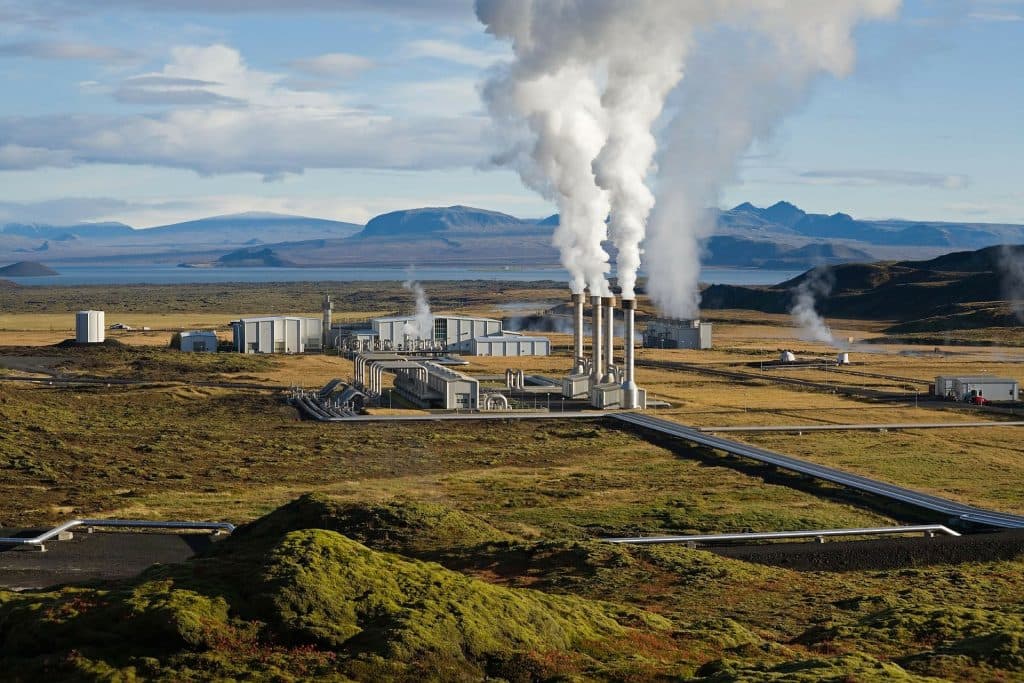
And how does geothermal heating work? If there is hot water underground (contained in rocks with a sufficient volume of pores or fractures, known as a hydrothermal resource), it only needs to be brought to the surface through a well. If there is no water underground, it must be injected there and, once heated by the surrounding rocks, pumped back to the surface.
In Czechia, geothermal energy is used, for example, by the city of Ústí nad Labem, where it heats swimming pools and, since May 2006, the zoo as well. A unique project using geothermal energy to produce heat operates in Děčín. Since 2002, a heating plant on Benešovská Street has been in operation there; it is the only one in the Czech Republic to use geothermal energy to supply heat to half of the city.
Relatively low temperatures below 100 °C are sufficient to obtain heat for heating purposes. This means that very deep wells are not required. In Central Europe, depths of up to 2000 m are sufficient.
The central heating plant then regulates the amount supplied according to heat demand. A boiler balancing peak demand evens out heat consumption. A backup boiler is also justified, so that a guaranteed heat supply can be ensured in the event of problems at the pumping station or in the well.
In addition to the countries already mentioned, France can also provide inspiration. The most interesting area in this respect is the Paris Basin, where most facilities were built between 1981 and 1986. France now has approximately 70 geothermal heating stations, around 80 % of which are located around Paris. These facilities supply heat to more than 200 000 apartments.
A typical heating unit consists of two wells approximately 1.7 km deep, one for production and the other for reinjection. The wells are approximately 5 to 10 km apart. The unit’s thermal capacity is 10 MW and water circulation is 40 to 80 l/s. Facility costs are not low, but the heating stations are economically advantageous and are expected to have a service life of 25 to 40 years.
Translation disclaimer
This article is a machine translation of the Czech original and has not yet been fully reviewed. In case of any doubt, please refer to the Czech version.