
8 November 2026, 20:02
Loading...
BNEF: Blue hydrogen is the cheapest low-carbon alternative thanks to falling natural gas prices

Jan Budín
29 July 2023, 08:37

The levelized cost of hydrogen production rose slightly in 2023 due to inflation and higher financing costs. According to researchers at BloombergNEF (BNEF), however, green hydrogen produced at new plants is still on track to become competitive with gray hydrogen produced at existing plants in five markets.
BNEF researchers said that, in addition to inflation and higher financing costs, longer timelines for new projects had also contributed to the increase in the levelized cost of hydrogen production.
At the same time, falling natural gas prices on global markets have made blue hydrogen—the variety produced from natural gas using CO2 capture technology—the cheapest low-carbon option. According to BNEF, the average levelized cost of blue hydrogen is 59% lower than that of green hydrogen (produced using electricity from renewable energy sources).
"Green hydrogen is still on track to beat blue hydrogen by 1-3 years across all modeled markets. Green hydrogen is cheaper than blue hydrogen as early as 2028 when using alkaline electrolyzers from China, and from 2033 when using alkaline electrolyzers from Western countries," BNEF researchers said.
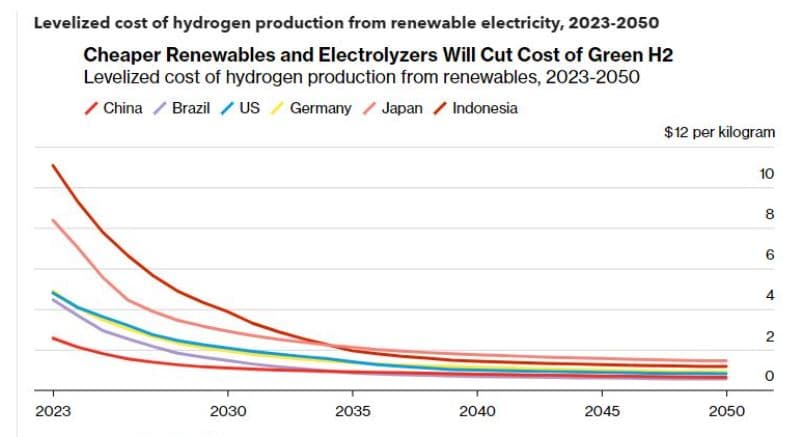
Outlook for the levelized cost of green hydrogen production in selected markets. Source: BNEF
According to BNEF's outlook, by 2035 the levelized cost of green hydrogen production will be lower than that of gray hydrogen (conventionally produced hydrogen) in more than 90% of modeled markets.
"By 2030, building a new green hydrogen plant will be more economical than continuing to operate an existing gray hydrogen plant in Brazil, China, Sweden, Spain and India," BNEF added, noting that this will be the case in all 28 modeled markets by 2050.
Translation disclaimer
This article is a machine translation of the Czech original and has not yet been fully reviewed. In case of any doubt, please refer to the Czech version.
Sdílejte článek prostřednictvím:
You might also like

8 November 2026, 13:59

8 November 2026, 08:10
7 November 2026, 17:23