20 October 2026, 15:34
Loading...
Chemnitz in the spotlight: HZwo as a driving force behind the hydrogen transition
Klára Čeperová
26 April 2025, 08:00
The HZwo association was founded in 2017 as a group of a handful of players in the automotive sector interested in the potential for developing hydrogen and hybrid technologies. Today, the association has more than 150 members and, although it remains closely tied to its home region and the city of Chemnitz, its members can be found around the world.
It will come as no surprise that Germany is the Czech Republic’s largest trading partner. The Czech Republic has maintained a trade surplus with Germany since 1998, and around a fifth of the value of Czech exports to Germany is linked to the automotive industry. In 2023, this amounted to almost CZK 400 billion.
Another unsurprising fact is that this sector has come under pressure in recent years from the energy transition and international competition, which is likely to intensify in the future. According to the Draghi report, Europe is lagging in automotive software and is slowly shifting towards zero-emission mobility.
In 2023, nearly a third of all European investment in green technologies took place in Germany, which is also the EU leader in clean technology manufacturing and related employment, including in the automotive industry.
Hydrogen could play a key role in the sector. However, Michael Sterner, a hydrogen expert at the VDI association, said that the development of a hydrogen economy in Germany has yet to get fully underway, mainly because of the classic chicken-and-egg problem.
One association helping to address this problem is HZwo, based in Chemnitz. It focuses on developing green hydrogen technologies for stationary and mobile applications. The association was founded in 2017 as a group comprising several automotive suppliers, a university and a research institute.
From zero to 150 in eight years
Today, the organisation is a certified European technology cluster focused on hydrogen technologies. In addition, at national level and in cooperation with partners from North Rhine-Westphalia, it is responsible for one of eleven transformation hubs commissioned by the Federal Ministry for Economic Affairs and Climate Action. These hubs are part of the German government’s transformation strategy, particularly its support for the shift towards climate neutrality in energy-intensive industries such as steelmaking, chemicals, cement and vehicle manufacturing. One outcome is the cH2ance knowledge-transfer project, which aims to help transform the German automotive industry and support industrial sectors and suppliers in their transition to hydrogen mobility.
“Our aim is to preserve traditional value chains, which are mostly closely linked to the automotive industry and internal combustion engines, and transform them using hydrogen technologies,” Frederik Wewetzer, who works at HZwo as a network manager and technical adviser at the Saxon Hydrogen Competence Centre, told oEnergetice.cz.
Innovation centre
At federal level, the association is responsible for the Hydrogen Innovation Centre (HIC), which is jointly funded to the tune of EUR 84.4 million by the Federal Ministry for Digital and Transport and the Saxon State Ministry for Economic Affairs, Labour, Energy and Climate Action. Its aim is to help meet the targets of Germany’s National Hydrogen Strategy.
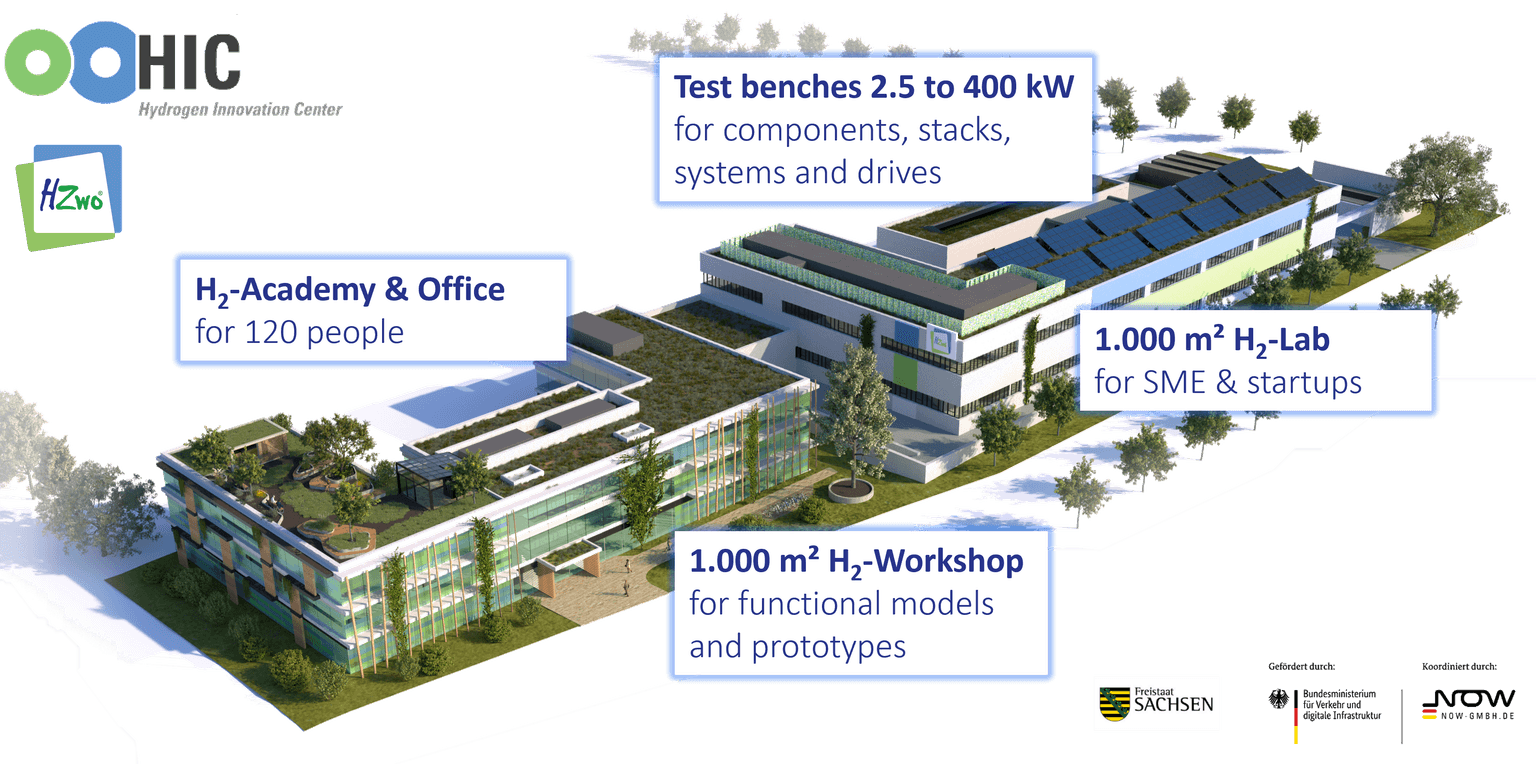
Source: HZwo. Hydrogen Innovation Centre
The Free State of Saxony is contributing a further EUR 15 million. It has tasked the association—which currently has a growing team of twelve and draws on its technical expertise—with fulfilling the objectives of Saxony’s Hydrogen Strategy.
In terms of potential hydrogen applications, transport is a priority in Saxony, a traditional industrial hub. Five car and engine manufacturing plants belonging to Volkswagen, BMW and Porsche are located in Chemnitz or its surrounding area, along with a further 780 companies of various sizes that supply components to the automotive industry. This is also reflected in HZwo’s membership.
“Our members include a few really large companies, some medium-sized companies and many small and medium-sized businesses, which make up the vast majority of at least the German automotive supply chain,” says Wewetzer.
From “a handful of players in the automotive sector”, the association has grown in eight years to more than 150 members from around the world. They include Czech company DEVINN, an integrator of hydrogen systems for energy and transport that is, among other things, involved in developing a Tatra truck powered entirely by hydrogen.
Global reach
Asked what makes membership attractive, Frederik Wewetzer replies: “We offer a healthy combination of technical expertise and public relations work to support collaborative projects across the hydrogen value chain.”
The association’s rapid growth means that not all members are linked solely to the automotive industry. HZwo also counts a number of research institutes and universities among its members, including the Fraunhofer Institute and Austria’s HyCentA. The automotive sector nevertheless remains predominant.
“Local organisations that are HZwo members, especially here in our region, naturally have an interest in working together to develop hydrogen technologies. Like hydrogen, it is one of those topics that can give the region a positive outlook,” Wewetzer says, describing what motivates local players to work together not only with HZwo but also with one another.
HZwo can help them with this, too. It organises workshops, conferences and informal networking events such as a June barbecue followed by the Hydrogen Drives Congress 2025. It also attends conferences such as HYVOLUTION in Paris and Hydrogen Days in Prague, where members can join them.
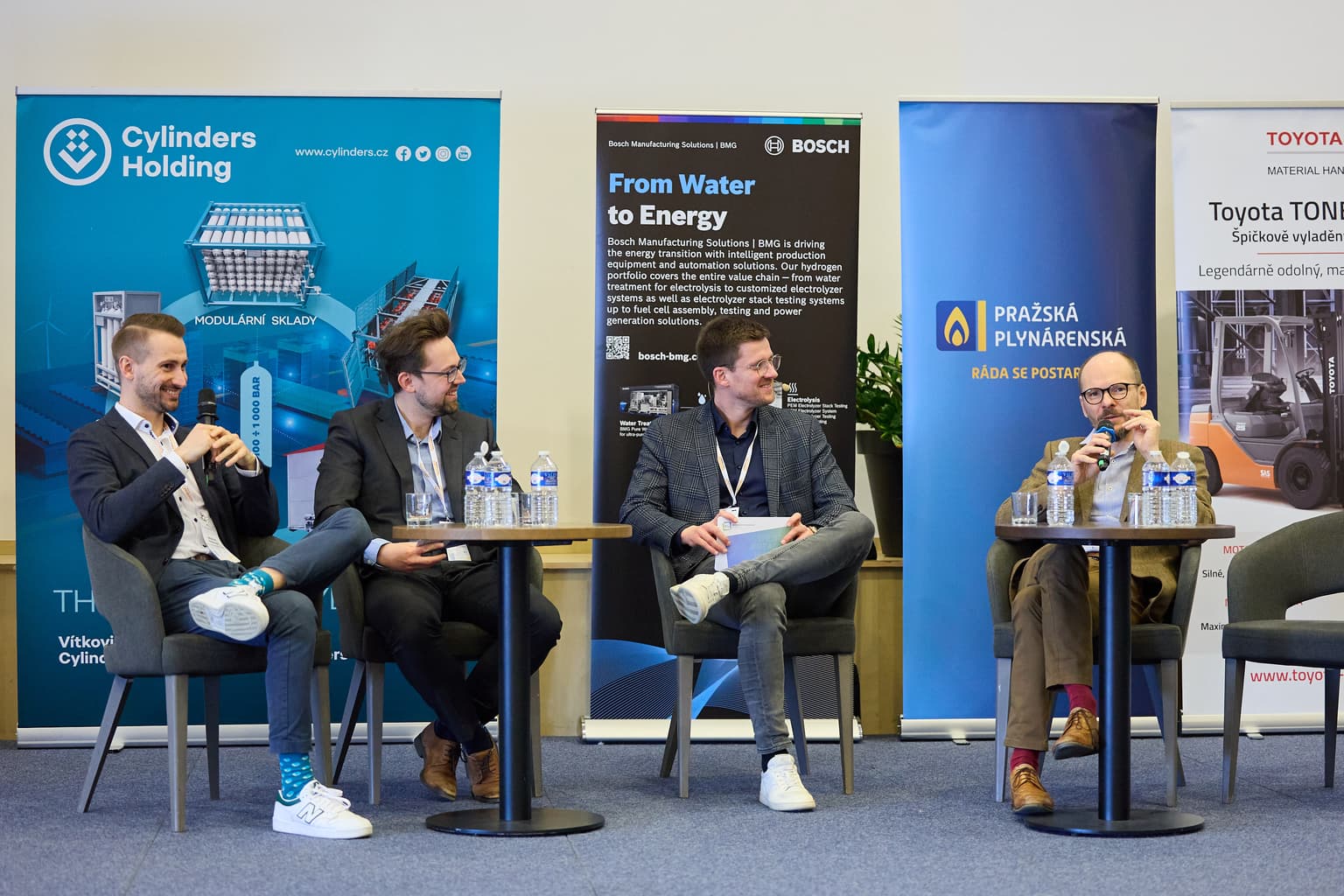
Source: Hydrogen Days
“It often works like this: HZwo rents a large shared exhibition space, which we divide into small stands. This gives us a good location on the exhibition floor, lets us share some of the stand fittings and reduce the rental costs for exhibitors who come with us, while also increasing footfall and visibility. We also often connect the exhibiting companies with one another this way, because sometimes they don’t know each other,” Wewetzer explains how HZwo approaches networking in practice.
He adds, however, that HZwo offers more than just “cold drinks and hot topics”. Through its cooperation with Chemnitz University of Technology and the new innovation centre, HZwo members can use various project platforms, such as the open-source stack. This fully functional PEM fuel cell stack has been, and continues to be, a core part of many of the more than 40 research and development projects that have emerged from HZwo, and has served as many companies’ first real point of contact with the technology.
“If you buy a fuel cell stack from an OEM that is well known today, it won’t be much use for in-house development. These units are designed to work, not to be tinkered with and tested. And even if you receive a development contract for a related component, you are not allowed to continue using the expertise you have gained because of the NDA you have to sign. That is exactly what the open-source stack aims to address: minimising barriers, making access easier, providing boundary conditions and ultimately building knowledge. At HIC, we will also offer tailored and customised research and development.”
This kind of cooperation is particularly attractive to small and medium-sized enterprises, which HZwo specifically focuses on.
“Our goal was to have members from across the entire hydrogen technology value chain. And I think we have achieved that to some extent. There are still technologies and gaps where we can continue to grow, and of course that is what we are working towards,” Frederik Wewetzer concludes.
Translation disclaimer
This article is a machine translation of the Czech original and has not yet been fully reviewed. In case of any doubt, please refer to the Czech version.
Sdílejte článek prostřednictvím:
You might also like
20 October 2026, 12:55
20 October 2026, 10:49
20 October 2026, 06:13