Poland finds it needs renewables, clears the way for their build-out in unconventional ways

Martin Voříšek
Martin Voříšek
10 October 2023, 11:52
polsko-zjistuje-ze-potrebuje-oze-vystavbe-oze-zameta-cestu-netradicnimi-zpusoby

Poland has one of the most difficult starting positions among EU countries for transforming its energy sector. After several years in which the government rather created obstacles to the development of renewable energy sources and energy-sector transformation, Polish energy appears to be gradually turning around. At least this is what the government’s latest steps suggest. The main reason for this shift is high costs related to greenhouse gas emissions, which substantially feed into the final price of energy. The Polish government is therefore revising legislation and removing barriers to the development of renewable energy sources.

If one country in the European Union had to be chosen as being probably furthest from low-carbon energy, it would likely be Poland. Even today, approximately 70 % of electricity in Poland is generated from hard coal and lignite. Although this may seem a high figure, the share was 85 % as recently as 2010 and even 95 % in 2000. This decline in coal use is due, among other things, to greater use of renewable energy sources in recent years. In the years ahead, it will mainly be renewables that continue to push down coal’s share in the energy mix.

The first part on Poland’s energy sector is available HERE.

Polská hnědouhelná elektrárna Belchatów
Poland’s Bełchatów lignite-fired power plant. Source: b3tarev3 / Creative Commons / Public Domain Mark 1.0

Although Poland is a country with enormous potential in renewable energy, it has long failed to realise it. The Polish government is partly to blame.

This was most recently demonstrated in the first half of this year, when the Polish government withdrew a proposal to update Poland’s energy policy through 2040. The update was drafted in response to the original version of the energy policy. That version was frequently criticised as insufficiently ambitious, and its update, which promised a much faster transition to renewables, was therefore received very positively.

The energy-policy update aimed to double installed renewable capacity to 50 GW by 2030 and to as much as 88 GW by 2040. In 2040, renewables were to cover up to 51 % of the country’s electricity consumption. If this scenario materialised, it would represent a unique turnaround: renewables would replace hard coal and lignite, which currently account for roughly two-thirds of electricity consumption through their generation.

Solární elektrárna
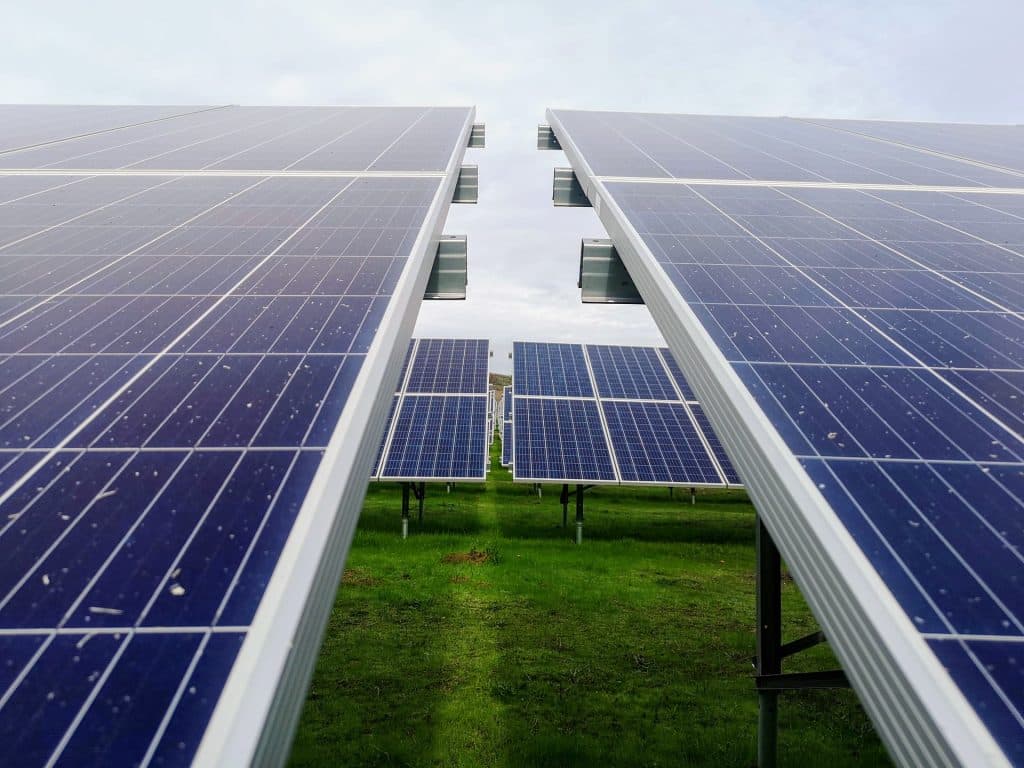
Solar power plant. Source: Pixabay

However, the ministry cancelled the energy-policy update at the last minute, allegedly because its publication triggered disputes between the government and trade unions representing the coal sector. These understandably fear that jobs linked to coal-based energy will be threatened as a result of a faster energy-sector transformation.

The government’s previous negative stance is gradually changing

The Polish government previously took a rather negative stance towards renewables. Poland was among the first countries to introduce the so-called 10H rule. This rule stipulates, in simplified terms, that a wind turbine must be located at least ten times its height away from the nearest dwelling. Depending on the turbine, this amounts to approximately 1.5 km.

As a result of the 10H rule, an estimated mere 0.26 % of Poland’s land area remained available for wind power development. This is unsurprising. The outcome has been the same in every country that introduced this rule: wind power development in the country effectively came to a halt. Even today, projects currently operating or at various stages of development in Poland generally obtained building permits before this controversial rule was introduced.

The government’s negative stance on renewables was also reflected in taxation. A seemingly inconspicuous change, such as an amendment to the legal definition of a “wind turbine”, became another obstacle to wind power development. Under the new definition, property tax was levied on the value of the entire wind turbine, rather than only on its structural elements as had been the case before the definition changed. Although legislation was later amended so that the tax returned to the level before the aforementioned change, it negatively affected many projects.

Větrné elektrárny v americkém státu Texas. Autor: Daxis @flickr
Wind turbines in the US state of Texas. Author: Daxis @flickr

The Czech state-controlled utility ČEZ also paid the price for Poland’s restrictive policy. It had several wind power projects under development in Poland, but due to policy measures, including changes in the tax burden, the Polish projects lost their appeal.

Times are changing – Poland needs renewables

However, as recent developments concerning Poland’s energy policy show, times are changing and even coal-heavy Poland intends to once again provide strong support for renewables. Although political pressure to preserve coal’s role persists for now, Poland too is heading towards a transformation of its sector and is looking for ways to further green its energy system.

And it has good reason to do so. Although Poland clearly ranks among the member states that are not especially concerned about meeting obligations arising from EU membership, higher renewable energy targets and greater emissions allowance costs are gradually forcing it to transform its energy sector.

How to ease the burden on grids? Sharing grid connections and simplifying construction of direct lines

This year has brought a range of legislative proposals intended to directly and indirectly support renewable energy development. The two main changes are an amendment to legislation on direct lines and the sharing of grid connection points, known as “cable pooling”.

Although these are not groundbreaking changes or entirely new forms of support, the renewable energy sector describes both as key changes that should facilitate renewable deployment while making only limited use of transmission and distribution grids. This is precisely the purpose of both measures:

  • a direct line is intended to ensure that electricity is supplied to a customer via a direct line without using the distribution grid; and
  • sharing a grid connection point is intended to ensure maximum use of grid capacity by locating several different generating sources at one connection point, which can partly complement each other, such as solar and wind power plants.
Elektrické vedení v Kalifornii
Power line in California. Source: Mayr / Creative Commons / CC-BY-2.0

The main obstacle to using both approaches was merely administrative: Polish legislation set barriers that prevented the effective use of either direct lines or shared grid connection points.

Direct lines were poorly regulated in Polish legislation for a long time and were therefore not used in practice. Indeed, reportedly no direct line had been built since 2005. The reason was that construction of every direct line required the consent of the Polish Energy Regulatory Office. This was granted only if an application for connection to the transmission or distribution grid had been rejected. Thus, although direct lines were permitted by legislation, practical barriers prevented their implementation. The advantages of direct lines for renewable energy development could therefore not be utilised.

Direct lines offer a number of advantages and can enable renewable energy development without burdening distribution and transmission grids, which often lack sufficient distribution or transmission capacity. This problem will likely worsen as the share of renewables in the grid grows, unless distribution and transmission grids are also developed at an adequately rapid pace. Supporting direct lines therefore enables renewable development without burdening grids, for the state, and for consumers also means, as a rule, no or lower regulated charges (see below).

In order to accelerate direct-line construction, the process for authorising their construction in Poland is being significantly simplified. Above all, the consent of the president of the Energy Regulatory Office is no longer required, nor is it necessary to demonstrate insufficient distribution or transmission capacity in the grid. Under the new rules, for projects with installed capacity below 2 MW, it is sufficient to notify the Energy Regulatory Office of the construction of a direct line.

Although electricity offtake via a direct line will not be subject to standard regulated charges for electricity transmission and distribution, customers should at least pay a solidarity contribution towards grid development.

Sharing grid connection points is another measure gradually finding its way into Polish legislation, intended to enable renewable development without placing an excessive burden on distribution and transmission grids. The principle of sharing grid connection points is relatively simple: several generating sources are connected under one connection point, requiring less connection capacity than if the sources were connected separately. The legislative amendment removing barriers to shared grid connection points has already taken effect, as of 1 October this year.

While this may seem an obvious measure, regulatory barriers meant that sharing a grid connection point among multiple generating sources was practically impossible in Poland. The renewable energy sector now welcomes it, as it may free up additional space for growth in renewable electricity generation.

This leads to optimised grid loading and more stable output supplied to the grid, thanks to the use of differing generation profiles of various types of renewable sources, such as solar and wind power plants. This hybrid system enables better use of existing grid connections, leading to greater utilisation of installed capacity and operational efficiency. Poland expects the introduction of shared grid connection points to partly circumvent the problem of insufficient available capacity for connecting renewable sources.

Relaxing the 10H rule

One of the main obstacles to onshore wind development is the 10H rule. Its introduction was criticised from the outset and, according to estimates, meant wind turbines could be built on only 0.28 % of Poland’s territory.

The rules are being relaxed after a full 7 years in force. Municipalities may now determine in their land-use plans the distance at which and locations where wind turbines can be built. Only a minimum threshold remains: 700 metres from the nearest residential or mixed-use residential buildings. Compared with the original rule, the minimum distance from dwellings is approximately half as large, assuming a wind turbine height of around 150m.

The new rule will expand the areas where wind turbines can be built by approximately sixteenfold. According to government estimates, around 4-5 % of Poland’s territory will be suitable for wind power development.

Industry associations had hoped for a shorter minimum distance from dwellings, with 500 m discussed in the first stage of the legislative process. Nevertheless, even with the 700 m minimum distance, space will be opened up for construction of up to 12 GW of installed capacity.

Faster permitting for nuclear, renewables, SMRs and LNG terminals

Permitting procedures for energy projects have been the main obstacle to their implementation in recent years. This is why European legislation has also focused on them: so-called projects of common interest were designated as early as 2013, and their permitting procedures were to receive the highest priority at member-state level. With greater pressure to develop renewable sources, permitting procedures were also separately addressed by the Renewable Energy Directive, known as RED II, whose permitting provisions were partially transposed in the Czech Republic through an amendment to the Energy Act known as Lex OZE I.

This year, Poland announced several legislative amendments intended to accelerate the energy-sector transformation. The amendments concern not only renewables, but also the construction of energy linear infrastructure, LNG terminals and small modular reactors.

In the area of renewables, this primarily involves implementation of the aforementioned RED II directive. In addition to easing permitting procedures for smaller renewable projects, a dedicated renewable energy office is to be introduced, serving as a one-stop shop for permitting renewable projects (Krajowy Punkt Kontaktowy OZE). Under RED II, each state should establish one competent authority to facilitate the entire process and make it easier for applicants.

Another planned simplification is legislation streamlining permitting procedures for nuclear projects and LNG terminals. For such developments, the environmental impact assessment is often the longest part of the process. The amendment being discussed by the Polish parliament specifically aims to shorten it.

For example, nuclear projects will be able to obtain an exemption from the standard environmental impact assessment process. The Polish government must decide on the exemption, which will be granted only to projects where circumstances justify the need for immediate implementation of the investment. Projects granted an exemption will be required to undergo a simplified procedure, in which opportunities for environmental associations to participate actively will also be limited.

Poland to establish a ministry for energy transformation

As part of its election pledges, the current government promised that, if re-elected, it would establish a ministry for energy transformation. Although the Polish government is apparently aiming primarily to score political points, this indicates that energy transformation is moving to the forefront of attention.

A similar ministry has already existed. The Ministry of Energy was first established in 2015, when the governing Law and Justice party came to power. Following the 2019 election, the responsibilities of the Ministry of Energy were taken over by the ministry responsible for state assets, regarding oversight of energy and mining companies, and the Ministry of Climate and Environment, regarding energy policy.

Election battle for voters or genuine transformation?

Recent developments in Poland may therefore give the renewable energy sector cause for cautious optimism. Although a number of the measures outlined above have not yet been approved, it is evident that energy transformation is moving to the forefront in the Czech Republic’s northern neighbour.

Whether this is merely an election-driven effort to win voters or the beginning of a change in Poland’s approach to energy will only become clear after the October election.

Translation disclaimer

This article is a machine translation of the Czech original and has not yet been fully reviewed. In case of any doubt, please refer to the Czech version.