4 November 2026, 14:17
Loading...
Europe now has 36 LNG terminals in operation; Czechia uses the Dutch Eemshaven terminal

oEnergetice.cz, ČTK
23 November 2023, 11:26
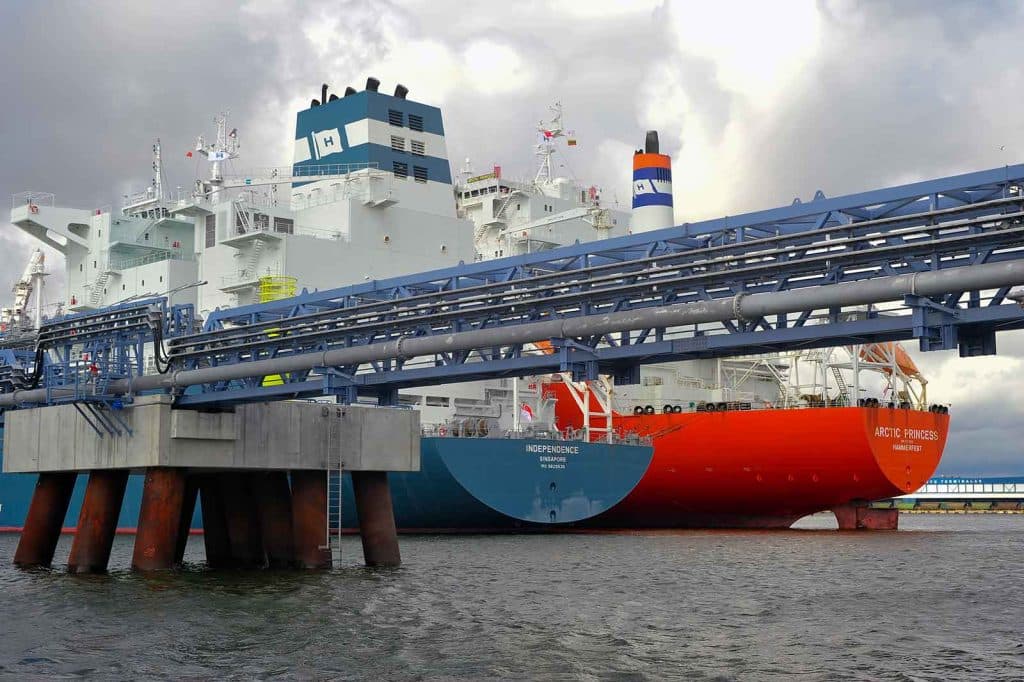
Selected data on liquefied natural gas (LNG) terminals in the Czech Republic and Europe (Czechia has secured capacity at an LNG import terminal under construction in Germany):
– Like many other European countries, the Czech Republic is now seeking to diversify its natural gas supplies. Before Russia’s invasion of Ukraine last year, the country imported gas exclusively from Russia. In the middle of the year, Minister of Industry and Trade Jozef Síkela (STAN) said that the Czech Republic had not used any Russian gas in the first half of this year. Russian gas supplies have been replaced by supplies from Norway and liquefied natural gas (LNG) from Belgium and the Netherlands.
– Last year, the partly state-owned energy company ČEZ secured gas supplies through 2027 at the LNG terminal in Eemshaven in the Netherlands, which began operations in mid-September 2022. At the time, it was the first liquefied natural gas terminal to open in Europe since the start of the war in Ukraine. After the Eemshaven terminal opened, other LNG terminals also began operating in Brunsbüttel, Lubmin and Wilhelmshaven in Germany.
– The facility in the Netherlands can process up to eight billion cubic meters of gas a year, of which up to three billion are allocated to the Czech Republic, equivalent to about a third of the country’s annual consumption. The Czech Republic, or rather ČEZ, has leased capacity at the terminal through 2027. In addition to ČEZ, the multinational companies Shell and Engie also use the terminal’s capacity.
– ČEZ recently reported that the Eemshaven terminal handled 21 ships for the Czech Republic during its first year of operation. They carried around two billion cubic meters of gas, equivalent to roughly 27 percent of last year’s domestic consumption. „Most of the ships arrive from the US, from terminals in Louisiana and Texas. We are gradually expanding our supplier list, however, so ships have also arrived from South America and Africa. We expect nine more ships to arrive by the end of the year,“ said ČEZ Chief Executive Daniel Beneš.
– In the middle of this month, ČEZ postponed its plan to secure capacity at a new Polish liquefied natural gas terminal because it was not satisfied with the terms on offer. Reuters reported this, citing two sources familiar with the matter. ČEZ spokesman Ladislav Kříž told the Czech News Agency that the company would not comment on the information for now.
– The Czech Republic has now secured capacity, in cooperation with the ČEZ energy group, at the Stade onshore terminal under construction near Hamburg. From 2027, it will have access to two billion cubic meters of gas a year there, more than a quarter of current domestic consumption. The company has signed a 15-year contract with the operator, with an option to extend it.
– The most attractive and accessible terminal for the Czech Republic was previously the one on the Croatian island of Krk, from which a Czech subsidiary of Slovak energy group SPP made its first small delivery in early May last year. Poland has built an LNG terminal in Świnoujście on the Baltic coast near the Polish-German border. The planned Stork II gas pipeline was intended to connect the storage facilities in Świnoujście and on the island of Krk; the project is now being revived.
– Prime Minister Petr Fiala (ODS) said in July this year that the 2026 commissioning deadline still stood. „There is another aspect to this. If we could build this pipeline, it would also enable us to secure capacity at Polish LNG terminals. That would, in turn, improve the overall energy security of Central Europe,“ Fiala added. The first section – the Stork I gas pipeline – was commissioned in 2011, but allowed gas to flow only from the Czech Republic to Poland.
– According to the Institute for Energy Economics and Financial Analysis (IEEFA), 36 LNG terminals are currently operating in Europe, with another 17 under construction or in the planning stages. Spain and the UK have the most. LNG infrastructure is expanding rapidly in Germany, where state-commissioned terminals are now operating in Wilhelmshaven in Lower Saxony and Brunsbüttel in Schleswig-Holstein. A purely commercial terminal has also been built in Lubmin, Mecklenburg-Western Pomerania. A state-funded LNG terminal near the island of Rügen in the Baltic Sea is expected to begin operations early next year.
– According to IEEFA, Europe’s LNG import capacity will increase by around 50 percent this decade. Some scenarios suggest, however, that European demand for LNG will not rise, or may even decline. While Europe needs new terminals to meet current LNG demand, there are concerns about insufficient demand over the longer term. One scenario from the International Energy Agency (IEA) suggests that EU gas consumption could fall by as much as 45 percent by 2030 as the transition to renewable energy sources advances.
Translation disclaimer
This article is a machine translation of the Czech original and has not yet been fully reviewed. In case of any doubt, please refer to the Czech version.
Sdílejte článek prostřednictvím:
You might also like

4 November 2026, 12:34

4 November 2026, 09:09