Czech PPA market is only just getting started. Price and contract length are key, says Enery's Jan Srna


Enery has been much talked about in the Czech Republic recently. It recently launched the unique 37 MWp Stella power plant in Dynín and also secured a new project—a 27 MWp solar power plant with a 20-year PPA already signed with an industrial customer. We spoke with Jan Srna, who helps connect Enery with buyers interested in electricity from renewable sources through PPAs, about the current state of large solar parks, their bankability, and where he currently sees the greatest potential for renewables in the Czech Republic.
The construction of large solar parks in the Czech Republic is progressing significantly more slowly than in many neighbouring countries. While new power plants with capacities of tens to hundreds of megawatts are being built in Germany, Poland and Romania, similar projects have been more of an exception in Czechia in recent years. Enery is one of the companies that has nevertheless managed to deliver large solar parks. It recently commissioned the Stella power plant in South Bohemia and is preparing to build another project with a capacity of 27 MWp.
The two projects share another important characteristic. Unlike most large solar power plants built in Czechia in the past, they do not rely on operating support. Their economics are based on long-term power purchase agreements (PPAs) with industrial customers. But this market, too, is only just getting started in Czechia, and large corporate PPA contracts remain relatively rare.
How difficult is it today to find an industrial customer willing to commit to buying electricity for decades? What prices are long-term contracts being signed at, and what determines whether they make economic sense? In the interview, we also discuss why solar panels that track the sun can generate up to a fifth more electricity, how generators are dealing with increasingly frequent negative prices, and why the future of PPAs lies in combining photovoltaics, batteries and other sources.
ENERY has recently completed or prepared two major projects in Czechia. Could you tell us about them?
The first is a power plant we call Stella, in Dynín in South Bohemia. It has a capacity of 37 MWp. What is interesting about it is that we already have a buyer for most of its electricity: an industrial company operating in the Czech Republic. A technical feature is that it uses a tracker system, with single-axis trackers. We see a technical advantage in this technology, although it is not widely used in the Czech Republic.
The second project combines a solar power plant with an installed capacity of 27 MWp and a battery storage facility. It is more complex because, once again, a long-term PPA has been signed with an industrial company.
So the Stella solar power plant is already generating electricity. What stage has the second project reached?
Yes, Stella is complete and already generating electricity. It has passed all the final steps and is connected to the distribution grid. The 27 MWp power plant, meanwhile, has a valid building permit and construction will start soon, with completion planned for next year.
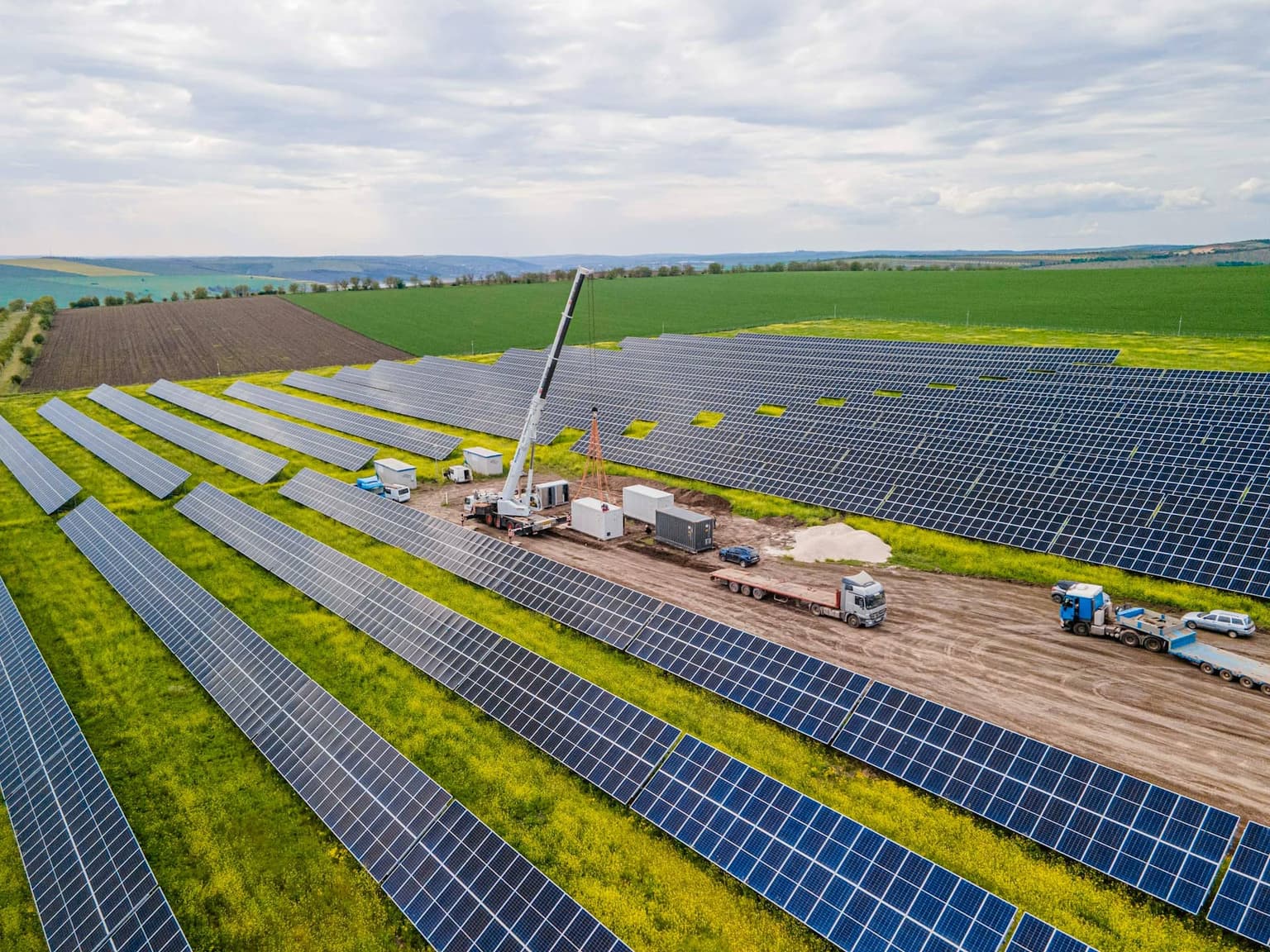
We plan to complete the second project in the second half of next year. The process of contracting the electricity supply is now under way.
At Stella, you use bifacial panels and single-axis trackers. How much can they increase generation?
The choice of bifacial panels reflects technological advances in photovoltaic modules. We assume that competitors and other companies in the sector are using them too. A bifacial panel adds somewhere between 5 and 10% compared with the older standard type. A tracker system—that is, single-axis trackers that use a sensor to turn the panel to follow the sun—should increase generation by somewhere between 12 and 20%. It depends on how the power plant is designed and how large the site is.
But it also changes the distribution of generation throughout the day, not just the amount of electricity produced, right?
I mentioned the absolute figures. If I had 10 MW facing south and 10 MW on trackers, the trackers would generate roughly 15% more in absolute terms. But the generation curve is different, too. Because the panels follow the sun, they start generating earlier. They do not reach as high an absolute peak as south-facing panels, but they can generate for longer, so the value of their generation profile is better.
Are trackers also economically worthwhile, especially given the variation in electricity prices from hour to hour?
It is complicated, because each power plant has to be designed optimally. Trackers involve higher upfront costs, or CAPEX. On the other hand, they provide a better—or more valuable—generation curve as well as higher overall generation. It is always a matter of comparing these factors, and there are also some finer points that need to be accounted for in the models. That is why each power plant is designed individually, and you cannot automatically say that trackers are suitable everywhere. Because the tracker system turns, it requires a larger site, so it is not suitable for every location.
People have long said that the long-term PPA market in Czechia is developing only slowly. Price and contract length have often been the problem. How do you see things today?
You have put your finger on it: price and contract length are probably the two biggest obstacles that need to be overcome when making a decision. The Czech PPA market is still in its infancy; it is an underdeveloped market. There are some projects here, but the on-site PPA market is more developed, where the source is connected directly to an industrial company’s consumption point. Those PPAs have longer terms but are smaller in scale. The situation could certainly be better. It is not that the Czech PPA market does not exist at all—these contracts are being signed—but we see that agreeing on the contract length may be an even bigger challenge.
What would help overcome companies’ reluctance to sign long-term contracts?
It is certainly a matter of raising awareness and emphasising that PPAs give companies stability. Both the energy and industrial sectors are dealing with a lack of stability, and PPAs provide it for customers. They give companies certainty about the price they will pay for a share of their energy, one of their biggest cost items. And then you do not have to worry so much about what is happening in geopolitics. You have a product you can rely on.
What are PPA prices like? Can you give at least a rough idea of the levels at which contracts are being signed?
They vary considerably. A PPA is like a car: you can get one for 400 thousand or one for 4 million, depending on the features you choose. In general, though, we believe that the electricity price in longer-term contracts is more favourable than buying at standard exchange prices—that is, buying on the wholesale market—regardless of whether the plant uses trackers or another technology, such as south-facing panels. We see added value in the fact that the electricity is emissions-free and comes from a new source, and that we are helping move towards the goals we have committed to as a society. But the PPA must always make economic sense for the customer too; otherwise, it cannot work in the long term.
What is the main motivation for industrial customers: price, certainty, or meeting ESG targets?
I would say stability—that is, having a long-term view of prices. It has to make economic sense, and there is also the added ESG value: the project is newly built and helps the customer meet certain targets. But today, the primary considerations are economics and price stability.
Solar power does not have an even generation profile. What kinds of supply do you therefore offer customers?
Across Europe, ENERY offers PPAs ranging from basic pay-as-nominated contracts, where we essentially guarantee that we will deliver whatever we generate. That is a pure solar profile. It can also be combined with battery storage, allowing us to deliver a pre-defined, adjusted solar profile. At the other end is green baseload, which we offer, for example, in Bulgaria, where it combines with wind sources that, unfortunately, are lacking in the Czech Republic. There we can supply industry with a green PPA—a combination of wind, solar and battery storage—as a baseload supply.

This can be attractive for industrial companies: buying a “baseload” rather than a peak profile is an advantage for them. It depends on the customer. Some need a solar profile, perhaps for technological reasons; others say they would like a PPA but need a different type of supply.
The number of hours with negative electricity prices is increasing. How does that affect PPA terms?
It depends on the customer and the specific PPA. Some prefer a long-term fixed price and do not worry about negative prices—the electricity is delivered even when prices are negative. Some have a price cap, while others strictly exclude settlement during periods of negative prices. Adding battery storage makes things even more complex. As generators, we are obviously not keen on negative prices. It is probably not optimal for industrial customers in the long term either—in a market economy, it does not make sense to produce anything at negative prices.
Do you expect the development of batteries to gradually eliminate negative prices?
They probably will not disappear completely. There can always be periods—typically a weekend or Easter—when it is exceptionally sunny and windy and negative prices emerge. In the long term, though, as battery storage develops, it does not make sense for prices to reach extreme levels. There may be periods when prices do turn negative, but the expansion of batteries should mostly bring negative prices back towards zero and gradually limit them.
Is interest in PPAs growing, and are customer requirements changing?
I would say the market is now more familiar with these contracts, and the awareness-raising work we are doing is bearing fruit. Clients are not surprised by them; they already have a basic understanding. Some even have dedicated teams of professionals who deal exclusively with PPAs for their companies. Hybrid PPAs are a growing trend—combinations of photovoltaics and battery storage, or photovoltaics and other sources. This is a growing trend in terms of the supply profile we can then guarantee. The market is moving towards more complex solutions that require a trader or aggregator. It is no longer just about building a solar power plant and starting to generate electricity.
Translation disclaimer
This article is a machine translation of the Czech original and has not yet been fully reviewed. In case of any doubt, please refer to the Czech version.