
28 October 2026, 15:10
Loading...
The LNG market remains dependent on long-term contracts at the expense of spot trading

Lukáš Lepič
2 May 2024, 14:24
According to a report issued by the Agency for the Cooperation of Energy Regulators, despite popular belief, European and global LNG markets remain dependent on long-term contracts. Short-term and spot trading has stabilised at around 35% of global trade. Traders have also moved away in recent years from pricing contracts against European gas hubs because of high volatility and extreme price swings.
As a result of the energy crisis in recent years, demand for liquefied natural gas (LNG) on the European market has soared. In 2023, EU member states imported 134 billion cubic metres (bcm) of LNG, representing 42% of total gas imports into the EU. This has also been reflected in infrastructure development. Thanks to investment, the EU’s LNG import capacity increased by 40 billion cubic metres per year in 2023, and further capacity development is expected this year.
As LNG imports to Europe grew at the expense of pipeline gas imports, discussion also began about a potential increase in short-term and spot contracts for natural gas. Historically, a significant share of natural gas volumes in Europe was traded through long-term bilateral contracts.
However, according to a report issued in April by the Agency for the Cooperation of Energy Regulators (ACER), despite popular belief, the European Union’s LNG import market remains more dependent on long-term contracts than spot purchases. Based on trades reported to ACER as part of ACER's LNG Price Assessment, spot and short-term trades involving LNG deliveries in Europe totalled 47 bcm in 2023.
The volume of spot and short-term contracts has even declined slightly since 2020, when it reached its peak. Annual traded volumes have meanwhile stabilised just below 200 bcm, around 35% of global LNG trade.
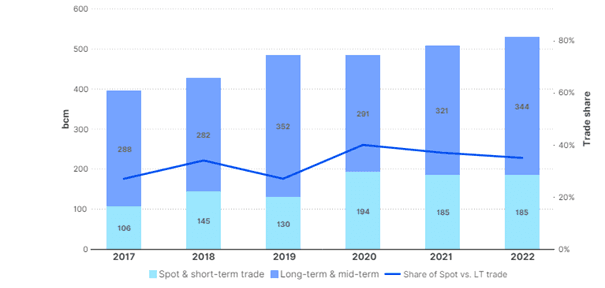
Historical trends in the share of short-term and long-term contracts in global LNG trade (bcm). Source: ACER
High volatility may be making European trading hubs less attractive for pricing
The large volumes covered by long-term contracts indicate that, following recent months, buyers tend to avoid growing dependence on the more volatile spot market. According to ACER, high price volatility on the European market and unprecedented price spikes during 2022 may also be among the reasons for different strategies in setting contract prices and for the reduced attractiveness of European trading hubs for indexation.
The US Henry Hub and Brent oil indices continue to dominate globally when it comes to pricing long-term contracts. By contrast, the use of TTF and other European gas hubs has fallen significantly, although they remain the predominant pricing reference for EU spot contracts (64%).
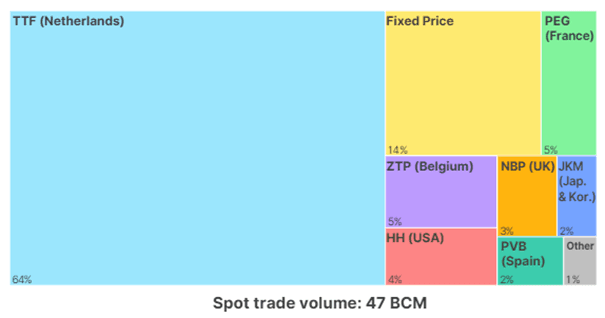
Breakdown of pricing references/indexation for spot and short-term trading in Europe in 2023. Source: ACER
According to a report published in January by S&P Global, volatility in recent years has also made it increasingly uneconomic for market participants to price their LNG contracts solely on the basis of an oil index. The report also suggests that the extent to which pricing is shifting from oil indexation to natural gas prices varies from region to region.
Translation disclaimer
This article is a machine translation of the Czech original and has not yet been fully reviewed. In case of any doubt, please refer to the Czech version.
Sdílejte článek prostřednictvím:
You might also like

28 October 2026, 13:08

28 October 2026, 11:10

28 October 2026, 09:08
