Nuclear financing: Opportunity or desperation?
Many veterans of the nuclear energy sector must have shaken their heads in disbelief at the announcement. The historically perhaps most famous supplier of reactors, fuel and related services – US company Westinghouse – is to be acquired by investment company Brookfield Business Partners. In other words, not a strategic investor from the sector, but a financial predator focused on “distressed assets” – prey that currently looks unattractive, but in which the investor still sees future potential. Clearly unlike those potential strategic partners.
The question, of course, is what the predator will actually do with its prey in order to make a profit from it. People in the sector may ultimately like that – or they may not like it at all.
It is now becoming clear that Westinghouse (and its current owner, Japan’s Toshiba) is far from the only company in the sector seeking to attract investment funds. Financial investors could also invest in new nuclear power plant construction projects. And such expectations are coming from a country whose nuclear energy history is no less illustrious than that of the United States.
That country is France, which paradoxically has always relied on a strong role for the state in this sector. The new innovative ideas are coming from senior managers at Électricité de France (EDF), a state-controlled company. The involvement of financial investors is expected to concern its Sizewell C power plant project in eastern England.
In any case, this is a debate that Czech politicians should follow closely. While they have long declared support for building new units at Dukovany and Temelín across the political spectrum, their rhetoric runs up against the reality of unclear financing.
EDF’s “new broom”
What exactly is the new “idea” from EDF? It was put forward by Italian manager Simone Rossi, who took over as head of EDF in the UK last year. The British market is crucial for the French company – especially after EDF took over Areva’s reactor business under the revived Framatome name. It thus also took over the projects for sophisticated Generation III+ EPR reactors, which have so far failed to meet expectations – their construction has been significantly delayed and has become more expensive.
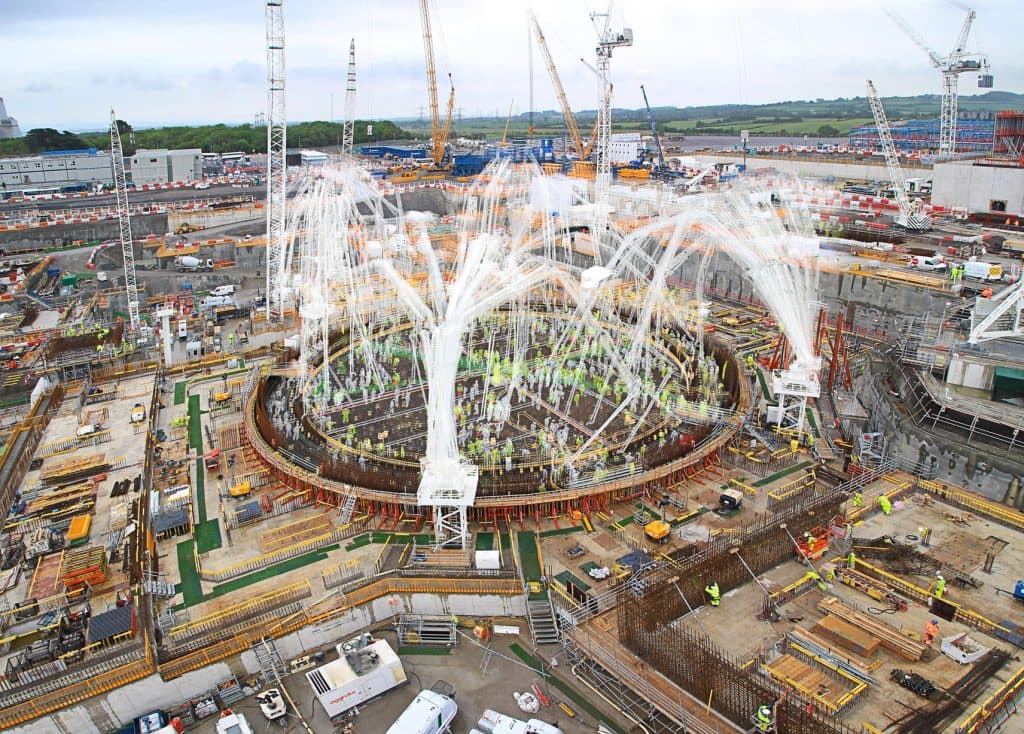
So far, the French have built four EPR reactors – two in China, one in France and one in Finland. They are preparing another in the UK, and the aim now is for these projects to be substantially more successful than the previous ones. The fifth and sixth EPR reactors are to be built at the UK’s Hinkley Point C plant, and this project is already as controversial as those at France’s Flamanville and Finland’s Olkiluoto. Despite still being at a very early stage of construction… Many Britons are convinced it is too expensive (it will cost nearly £20 billion) and is not economically worthwhile for the United Kingdom.
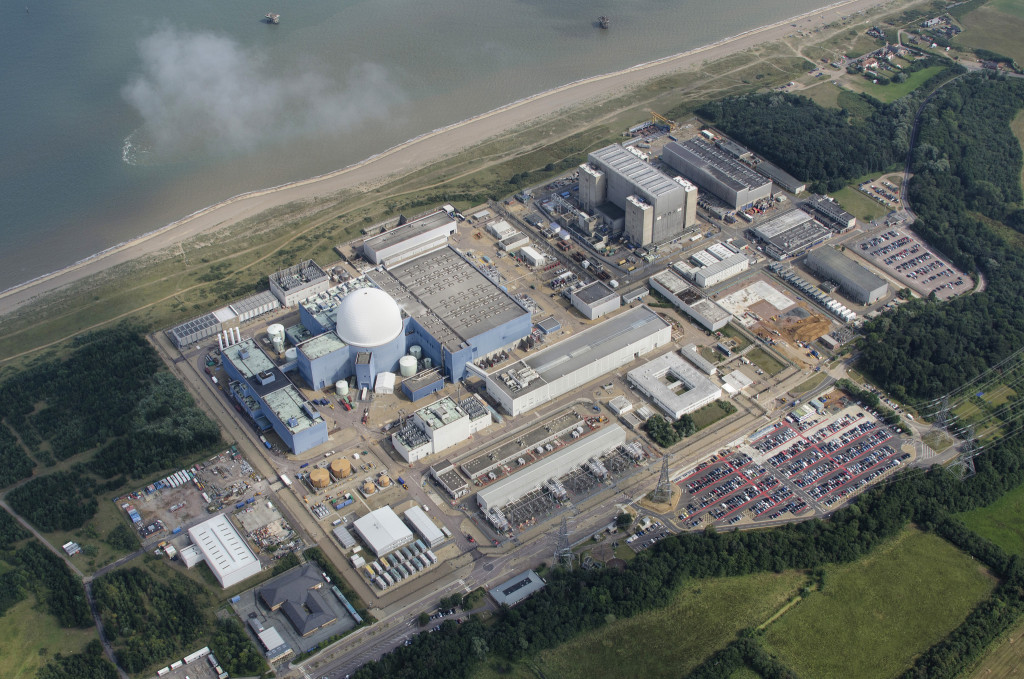
The key “iron in the fire” is now the aforementioned Sizewell C plant, where the French are to build the seventh and eighth EPR units. Simone Rossi says this plant could be much cheaper than the criticised Hinkley Point C. There are several reasons for this. Experience from Hinkley Point C can be used, approval-process costs will be lower for the second project on the British Isles, and better opportunities for connection to the transmission system also favour Sizewell C.
A new financing model
However, EDF’s chief executive in the UK also says that a “new financing model” will contribute to the lower price. He means precisely the involvement of financial investors, with whom he is reportedly already negotiating the sale of a stake in the Sizewell C project. The logic appears to be as follows: rather than the expensive loans taken out by EDF in the case of Hinkley Point C, the new investors will use their “spare cash”. Behind this may be the assumption that, following the end of the most recent economic crisis, there is a relatively large amount of spare capital in the world seeking investment opportunities.
In the case of Hinkley Point C, the British government had to guarantee the French company – which is also investing in the project jointly with Chinese company CGN – an electricity price from the future new units of more than £90 per megawatt-hour. The fact remains, however, that the “cost of money” – namely the aforementioned expensive loans – has a major impact here.
For example, advocates of building nuclear power plants in Central Europe have long argued that if the state or an entity it controls borrows for construction, financing will be much cheaper. This applies to the project for new units at Hungary’s Paks power plant and could also apply to Dukovany or Temelín. This is why Prague has, for example, considered the possibility that the state could fully take over ČEZ’s subsidiaries set up to build new nuclear units at both sites.
No predators?
But back to the Sizewell C project. There, the solution is not supposed to be state investment, but the involvement of financial investors. In this case, these could most likely include infrastructure investors such as the aforementioned Brookfield Business Partners. (This Canada-based investment group is the world’s second-largest infrastructure investor, investing in ports, railways and gas pipelines.)
According to available information, however, the French are placing considerable hopes on pension funds in the case of Sizewell C. In this case, the comparison with “financial predators” is no longer very appropriate. These are investors seeking to place their money in stable assets for the long term. But it is highly questionable whether they will include nuclear power plant construction among these assets – a type of project whose economic viability is subject to enormous doubts in today’s world. (Another matter is that many states still regard their construction as the best solution when all factors are taken into account – energy needs, energy security and economics, particularly over a longer time horizon.)
Investors may nevertheless see certainty in the UK’s guaranteed-price system – the so-called Contract for Difference. Even so, Simone Rossi’s new idea can be interpreted in two ways. On the one hand, there may indeed be a chance that other private investors could also be involved in financing nuclear power plants; on the other, it may be a sign of desperation, with the “drowning” party clutching at any straw after the highly problematic EPR reactor construction projects to date. Or perhaps EDF is simply floating trial balloons. In any event, there are still 3-5 years before a final decision on Sizewell C.
A forced step
Either way, it cannot be denied that EDF’s search for a “new financing model” is clearly a forced step. British auditors from the country’s National Audit Office (NAO) concluded last year that, in the construction of the new Hinkley Point units, London’s Department for Business, Energy and Industrial Strategy had not acted properly. It concluded an agreement with EDF without sufficiently considering all costs and risks. Given the guaranteed electricity price, the ministry reportedly exposed British consumers, who will ultimately have to pay the costs, to considerable uncertainty.
All this does not mean that the approach taken under the Hinkley Point C project may not ultimately prove to be the right one. But according to the NAO’s verdict, the ministry did not do everything it could to maximise the likelihood that this would indeed be the case. The British auditors specifically called for other financing models to be sought for future projects.
Hitachi takes a different path
Not everyone has taken up this challenge in the same way. While EDF in the UK is floating trial balloons to financial investors, Japanese company Hitachi, which is to build the Wylfa nuclear power plant in Wales, has chosen a completely different approach to overall financing. Here, a deal between the governments in London and Tokyo for the greatest possible involvement of the public sector is instead taking shape – whether in the form of loans and insurance from export agencies or development banks, or even equity stakes in the project. It appears that London is willing in this respect to embrace “new models” it had previously avoided.
The involvement of the public sector in advanced market economies may surprise some, but it has a clear logic. Economically advanced countries may lose out to competitors such as China, which everyone expects to continue strongly supporting its energy companies from public funds. On the other hand, nothing is certain in today’s world, and public resources are not bottomless either.
Rosatom chief Alexey Likhachev, for example, says that the corporation – now the world leader in building nuclear power plants in foreign markets – will no longer be able to count on the same state support in the next decade. It is not entirely clear what he means. For example, under the project for new units at Hungary’s Paks nuclear power plant, which Rosatom itself will build, Russia is prepared to provide Hungary with an intergovernmental loan. Can similar willingness from the Russian government therefore be expected in future projects?
The article’s author is a consultant and energy-project specialist at HATcom agency.
Lead photo: EDF’s Fessenheim nuclear power plant in France. Source: EDF
Translation disclaimer
This article is a machine translation of the Czech original and has not yet been fully reviewed. In case of any doubt, please refer to the Czech version.