Nuclear fusion still faces a thorny path, but it has already created a new sector of the economy
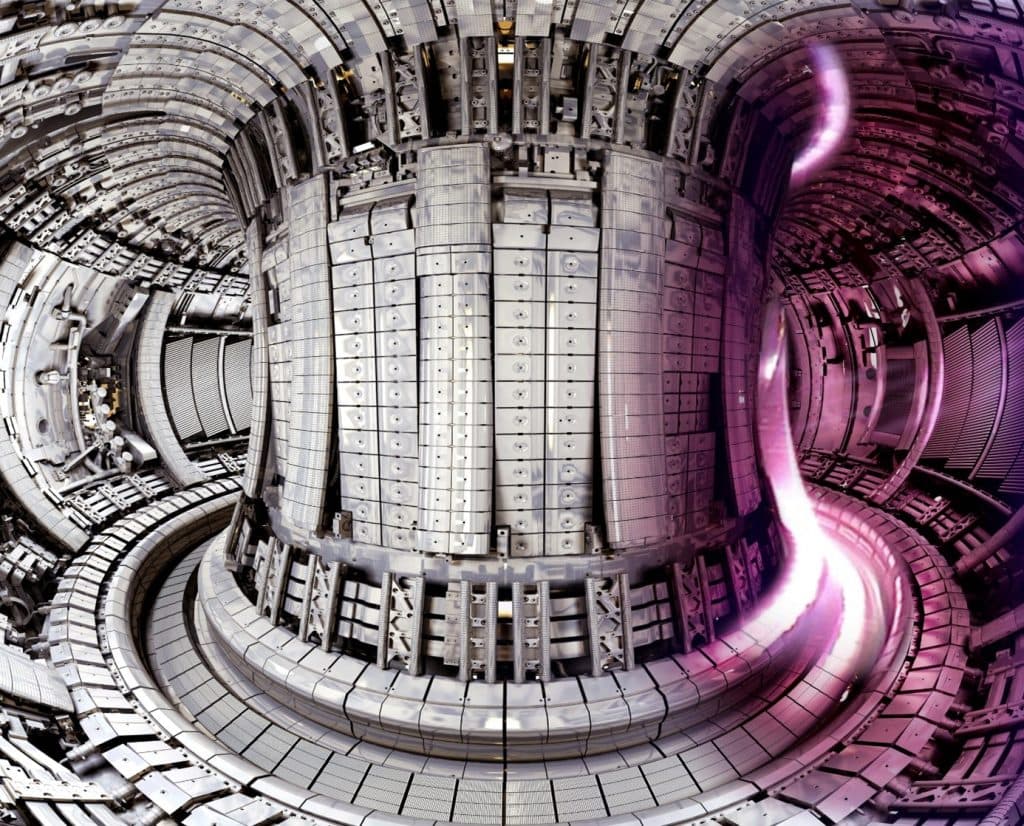
Nuclear fusion, which could one day become a virtually unlimited source of energy, has begun to rank among the most promising technologies of the future in the eyes of economic visionaries. Experiments in recent years have confirmed that fusion can enable people to produce more energy than is needed to initiate it. Large-scale use of this new stable and clean source is still a long way off, but its development is already attracting money from private investors, future major consumers and suppliers of components for fusion reactors. A new sector of the economy has been born.
Unlike conventional nuclear power, fusion relies not on splitting atoms but on combining the atomic nuclei of light elements (primarily the hydrogen isotopes deuterium and tritium). Unlike existing nuclear power plants, generating energy from nuclear fusion will not require spent fuel to be stored underground for hundreds of thousands of years. Research in this field also has a strong tradition in Czechia. Czech scientists have in the past contributed to findings that enable fusion in a tokamak – the traditional type of fusion reactor.
In the coming years, Czech companies will need to seize the new opportunities in the fusion sector as well. Examples already exist. Ateko, a company from Hradec Králové that originally emerged from an institute of food-processing and refrigeration technology, has become a major supplier of key equipment – helium turbocirculators – for the ITER international thermonuclear reactor project under construction in Cadarache, France.
WHAT DO CHANCELLOR MERZ AND TRUMP JR. HAVE IN COMMON?
Among the figures embracing the vision of nuclear fusion are German Chancellor Friedrich Merz, the US president's son, Chinese government officials, renowned economist Nouriel Roubini, and managers and investors at leading US technology companies such as Google and Microsoft.
Donald Trump Jr.'s name was frequently mentioned around the turn of last year after Trump Media & Technology Group, which among other things is behind the US president's Truth Social network, announced a merger with California-based TAE Technologies. The aim is to create one of the world's largest publicly traded companies in the nuclear fusion sector. Google has backed development at TAE Technologies, which unusually relies on boron in addition to hydrogen. The president's son will also sit on the new company's board. This suggests that, much like the development of artificial intelligence, the commercialisation of thermonuclear fusion will have influential supporters in Washington under the Trump administration.
GERMANY'S NUCLEAR FACE
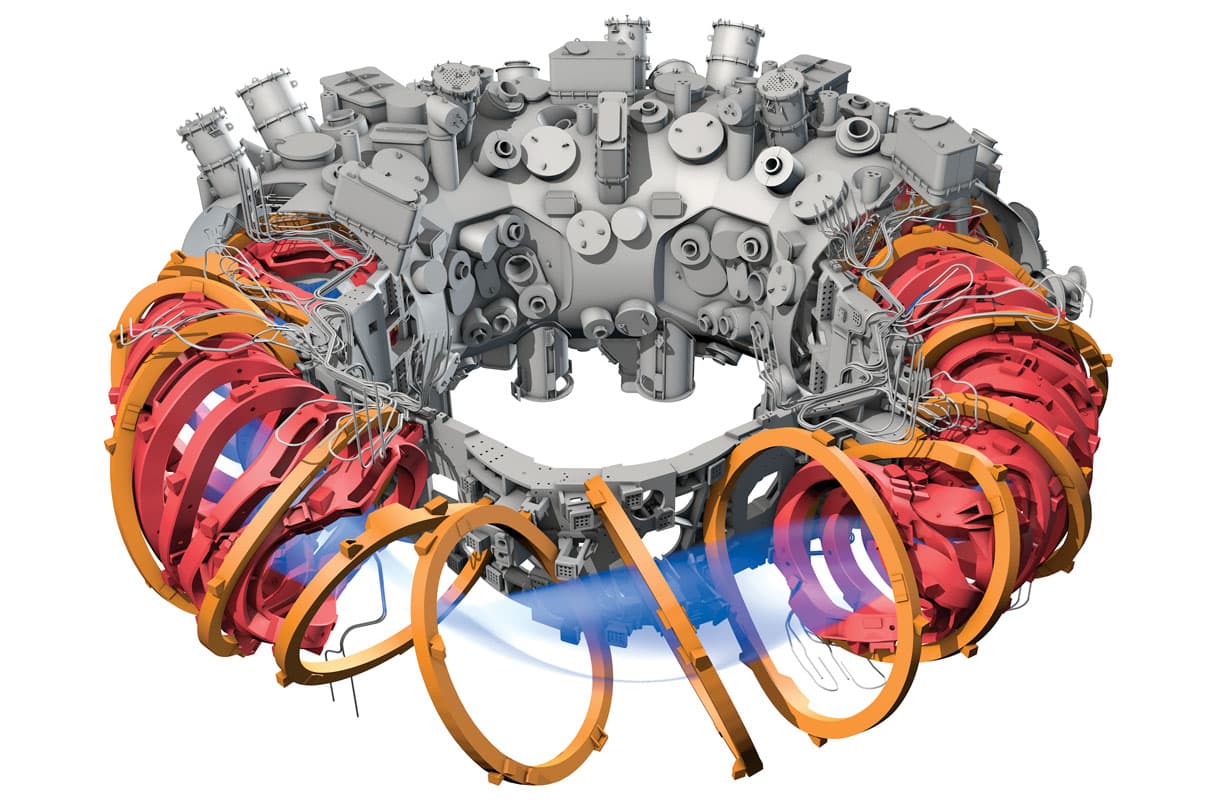
Last year, Chancellor Friedrich Merz turned his attention to fusion in a country where the word “nuclear” was in the past met by many with deep suspicion or outright opposition. Merz not only criticised Germany's exit from conventional nuclear power, but also described nuclear fusion as one of the key technologies deserving strong support from Berlin. German economists will probably still debate whether fusion is the right answer to kick-starting the country's economy, but the fact remains that the Federal Republic is by no means lagging behind in fusion research. Germany's Wendelstein 7-X stellarator (a different type of fusion reactor from a tokamak) is renowned. As in the United States, fusion start-ups are also emerging in Germany that want to accelerate the commercialisation of this promising technology.
From a Czech perspective, it is important that many domestic scientists can also point to cooperation with their German colleagues. Within the EUROfusion consortium, which among other things is building the aforementioned ITER international tokamak, Germany's Max Planck Institute for Plasma Physics works with the Czech Academy of Sciences' Institute of Plasma Physics and the Research Centre Řež. Czechia is attractive to foreign partners, including Germans and Americans, thanks to the newly built fusion experimental facility – the Compass-U tokamak in Prague's Libeň district. One of this tokamak's advantages is expected to be that, in many respects, its technical parameters will resemble those of the larger ITER. Like the construction project in France, however, the Czech project has also suffered significant delays.
A VOICE FOR FUSION FROM “DR. DOOM”
Nearly two decades ago, US economist Nouriel Roubini earned the nickname “Dr. Doom” after predicting the last major financial crisis. Last year, a different moniker emerged – “Dr. Boom” – as his warnings of recession gave way to expectations of an investment boom in the United States. Despite Donald Trump's policies, which are instead weakening the prospects of such a boom.
Alongside artificial intelligence, Roubini believes an energy revolution is set to drive investment. The economist considers a technological breakthrough in nuclear fusion to be crucial. And it must be said that virtually every word Roubini utters is followed not only by all of Wall Street, but also by financiers in other parts of the world. US Big Tech, often in partnership with major energy companies, plays a key role in supporting fusion. It anticipates rising electricity demand from artificial intelligence and data centres. The aforementioned TAE Technologies has been backed by Google alongside oil giant Chevron and financiers from Goldman Sachs.
This is not only about economic ambitions. In the United States, there is also thinking about the global technological contest and geopolitics. Whoever is first to generate energy from fusion will gain an enormous advantage. The ambitions of global powers are also illustrated by the list of ITER project partners: in addition to the European Union, the US, Japan, South Korea and India, they include China and Russia, which was not excluded even by international sanctions imposed during its aggression against Ukraine. All these countries have their own projects as well, and China in particular raises concerns, having already pulled ahead of its competitors in various technologies. China's EAST tokamak can boast a number of successes, while Beijing also has high hopes for the further fusion reactor under construction, BEST.
THE GREATEST PROMISE THE WORLD HAS EVER SEEN?
Major US technology companies have decided to support fusion power development in a highly innovative way that has left many observers shaking their heads in bewilderment. At a time when it remains unclear how long it will take before the new technology can generate electricity on a large scale, and which reactor concept will ultimately prevail among competing designs, companies such as Microsoft and Google have begun signing agreements to purchase future fusion energy. US Big Tech has also entered into similar contracts in conventional nuclear power – with developers of small modular reactors, which visionaries regard as another promising technology.
Microsoft signed the first agreement to purchase nuclear fusion power in 2023 with Helion Energy, which has already begun construction of the first fusion power plant, Orion, in Washington state. It intends to move from experimental reactors to a facility that will actually generate energy. Helion currently plans to supply electricity to the grid as early as 2028. Google, meanwhile, has signed an agreement with another US company, Commonwealth Fusion Systems (CFS), whose power plant is expected to come online in the early 2030s.
According to Slavomír Entler of Prague's Institute of Plasma Physics, CFS and Germany's Proxima Fusion are among the most outstanding companies in the field. As Entler noted in an article for the Vedavyzkum.cz website, US-based CFS was established as a spin-off from the renowned Massachusetts Institute of Technology, while Proxima emerged as a spin-off from the Max Planck Institute for Plasma Physics.
Slavomír Entler also warns against physically unfeasible visions in which the authors' persuasiveness plays the leading role. In his view, an extreme example is precisely the contracts for the sale of future electricity generated by nuclear fusion, and in this context he specifically mentions the Microsoft-Helion agreement. Big Tech therefore appears to be creating excessive expectations, although on the other hand it probably does not place too much reliance on its partners actually meeting their timelines.
A SLOW EUROPE?
A different perspective on “American methods” was offered by researcher Anda Bologa of the Centre for European Policy Analysis (CEPA), who contributes to its Tech Policy Program. She describes the European approach as overly cautious – if the EU does not launch its first demonstration power plant until sometime in the 2040s, as had appeared likely so far, electricity from fusion sources will reach the grid much later still. According to the researcher, this timetable made sense when fusion was regarded as a long-term research project. But it makes little sense at a time when industry is pressing ahead and targeting major projects in the next decade.
According to optimists, the involvement of private companies could help expand applied research and development, speeding up power plant construction. Yet whether the rapid path to fusion electricity is based on realistic scenarios or merely dreams, it is certain that Europe faces a substantial handicap compared with the United States. US investors, including entrepreneurs such as Bill Gates, Big Tech and various venture capitalists, have long been willing to invest in projects that are a long-term endeavour. This is why America leads in artificial intelligence, the semiconductor industry and biotechnology. Europe struggles with an underdeveloped capital market and a strong aversion to risk. Brussels is trying to address this by creating various funds, but these are often either insufficient or do not do enough to encourage the commercialisation of research results.
According to a report by the F4E Fusion Observatory, private investors had put around $15 billion into fusion development itself by last September, with more than half of that in the US, and spending is expected to continue growing. China has accounted for roughly a third so far, while the European Union accounts for only single-digit percentages, predominantly German money. This is also one reason why Europe is increasingly expected to see the first fusion power plants built outside the continent.
The question is whether the new policy of Friedrich Merz's government in Germany, which intends to invest $2 billion in the sector and has set the goal of a first fusion power plant in the Federal Republic, will alter that expectation. There is even talk in this context of a possible “world first”, which may have more to do with efforts to motivate than with reality.
EUROPE ALSO HAS ITS TRUMP CARDS
Even if Europe is not the fastest at bringing the first new power plants online, its role in the fusion economy will be significant in any case. Many European companies are already involved in the fusion reactor supply chain, particularly thanks to the ITER project. The European part of this international project is managed by Fusion for Energy (F4E), which has involved more than 2,700 companies and 75 research organisations through various contracts. This has brought investments amounting to €6.8 billion between 2007 and 2024.
To achieve a leading technological level, individual countries or companies do not always need to be the final supplier. Consider the example of the semiconductor industry – the world's largest manufacturer, renowned Taiwanese company TSMC, does not sell chips under its own brand but supplies them to well-known US companies such as Nvidia and Apple. Yet no one doubts TSMC's exceptional capabilities. Europe has at least a chance to play a similar role in nuclear fusion.
Moreover, fusion projects can give Europeans know-how that they can use in other sectors. Examples include companies such as Germany's Rolf Kind, which is strong in corrosion-resistant materials; Spain's Gutmar, successful in precision engineering; and Belgian microchip manufacturer Magics Technologies, which supplies microchips for the nuclear energy and space industries. The space sector, which also makes a significant contribution to terrestrial innovation, can be an inspiration for the entire European fusion sector.
CZECHS WERE DRAWN TO SPACE, SO WHY NOT FUSION?
Petr Kapoun, founder of Brno-based company TRL Space, described the development of the Czech space industry in an interview with Export.cz: “When Czechia joined the European Space Agency in 2008, it was a key turning point because it opened up opportunities for various tenders and involvement in supply chains. At TRL Space, we progressed to entire satellites and space missions, but we could not have done it without our previous involvement in ESA programmes.”
Compared with the space sector, fusion – with a few exceptions – remains largely outside the attention of Czech companies. That is not the case for Czech scientists, who could help align industry with research. Entrepreneurs may need an impulse similar to Czechia's accession to ESA in the case of the space industry. Greater awareness that supply chains for fusion reactors are already taking shape today could provide it: companies with a wide variety of specialisations can find a place in them – not only those with a perfect understanding of atomic nuclei fusing together.
Translation disclaimer
This article is a machine translation of the Czech original and has not yet been fully reviewed. In case of any doubt, please refer to the Czech version.