28 October 2026, 15:10
Loading...
Tender to complete two units at the Czech Temelín plant was canceled ten years ago

oEnergetice.cz, ČTK
9 April 2024, 09:25
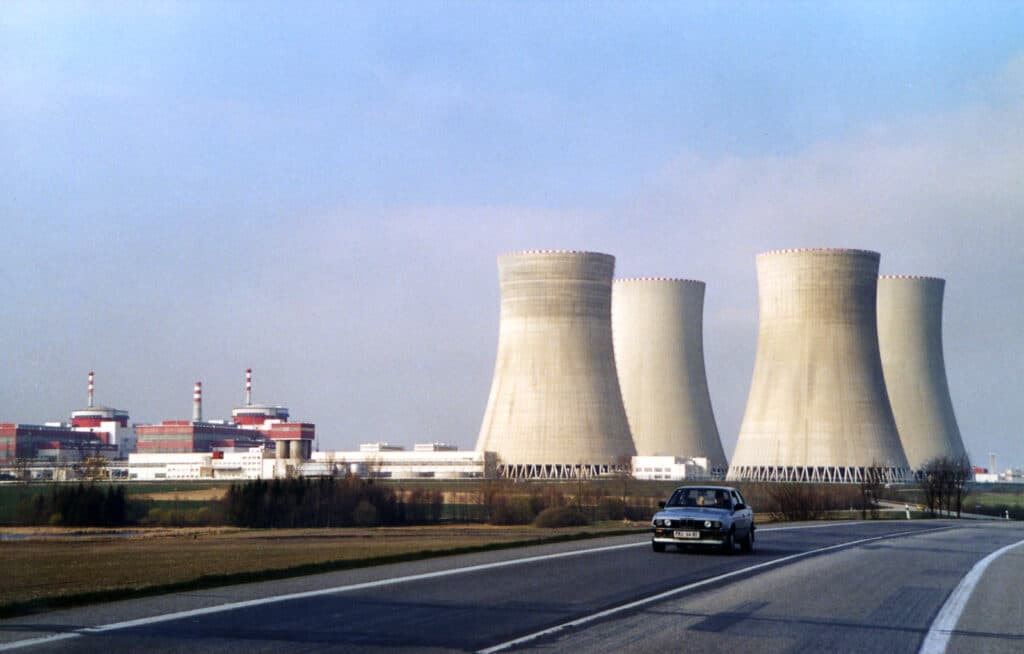
The construction of two additional units at the Temelín Nuclear Power Plant (JETE) has been discussed for many years. ČEZ, which owns Temelín, launched a tender to complete the units in August 2009. But ten years ago, on 10 April 2014, ČEZ canceled the tender. Shortly beforehand, the government had announced that it would not guarantee the purchase price of electricity from the expanded power plant. The completion of another nuclear power plant, Dukovany, is currently being actively discussed in Czechia.
Three bidders entered the 2009 tender to complete Temelín: US-based Westinghouse, the Czech-Russian MIR.1200 Consortium and France’s Areva, whose bid was excluded from the tender for failing to meet the requirements. In February 2011, the government approved the steps needed to complete JETE, including investment in the transmission system and strengthening the work of the State Office for Nuclear Safety (SÚJB). At the time, ČEZ moved the planned completion date for JETE to 2025. In January 2013, the Ministry of the Environment issued a favorable opinion on the construction of two new JETE units. But in April 2014, the tender was canceled because the government was unwilling to provide the requested guarantees on the return on investment.
Temelín’s history began in the 1970s, with an investment plan for a four-unit nuclear power plant issued in February 1979. Soon afterward, it was decided that the plant, based on a Soviet technical design, would be built near Temelín, close to Týn nad Vltavou in South Bohemia. Major construction work began in 1987. Rising costs, together with changing economic conditions, led to a decision after the fall of communism to reduce the number of units from four to two. ČEZ brought the power plant into operation in December 2000.
The completion of another nuclear power plant, Dukovany, is currently under consideration in Czechia. In 2021, Elektrárna Dukovany II, part of the ČEZ Group, received a permit from the State Office for Nuclear Safety (SÚJB) to site a new nuclear facility at Dukovany. Czechia invited four bidders to the announced tender: France’s EDF, South Korea’s KHNP, North America’s Westinghouse and Russia’s Rosatom. The opposition criticized Russia’s participation, so the government subsequently excluded Rosatom. At the end of last October, the three remaining bidders—Westinghouse, KHNP and EDF—submitted their final offers. At the end of this January, the government decided to invite EDF and KHNP to submit binding bids to build up to four new reactors—not only at Dukovany but also at Temelín. Westinghouse is no longer in the competition because its bid did not meet the requirements. A few days ago, the deadline for submitting binding bids to build the nuclear units was extended by two weeks, giving bidders until 30 April, but the project schedule remains unchanged.
The much-discussed completion of Temelín looks increasingly realistic amid the energy crisis. This is also supported by exceptionally high public backing, as shown in a survey by consulting firm IBRS cited recently by the daily Právo. Asked whether the share of nuclear power should increase or decrease, only 32 percent of people favored an increase in 2021, while one in five Czechs favored the opposite. A year later, however, 56 percent of respondents called for a greater role for nuclear power plants, and support for nuclear energy in Czechia has now reached a record 72 percent of respondents.
Temelín is the country’s largest electricity producer, covering roughly one-fifth of domestic consumption. In 2023, it exceeded 16 TWh of generation for the second year in a row.
Translation disclaimer
This article is a machine translation of the Czech original and has not yet been fully reviewed. In case of any doubt, please refer to the Czech version.
Sdílejte článek prostřednictvím:
You might also like
28 October 2026, 13:08
28 October 2026, 11:10
28 October 2026, 09:08