Czechia is betting on nuclear power. However, it still does not know what it will do with radioactive waste. There will probably be more of it than planned, due to the extended operating life of the Dukovany Nuclear Power Plant. Increasingly, there are warnings that one site among the current four finalists for a nuclear waste repository may not be enough.
Czechia has been dealing with where to store spent nuclear fuel for several years. The number of shortlisted sites has gradually been reduced to the current four unwilling finalists: Březový potok in the Plzeň Region, Horka and Hrádek in the Vysočina Region, and Janoch in South Bohemia. The state had originally been due to select a final and a reserve site in 2025; it now looks more likely to happen in 2030.
The first geological survey began this week in Janoch near Temelín. Boreholes to depths of 30 and 100 metres are focusing on water.
Under the EU taxonomy rules for sustainable financing of nuclear power, the repository is to be completed in 2050. This is also reflected in the Czech Republic’s Strategy for the Management of Radioactive Waste and Spent Nuclear Fuel, which is currently undergoing a strategic environmental assessment (SEA).
The Radioactive Waste Repository Authority (SÚRAO) considers the 2030 and 2050 deadlines binding. “Hydrogeological monitoring and detailed geological mapping are already under way at all sites, geophysical work is being prepared, and extensive evaluation of existing geological data is continuing,” SÚRAO spokesperson Martina Bílá said.
What the SÚRAO document says
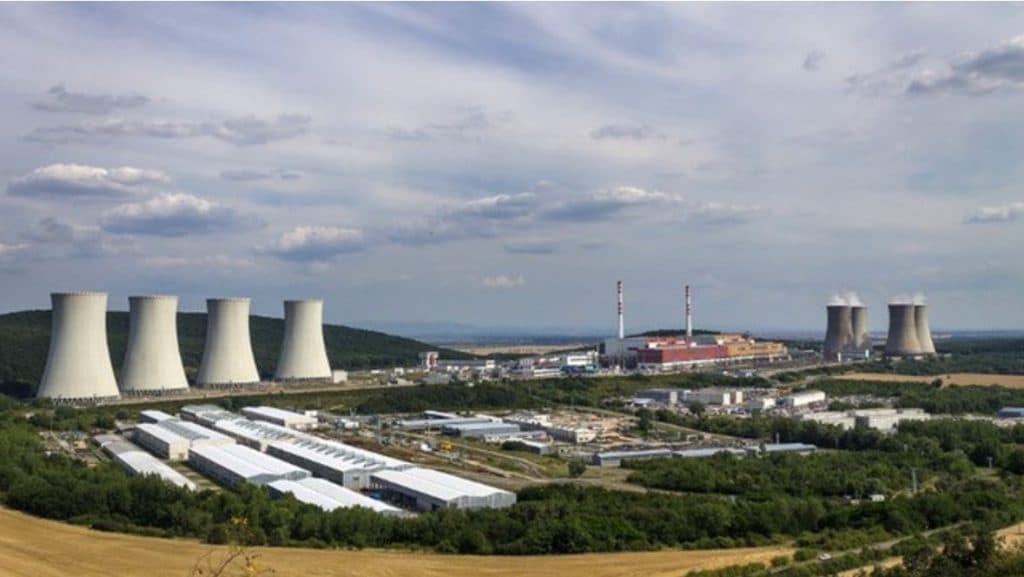
In April this year, the semi-state energy group ČEZ announced that it would extend the operating life of the Dukovany Nuclear Power Plant to 80 years. It also plans to build small modular reactors in the future, once the technology allows it, so there will most likely be far more waste than anticipated.
The permanent nuclear waste repository project is to be financed from the so-called nuclear account, to which radioactive waste producers in Czechia contribute. “There are two shifts. The strategy contains a new timetable, under which the period from site selection to construction will be cut in half,” says energy expert Edvard Sequens of Calla – Association for Nature Conservation.
“The second issue is capacity. They have said that Dukovany will operate for 80 years, increasing the expected volume of waste and therefore the footprint of the repository. The question is whether all sites will have such a margin. We will probably be pushed towards two repositories,” Sequens fears.
That SÚRAO, which is responsible for the project, had already considered this idea in its background materials is apparent from its two-year-old document on the status of the deep geological repository. It states that redesigning a deep geological repository for a larger volume of waste would be very difficult.
“If there is a significant increase in the expected volume of spent nuclear fuel and radioactive waste to be disposed of between 2025 and 2050, it will therefore be necessary to begin preparations for another DGR (deep geological repository, author’s note) and designate a new site for DGR II,” reads the SÚRAO document seen by Ekonews. Its authors use this to justify why the state should retain a reserve site for as long as possible.
“We cannot confirm your information about two repositories under any circumstances; we are not aware of anything of the kind,” Bílá of SÚRAO replied to a direct question from Ekonews.
According to David Hluštík of the press department at the Ministry of Industry and Trade, the current plan envisages one deep geological repository, whose capacity will be continuously adjusted to future needs. “The second site is maintained only as a reserve option until a final decision is made,” Hluštík says.
Municipalities complain that the state does not communicate
All developments to date concern the municipalities associated in the Platform Against the Repository, whose members also include Calla – Association for Environmental Conservation. It currently represents the interests of 58 members: around 40 towns and municipalities and 18 associations. Its goal is to bring about a change in the state’s approach to managing nuclear waste, one that is not limited solely to a deep geological repository.
“Consideration can be given to long-term storage until an acceptable solution is found (the concept of rolling stewardship), the establishment of a joint international repository abroad, or the use of reprocessed spent fuel in fast reactors and disposal only of the residues from this process,” the platform’s website states. “The problem is that since the 1990s we have bet on one approach. Once they put it in there, nobody will take it out again,” Sequens is convinced.
The platform also advocates making a decision on selecting a site for potential disposal conditional on prior consent from the affected municipalities. Municipalities have long complained about insufficient communication from both the Ministry of Industry and Trade and SÚRAO. They also fear that the new deadlines will create a tendency to rush matters and skip or gloss over certain important steps.
Problem with exploratory boreholes
Geological exploratory boreholes, which should already have been under way, are one example. At the start of the year, SÚRAO had to cancel the tender for a contractor because the sole bid submitted was too expensive. The repository authority subsequently decided to split the contracts into smaller lots.
A total of seven boreholes are planned for each site: one to a depth of 1,200 metres, two to 600 metres and four to around 300 metres. SÚRAO is now beginning to select suppliers for the 600-metre boreholes.
“Everything is being pushed back again. And even though they have now split it up, it will not be cheaper. The sums will add up, and above all it will take even longer when there is a separate tender for each borehole,” Sequens believes. He also doubts that the final site will be decided after a comprehensive assessment of all data. “We fear that they will decide on the basis of incomplete data,” he says.
Bílá acknowledges that preparations for deep geological boreholes have been delayed compared with the original assumptions. “This happened mainly in connection with permitting processes and subsequently with the very high bid prices in public procurement. However, this does not mean that the entire programme has stopped or that work is currently at a standstill,” Bílá says. SÚRAO still counts on all types of boreholes, but in successive stages.
She stresses that site selection is not based solely on one type of survey or on boreholes themselves. It is to involve a combination of long-term safety assessment, geological, hydrogeological and geomechanical data, modelling results and comparison of sites according to a predefined methodology. “Boreholes are a very important part of the programme, but they are not the only source of information,” Bílá assures.
It is a political decision
Matěj Machek is a researcher at the Institute of Geophysics of the Czech Academy of Sciences and sits on SÚRAO’s Expert Advisory Panel, an independent group of specialists. Regarding the repository authority, he says it should be as transparent as possible, including in relation to geological work.
“There are many uncertainties in geology; that cannot be avoided. And it should be presented transparently: there will always be uncertainty. In any case, it is necessary to look underground. The rock must be selected so that, in the worst-case scenario, it can withstand even a failure of the waste package,” Machek warns.
He sees the repository as a form of resignation. Like other critics, he objects that alternatives are not being considered. “I would expect the strategy to include an analysis and assessment of other approaches as well. As it stands, it is a political decision. I do not get the impression that SÚRAO has much confidence in dealing with political representatives,” he says.
Municipalities have also turned to the courts over their rejection of geological boreholes. Following the dismissal of their lawsuits against the Ministry of the Environment, which permitted the work, they are now filing a cassation appeal with the Supreme Administrative Court.
“For years, the state has been deciding the future of our municipalities without us. Governments in the past had an opportunity to remedy this injustice, but instead of strengthening municipal rights, they failed to ensure even basic legal guarantees, let alone genuine dialogue. The Radioactive Waste Repository Authority is launching geological work even though municipalities have no real opportunity to defend the water, landscape or property rights of their residents,” the platform wrote in a press release this April.
Municipalities had originally placed their hopes in the repository act, which was meant to give them certain powers. But they are not satisfied with the outcome; the government still has the final say. “That law was being prepared for years, and despite all the proposals and promises, it contains only cosmetic changes,” Sequens says. “One minister is the same as another; they do not want to talk about it. They literally push it away from themselves,” he adds.
Costs will be at least 130 billion
According to SÚRAO’s calculations to date, building the deep geological nuclear waste repository, including its 100-year operation, will cost 130 billion crowns. But it will probably be more. Based on 2017 data, experts at the Czech Technical University in Prague’s Faculty of Electrical Engineering calculated expenditure associated with the deep geological repository at almost 100 billion under current conditions and 152 billion if new nuclear capacity is built. The higher figure assumes the addition of two nuclear units.
The Platform Against the Deep Geological Repository, drawing on the update to the government strategy and taking into account new units and an accelerated timetable, estimates costs at 270 billion crowns. As of 31 December last year, the nuclear account held 46.34 billion crowns. It finances not only repository preparation, but also the operation of existing surface facilities and contributions to affected municipalities. Under the Atomic Act, ČEZ, as operator of nuclear power plants, originally paid 55 crowns for every megawatt-hour of nuclear electricity generated. From January this year, the levy increased to 88 crowns per megawatt-hour.
“If there were a risk of insufficient funds, the state could adjust the contributions of waste producers to the nuclear account. A large part of the funds needed to build the basic infrastructure of the deep geological repository has already been saved, and the resources in the account continue to grow,” says Hluštík of the Ministry of Industry and Trade.
Six million a year does not ease concerns
A municipality whose cadastral area includes a designated protected area for a repository is entitled to a one-off payment of 60 million crowns. The annual payment then starts at 850,000 crowns, with an additional amount based on the size of the specific exploration or protected area at the site. Municipalities where the repository ultimately will not be built therefore also receive money during the exploration phase.
During operation of the repository at the selected site, the payment is expected to reach six million crowns per year, plus a payment based on the volume of fuel disposed of. However, this does not ease mayors’ concerns. They fear a sharp rise in population, problems with water resources or insufficient school capacity, and increased crime when a large number of manual workers move into the area.
“It is good that the municipalities are still trying to act together. That is important, because SÚRAO is trying to set up local working groups and fragment the municipalities’ efforts,” Machek says.
This article was produced with the support of Journalismfund Europe.