US oilmen accept climate change. What does Trump say?
Elon Musk, the model “green” entrepreneur, shocked his supporters at the end of January. Contrary to many expectations, the head of automaker Tesla praised Rex Tillerson – until recently the head of oil giant ExxonMobil and now the confirmed Secretary of State in Donald Trump’s administration.
Unbelievable to many – Musk, an innovator and advocate of renewable energy, is defending a man who has devoted his entire life to promoting fossil fuels. In his view, he will be a “great” Secretary of State. Yet Tillerson also has a reputation as a man who has acknowledged that climate change is a real problem, welcomed the Paris Agreement on climate protection and in the past advocated a carbon tax.
Musk has meanwhile become an outside adviser (one of many) to the president himself and apparently is betting that Trump’s notorious opposition to the whole theory of global warming can at least be softened. And who else could help people like Musk in this respect if not Tillerson, who brought an oil colossus like ExxonMobil to acknowledge climate change?
Musk’s dependence
Many of Tillerson’s critics, on the other hand, argue that ExxonMobil has never actually done anything meaningful for modern energy and that no genuine enthusiasm for advancing the climate agenda in the spirit of the Paris Agreement can be expected from the company’s former chief.
Musk’s “kind” words in support of people from the new administration may have a purely pragmatic reason – this entrepreneur’s business is to a considerable extent dependent on Washington’s goodwill, tax breaks and government contracts. According to some reports, tax breaks for Musk’s battery manufacturer Gigafactory amount to more than a billion dollars. And Musk’s space company SpaceX receives contracts from NASA.
While it is logical that Musk is betting on Tillerson in this situation, the stance of the Secretary’s critics may seem far more realistic. “Tillerson will never separate himself from ExxonMobil,” said Chuck Schumer, the Democratic leader in the Senate, for example. In his view, the interests of the United States will be secondary for Tillerson.
What ExxonMobil is good for
The fact is that Tillerson spent virtually his entire life at ExxonMobil, and its corporate culture undoubtedly shaped him strongly. Yet this fact too can be interpreted in two entirely different ways. On the one hand, it is probably true that Tillerson will never become a sworn opponent of using fossil fuels. On the other, many are betting precisely on the fact that, thanks to that corporate culture, Tillerson will always prefer a rational approach, negotiation and adherence to certain rules. Violating international agreements – including the Paris one – is probably not his style.
The chaos that Donald Trump and his advisers brought into US government with a barrage of rapid (and often presumably hasty) decisions in the first days of his presidency will apparently be quite alien to Tillerson. But that does not mean Tillerson will have the strength to stand up to the president’s advisers – especially if he fails to convince Trump himself of his views.
A threat, but how great?
But let us assume that Tillerson’s views will nevertheless play some role and may be able to temper the president’s “decision-making barrage”. So what exactly did the new Secretary of State say at his January hearing in the Senate?
In his view, the risks of climate change may be sufficiently serious, and therefore action is needed. He thus apparently also considers the human impact on these climate changes to be entirely real. Tillerson’s view evolved over twenty years alongside scientific knowledge. He came to the conclusion that rising concentrations of greenhouse gases in the atmosphere affect the Earth’s climate.
While Donald Trump, during the election campaign, even promised to cancel the Paris Agreement (which is effectively nonsense), Tillerson said somewhat vaguely that it made sense to remain at the negotiating table.
Despite all this, climate “alarmists” cannot be pleased by Tillerson’s words. The former ExxonMobil chief also said that our ability to predict the overall impacts of greenhouse-gas emissions is limited, that we do not know how great a threat it really is, and that it is not an acute threat to US national security.
Corporate legacy
Now let us also assume that ExxonMobil’s interests will be reflected to a greater or lesser extent in Tillerson’s views – whether consciously or simply because the corporation has shaped Tillerson’s thinking for so long.
Optimists among environmentalists might say that ExxonMobil, too, now has its own interests in modern “green” energy, which it will not want to give up – like other major oil companies. Yet such a claim would be highly questionable.
It is true that these giant corporations have indeed realistically begun developing renewable energy as well. And it was under Tillerson’s leadership that ExxonMobil fundamentally changed from 2006 onwards and acknowledged the risk of climate change. Tillerson’s predecessor at the helm of the corporation, Lee Raymond, can undoubtedly still be “categorised” among the straightforward deniers of global warming, who did not hesitate to fund research and studies directed towards one main aim – denying the human impact on climate change. (Critics of ExxonMobil cite information according to which the company had long been well aware of global warming and wanted to use this climate effect in Arctic extraction.)
On the other hand, ExxonMobil has a reputation as a company that has lagged far behind in its “green enthusiasm”, even compared with other oil corporations. If it embarked on any major “new energy” project, it was CCS technology (carbon capture and underground storage) – still linked to the use of fossil fuels.
No holy zeal
As ExxonMobil’s chief, Tillerson was certainly no enthusiast for a holy war against climate change, but he realistically sought to adapt a major oil company to a new environment in which Raymond’s old policy could already have harmed it. Advocates of the need to confront global warming were gaining ever stronger support around the world and in America itself.
The question is how he will now assess in Washington the risks of a policy that would lead to the complete rejection of climate initiatives from the Barack Obama era and to a gradual US withdrawal from the Paris Agreement. (Given the rules in place, this would formally take longer than Trump’s entire term in office, unless he were re-elected.) Tillerson, who already has experience with something similar at ExxonMobil, will certainly want to minimise the negative impacts on the United States’ standing in the world.
Already today, it appears that Chinese President Xi Jinping is taking the initiative at global climate forums; he had previously formed a certainly remarkable pairing with Barack Obama. Donald Trump will certainly at least take into account the argument that the United States is ceding the initiative to China – in any field whatsoever –.
Musk and Trump: What they have in common
Perhaps Trump will have more reasons to reflect. After all, the aforementioned Elon Musk may ultimately share interests with President Trump – if he creates new jobs and develops domestic industry and new technologies that “make America great again”.
More for interest and amusement, let us add that Rex Tillerson could then seek support from the environmental wing among Republicans, who virtually adore the new Secretary of State. It was Tillerson, while still head of ExxonMobil, who promoted a revenue-neutral carbon tax and rejected, for example, an emissions trading system which, in his view, would lead to the creation of a new and unnecessary financial business – a kind of “permit Wall Street”.
Conservative environmentalists – the so-called “eco-right” – paradoxically believe that it will ultimately be the Trump administration that actually does much more to fight climate change than its predecessors – because it will leave the initiative to market forces and reject counterproductive regulation.
An interesting view, but most experts on the right and left will certainly agree that it is far removed from reality. Realistically, it can be said that America (and the world) faces a visible turn away from Obama’s climate policy. The battle will be over how sharp that turn will be.
The author works as a consultant and energy-project specialist for the HATcom agency.
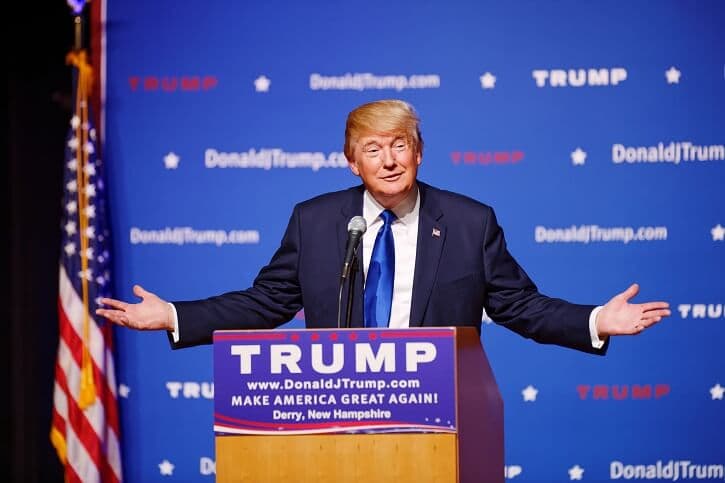
Lead photo: Michael Vadon, Flickr
Translation disclaimer
This article is a machine translation of the Czech original and has not yet been fully reviewed. In case of any doubt, please refer to the Czech version.