Liquid-fuel reactor produces uranium-233 from thorium for first time
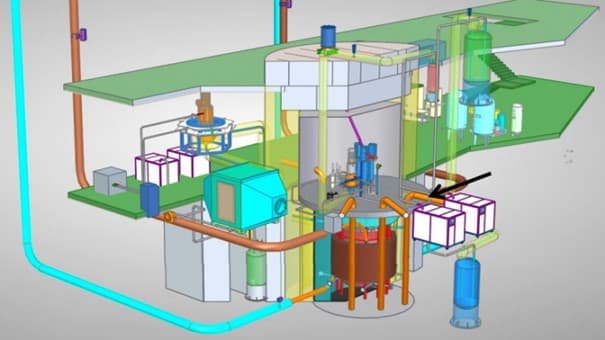
China is moving to the forefront of research into advanced nuclear technologies. Another significant step is the launch of thorium-cycle tests in the TMSR-LF1 prototype liquid-fuel reactor, which uses molten salts.
Interest is currently being revived in the use of liquid-fuel reactors employing molten salts containing uranium, thorium or transuranic elements. These reactors could enable the closure of the fuel cycle, with the use of thorium potentially bringing major benefits in this respect. A liquid-fuel blanket is also expected to be used in accelerator-driven subcritical transmutation systems, which could enable highly efficient burning of nuclear waste. China is focusing very intensively on these technologies and has achieved a new success. Tests using thorium to produce uranium-233 have begun in the new TMSR-LF1 (Thorium-based Molten Salt Reactor Liquid Fuel) prototype molten-salt reactor.
History of liquid-fuel reactors
The first reactor to use liquid fuel in the form of molten salts was at the Oak Ridge laboratory. Work on this type of reactor, intended to power aircraft, was already under way in the 1950s. Development took place at INL (Idaho National Laboratory) and ORNL (Oak Ridge National Laboratory). It was a high-temperature reactor using fluoride molten salts. In the 1960s, research into reactors using molten salts was concentrated at the Oak Ridge laboratory.
This work culminated there in the MSRE (Molten-Salt Reactor Experiment). It was a prototype test reactor experiment using molten salts as both fuel and coolant. It was intended to test the behaviour, particularly the neutronics, of future systems capable of burning thorium. Fluoride salts containing lithium, beryllium, zirconium and uranium, LiF/BeF2/ZrF4/UF4 (65-29-5-1) mol%, were used as the fuel carrier. These salts are highly corrosive, so the structural components were made from the special resistant Hastelloy-N alloy. The reactor operated with an epithermal neutron spectrum, with graphite providing moderation. Fluoride salts were again used for secondary cooling. The operating temperature could therefore be around 650˚C. The fission chain reaction began in the reactor in 1965, and experiments continued for roughly four years. Uranium was used as fuel in these experiments. Based on the experience gained, a project was prepared for a larger, more advanced reactor that would operate with thorium. However, it was never built.
The thorium cycle
Using the thorium cycle brings a range of benefits. Thorium is even more abundant on Earth than uranium. This is also due to the fact that thorium-232 has a half-life of 14 billion years, while uranium-238 has a half-life of 4.5 billion years. Thorium has fewer nucleons (232) than uranium (235 and 238). When it is used as fuel in a reactor, heavier transuranic elements, which are the most hazardous component of nuclear waste, are not produced.
Thorium-232 has an even number of neutrons and therefore cannot be fissioned by low-energy neutrons. By capturing a neutron, it becomes thorium-233, which through two beta decays transforms via protactinium-233 into uranium-233. This has an odd number of neutrons and also undergoes fission upon capturing thermal neutrons. It is therefore a fissile material and suitable fuel for nuclear reactors.
To use thorium, as with uranium-238, specific reactor types are needed. One option is a combination of fast reactors and heavy-water reactors. Reactors using unmoderated neutrons can, with an appropriate core configuration, enable the efficient transmutation of thorium-232 into uranium-233. Heavy water, meanwhile, captures far fewer neutrons and its neutronics are more suitable for burning a mixture of thorium-232 and uranium-233. Heavy-water reactors can also use natural uranium as fuel without enrichment.
India has taken this path, as it lacks uranium but has large thorium reserves. The principles of its nuclear programme are described in an older article, while updates are included in annual reviews (the latest is here).
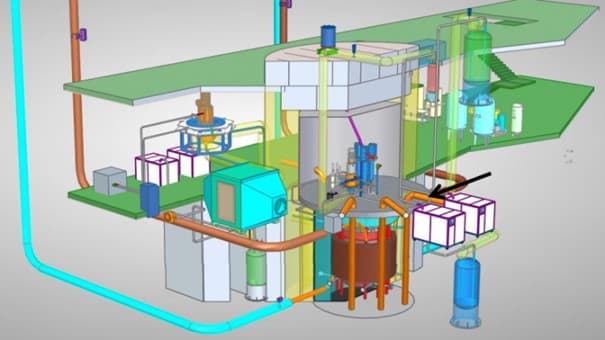
Molten salts as both coolant and fuel
Another option for burning thorium-232 is the use of liquid fuel in the form of molten salts. Molten salts can be used as a coolant in high-temperature reactors. In that case, they do not contain uranium or thorium. Fluorides, chlorides or nitrates can be used. Molten salts are also used for energy (heat) storage, for example in solar thermal power plants. When salts are used as a coolant or for heat storage, their very high volumetric heat capacity and high boiling point, and thus their wide range of possible operating temperatures, are utilised. Mixtures of different salts are used.
It is necessary to select nuclides that make it possible to achieve optimal neutronics. If the salt contains lithium, it must be highly enriched in lithium-7. This isotope has a low probability of neutron capture. It is important for the salts to have high radiation resistance and not to undergo reactions producing radioactive nuclei.
When thorium or uranium salts and liquid-form fuel are used, a major advantage is the possibility of continuously replacing fuel and separating radionuclides. This is particularly important for implementing a closed fuel cycle.
In the conventional variant, the fuel would be dissolved in salts in the form of uranium tetrafluoride (UF4) or thorium tetrafluoride (ThF4). A mixture of lithium fluoride LiF and beryllium fluoride BeF2 would be used as the salt, which is advantageous because both uranium tetrafluoride and thorium tetrafluoride dissolve very well in it. For burning transuranic elements, trifluorides will be used, for example plutonium trifluoride (PuF3). These dissolve best in salts containing lithium fluoride and sodium fluoride.
A more detailed description of Generation IV reactors using molten salts can be found in an earlier article for Osel, which also describes some of the research we conducted in this field.
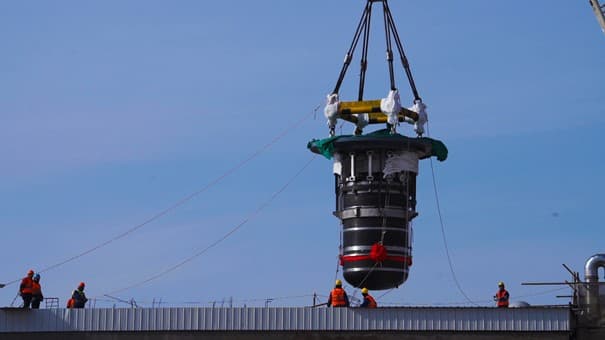
The TMSR-LF1 reactor
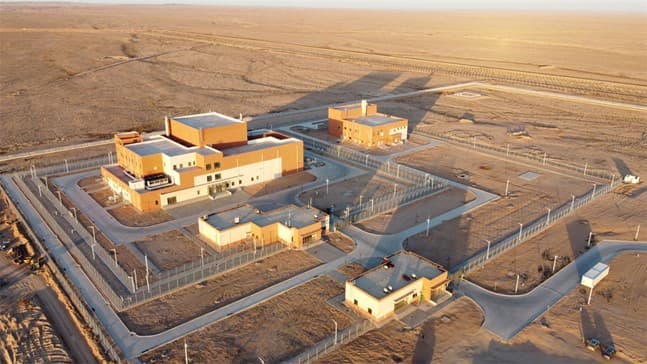
China drew on its earlier experience with molten-salt reactors from the 1960s and 1970s, as well as on the aforementioned US project at Oak Ridge. In 2011, the Chinese Academy of Sciences resumed work on developing a reactor cooled by molten salts, potentially also with liquid fuel, and on the possibilities for its use in the thorium cycle. In 2018, the Shanghai Institute of Applied Physics (SINAP) of the Chinese Academy of Sciences began building the TMSR-LF1 experimental reactor in the city of Wuwei in Gansu province.
The reactor uses molten salts for both fuel and cooling. It allows fuel to be continuously added and combustion products to be gradually removed. The reactor's thermal output is 2 MWt. The TMSR-LF1 reactor will use fuel enriched to just below 20% uranium-235. This is HALEU (High-Assay Low-Enriched Uranium) fuel, meaning it is still enriched to below 20% and does not require special handling, but is close to that threshold. The blanket is expected to convert around 50 kg of thorium, with a conversion ratio of around 0.1. The breeding blanket uses a mixture known as FLiBe, comprising lithium fluoride LiF enriched to 99.95% lithium-7 and beryllium fluoride (BeF2), while the fuel is uranium tetrafluoride UF4.
The reactor will initially operate in batch mode, with fuel replenishment and removal of gaseous fission products. After five to eight years, all salts will be drained to separate fission products and actinides. It will then continue in continuous mode, with ongoing removal of fission products and actinides. Thorium-burning efficiency is expected to increase from 20% to 80%.
The reactor was originally expected to be completed in 2024, but the project was accelerated and completed as early as August 2021. Preparations for start-up therefore began in August 2022. The fission chain reaction was first initiated in the reactor in October 2023. Since then, the reactor has continuously produced heat through a fission chain reaction. Full output was reached in August 2024, and in September the reactor received authorisation to load its first batch of thorium. Thorium was therefore placed in the reactor in October 2024. Now, in November 2025, the transmutation of the first batch of thorium into uranium-233 fuel has been completed, which can then also be used in conventional reactor types.
The reactor's operating temperature is 650˚C, and a major safety advantage is that it operates at normal pressure. The reactor does not need water for cooling and would be ideal for dry regions, including for water desalination. China would therefore like to use it very intensively in the future in sparsely populated desert areas, where large outputs are not needed and water is scarce. If this reactor succeeds, China plans to build a larger one with a thermal output of 100 MWt by 2035.
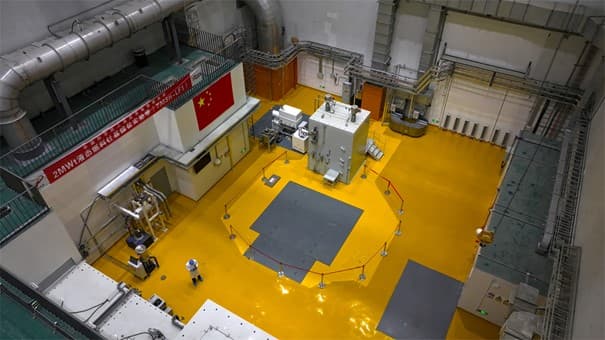
Conclusion – significance for future nuclear technologies
With this dramatic breakthrough, China is moving to the forefront of another area of nuclear technology development. Studying the properties of molten-salt reactors is enormously important for using thorium and efficiently burning transuranic elements from spent fuel from conventional reactors. They should also serve as blankets in accelerator-driven transmutation systems, discussed in more detail in an older article. The current success and practical experience gained could accelerate the development of small modular reactors of this type; examples include Terrestrial Energy Company's ISMR (Integral Molten Salt Reactor) project and ThorCon. At the same time, it could bring closer the deployment of an accelerator-driven transmutation system, which China is also developing. This could therefore represent a significant shift in global nuclear energy.
Translation disclaimer
This article is a machine translation of the Czech original and has not yet been fully reviewed. In case of any doubt, please refer to the Czech version.