25 September 2026, 09:51
Loading...
Nuclear energy in 2024, part 1: A key year for Czechia
Vladimír Wagner
12 January 2025, 07:20
This year saw key decisions in the Czech Republic on the further development of nuclear energy. Japan decided to return to intensive development in this area. In China, the development of nuclear capacity continues to accelerate. A nuclear renaissance is also awakening in Europe, and even German politicians are beginning to change their minds. The deployment of small modular reactors is approaching.
Germany in 2024, when it no longer had any nuclear reactors in operation, demonstrated the fundamental problematic features of its Energiewende. Despite the enormous installed capacity of wind and solar resources, a large share of its electricity is generated using fossil fuels. Moreover, it has changed from a net exporter of electricity into a net importer.
France, by contrast, has had low-carbon electricity generation for decades thanks to its combination of nuclear and renewable sources, and is one of the largest net exporters of electricity. Comparing the two shows which path truly leads to reducing carbon dioxide emissions and which leads to a dead end.
Germany is also experiencing unpredictable periods of surplus electricity production when winds are strong and the sun is shining, and production shortages when so-called dunkelflaute occurs, with neither wind nor sunshine. Due to operating subsidies for renewable sources, spot prices can even turn negative in windy and sunny periods. During dunkelflaute, when solar and wind plants provide almost nothing, there is a shortage of electricity production despite the enormous installed capacity, and spot prices soar to dizzying heights. I analysed Germany's current situation in greater detail in a recent article.
Whether there will be a surplus or shortage of wind and solar electricity at a particular time cannot be predicted far in advance. This is very clearly illustrated by comparing the situation during the Christmas holidays in different years. In winter, there is a greater probability that it will be windy, while consumption is low during the Christmas holidays. Germany therefore usually has a large surplus of wind power at that time, with low and often negative prices on the spot market. This was also the case at the end of 2023. By contrast, there was dunkelflaute during the Christmas holidays in 2024. Despite low consumption, negligible wind resulted in a shortage of electricity production in Germany and high spot prices.
As a number of Germany's neighbours have also built renewable sources, Germany additionally tends to export when electricity prices are low and import when prices are high. The situation is already becoming clear to some German politicians. Industrial Bavaria is particularly affected. Bavaria's Minister-President Markus Söder therefore met Czech politicians at the end of 2024 to discuss cooperation in nuclear energy and the use of Czech nuclear capacity. This too is a sign of how fundamentally attitudes towards the use of nuclear energy are changing in Europe.
Let us first look at the overall statistics, followed by details of developments in nuclear energy worldwide last year.
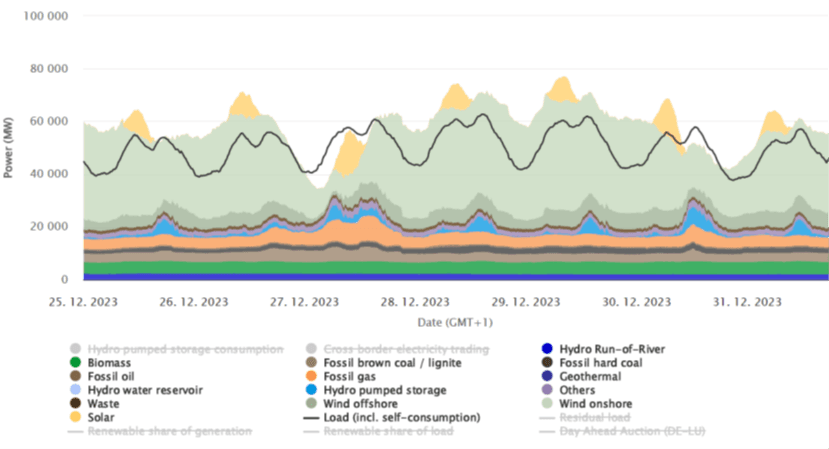
Electricity generation in Germany during the Christmas holidays in 2023. Winds were strong at the time, while consumption also falls during the Christmas holidays. Germany therefore had a large generation surplus and had to export it. The individual colours denote different sources (dark blue – hydro, green – biomass, light brown – lignite, dark brown – hard coal, orange – natural gas, light blue – pumped-storage plants, various shades of grey – wind sources, yellow – solar PV); the black line is consumption (source: Energo-chart).
Statistical overview
This overview of nuclear energy developments over the past year is the sixteenth in the series and follows articles from previous years. The latest overview is from 2023 (part 1, part 2, part 3, part 4). In November 2023, there were 436 reactors with capacity of 392 GWe; by December 2024, there were 441 with capacity of 399 GWe (data from the World Nuclear Association and the PRIS database). A total of 64 units with capacity of 69 GWe are under construction. In 2024, more new reactors entered operation than were shut down. Let us hope that this trend continues in the coming years.
A total of three units were shut down during 2024. As early as the end of January, the second unit of the Kursk nuclear power plant, which had operated since 1979, was closed. It was an RBMK reactor, the Chernobyl type. Recall that VVER1200 units are being completed at this plant and will gradually replace its four RBMK reactors. The remaining two RBMK units should be shut down by 2031. At the end of July 2024, the 890 MWe Ma-an-shan (Maansham) 1 pressurised-water reactor in Taiwan was shut down. It had operated since 1984. Taiwan now has only one reactor in operation, the second unit at Ma-an-shan, and is completing its withdrawal from the use of nuclear energy. It is thus becoming increasingly dependent on fossil sources, which supply it with over 80 % of its electricity. These are coal and liquefied natural gas, both of which are needed in very large volumes. It must import all of them. The question is therefore how it could withstand a Chinese naval blockade of the island. Its attitude towards nuclear power may thus change again in the future. The last reactor shut down in 2024 was Canada's Pickering 1 heavy-water reactor at the end of September; it had operated since 1971. Pickering 4 was then shut down on 2 January 2025, but that belongs in the 2025 statistics.
Eight reactors newly entered operation in 2024. The start-up of Sin Hanul (Shin Hanul) 2 in December 2023 was already covered in the previous overview. At the end of February, India's Kákrapar (Kakrapar) 4 began supplying electricity. It is the second domestically designed 700 MWe PHWR heavy-water reactor. In early March, the US AP1000 reactor at Vogtle, the plant's fourth unit, finally began supplying electricity. At the end of March, Barakah 4 in the United Arab Emirates began generating electricity. All four South Korean APR1400 reactors are now operating there. This was followed by the commissioning of three new Chinese nuclear units. From the beginning of April, electricity began flowing from the fourth unit at Fang-čcheng-kang (Fangchenggang), where a new Hualong One reactor was started up. Its construction was delayed and took just under eight years. The other two Chinese reactors were completed in five years. In October, Š’-tao-wan (Shidaowan) Guohe One 1 began operating. It is the first commissioned CAP1400 reactor, a Chinese higher-capacity version of the AP1000. At the end of November, Čang-čou (Zhangzhou) 1 began generating electricity. This is another Chinese Hualong One reactor. At the end of the year, in early December, the long-built French Flamanville 3 unit supplied electricity for the first time. It is a 1700 MWe EPR reactor. In addition, another Indian heavy-water reactor, Rádžasthán (Rajasthan) 7, began start-up towards the end of the year.
Construction began on nine reactors, again more than were commissioned in the previous year. The start of nuclear-island concreting for China's Sü-ta-pao (Xudabao) 1 in November 2023 was already covered in the previous overview. It is a CAP1000 reactor, the Chinese variant of the AP1000. At the end of January 2024, concreting began on the fourth unit at El Dabaa in Egypt. All four VVER1200 reactors are now under construction there. Construction of Čang-čou 3 began in February and of Čang-čou 4 in October; both are Hualong One reactors. In mid-March, concreting began for the nuclear island of the seventh unit at the Leningrad nuclear power plant, where a VVER1200 reactor will be built. Following the first unit in 2024, construction of the nuclear island began for the second CAP1000 unit at the Liang-ťiang (Liangjiang) nuclear power plant. In mid-July, construction began on a CAP1000 reactor as the second unit at Sü-ta-pao. On 28 July 2024, concreting began on the nuclear islands of two new Hualong One reactors: Ning-te (Nindge) 5 and Š'-tao-wan (Shidaowan) 1. At the beginning of 2025, construction also began on Čašma (Chashma) 5 in Pakistan. This is a Chinese Hualong One reactor.
Nuclear electricity generation reached 2 602 TWh in 2023. Compared with 2022, when 2 545 TWh was generated, it rose by 57 TWh. The positive trend is also due to the resolution of problems in the French nuclear fleet, the gradual restoration of operation at Japan's nuclear facilities, and the commissioning of new Chinese nuclear power plants. Nuclear generation can be expected to have risen in 2024 as well, with this trend continuing in the coming years.
Czech nuclear energy had a year of decisions
For the Czech Republic, 2024 was a year of two key decisions. Both are linked to ČEZ. The first was the outcome of the tender for new units at Dukovany and the second was the selection of a partner in small modular reactors.
The first major decision during the tender came in September 2021, when China and Russia were excluded for geopolitical security reasons. Had this not been done at that time, such a step would have had to be taken after Russia launched its war against Ukraine in February 2022. The tender therefore had three bids: the AP1000 reactor from US company Westinghouse, the EPR1200 from France's EDF, and the APR1000 reactor from South Korea's KHNP.
All these companies are highly experienced players in the nuclear technology market. They offer Generation III reactors with very good safety parameters. The decisive criteria thus become economic ones: not only the lowest price, but above all the guarantees that the company is willing to provide for keeping to that price and the construction schedule.
Westinghouse was excluded from the tender in January 2024 because it was unwilling to guarantee the delivery of the unit's construction. At the same time, the tender changed: it now covers construction of two units at Dukovany, with an option for another two at Temelín. It was very important that the European Commission approved notification of state support for financing the first Dukovany unit. The Korean bid was selected in July, as it was superior on all critical economic parameters.
In my view, the main reason for the Koreans' victory was their greater effort to win the tender and willingness to accommodate the contracting authority to the maximum extent. In a number of cases, they were therefore willing to meet even non-mandatory conditions in their bid. This included willingness to license the proposed unit in their home country. Recall that both France's EDF and South Korea's KHNP offer scaled-down versions of reactors that they do not plan to build in their own countries. The French immediately said that they would not carry out domestic licensing. The Koreans, by contrast, even changed their laws, which had prevented their nuclear regulator from licensing nuclear technologies that would not be built in South Korea.
It was also crucial that the scaled-down Korean APR1000 reactor is based on the OPR1000 Generation II reactor of the same output and on the higher-output APR1400 Generation III reactor, itself derived from the OPR1000. The entire project is therefore already very well defined. Reducing the 1700 MWe EPR reactor involves a more substantial change, including, for example, reducing the number of loops from four to three. At the same time, following the successful construction of four units in the United Arab Emirates, the Koreans are much more confident in their price offer and ability to meet the specified deadlines.
I also stressed in the previous overview that the most important thing was for the tender winner to be selected according to transparent criteria and clearly defined parameters. In my view, that was achieved. This is also demonstrated by the very limited protests from the unsuccessful bidders so far. They filed a complaint with the Office for the Protection of Competition, but it was quickly rejected for clear reasons. Both companies filed appeals, and the Office has 60 days to settle them. It can be expected to reject them again, strictly and clearly. Nothing should therefore stand in the way of signing the detailed contract between ČEZ and KHNP, expected in March 2025. EDF is making some effort to challenge the tender through the European Commission, alleging illegal support for KHNP by the Korean government. In my opinion, however, taking the fight against KHNP to the European level would be an act of self-harm by EDF and a threat to the overall development of nuclear energy in the European Union. Anti-nuclear activists, of whom there are a considerable number in European bodies, would be very keen to exploit the situation. Regarding licensing disputes between Westinghouse and KHNP, it is very important that the United States and South Korea signed a memorandum of understanding in early January 2025 on principles concerning exports and cooperation in the nuclear field.
It is very important that hundreds of employees on both the Czech and South Korean sides are already involved in preparing the detailed contract and working on the project. As far as I can observe, the cooperation is highly intensive and rapid progress is being made. There is great hope that a very well-developed document will be ready in March. Work has already begun on a study of the potential for longer-term joint operation of the old and new Dukovany units, to be prepared by ÚJV a.s.; the Institute of Archaeology of the Czech Academy of Sciences recommends carrying out predictive and rescue archaeological research before the construction site is handed over to the contractor; work is under way on a geotechnical model, seismotectonic monitoring, and modifications to the Slavětice substation.
The second key decision was the selection of Rolls-Royce SMR as a partner for developing and deploying small modular reactors. ČEZ needs small modular reactors as quickly as possible to replace its coal-fired assets, especially larger coal-fired combined heat and power plants and district heating plants such as Tušimice, Dětmarovice, Ledvice and others. These often comprise several 200 MWe units, and small modular reactors with capacity of several hundred megawatts electric would be their ideal replacement. It therefore needs to join a partner that is already close to delivering a commercial small modular reactor.
At the same time, ČEZ owns research facilities such as ÚJV a.s. in Řež and manufacturing companies such as Škoda JS. It therefore needs to participate in development and subsequently in manufacturing as well. The most advanced projects currently are NuScale, GE Hitachi's BWRX-300 and Rolls-Royce. The NuScale small modular reactor has an output of 77 MWe and is designed for large power plants consisting of six or twelve modules. The BWRX-300 and Rolls-Royce projects are both already far advanced in project preparation and licensing. The site for a prototype BWRX-300 reactor is already being prepared at the Canadian Darlington plant. We will return to this later. However, the BWRX-300 is a boiling-water reactor, a type with which we have no experience so far. This would place much greater demands on the Czech State Office for Nuclear Safety (SÚJB) during licensing.
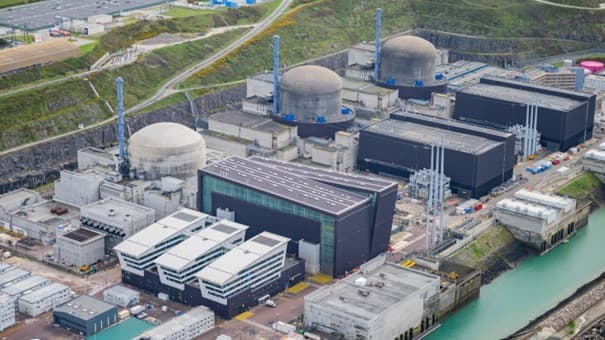
After long delays, the Flamanville 3 reactor has started up (source: EDF).
At the same time, Rolls-Royce SMR was far more open and allows far greater participation in the development and manufacture of its reactor. ČEZ therefore signed an agreement to acquire a stake in Rolls-Royce SMR. It expects to increase its share in the company to as much as 20 % in the future, with very significant involvement by Czech research organisations and manufacturing companies. Two plants for producing certain Rolls-Royce reactor modules could also be built in Czechia, one for example near a South Bohemian airport.
Such intensive involvement is conditional on construction of the first prototype of this reactor beginning in the United Kingdom soon. This depends on the outcome of the UK government's procurement process. It is to select up to four types of small modular reactors for use in the United Kingdom. In October 2024, the following six companies reached the shortlist: EDF, GE Hitachi Nuclear Energy, Holtec, NuScale Power, Rolls-Royce SMR and Westinghouse. In November, the selection was narrowed to four candidates: GE Hitachi, Holtec, Rolls-Royce SMR and Westinghouse. Intensive negotiations are now under way with them. The selection should be decided in the first half of 2025. The Wylfa and Oldbury sites, which the UK government bought from Hitachi, which had originally planned to build its large boiling-water reactors there, are also planned for small modular reactor construction.
ČEZ plans to follow the construction of the first prototype in the United Kingdom very quickly with construction of its own first small modular reactor prototype at the Temelín site, taking advantage of all the benefits of drawing on UK experience. Czech experts are already consulting and cooperating very intensively with their British counterparts and maintaining a good overview of the project's status.
A more detailed analysis of ČEZ's and the Czech Republic's strategy in nuclear energy is available in a recent article. Faster delivery of large nuclear units and deployment of small nuclear reactors will also be helped by the approved amendment to the Atomic Act, adopted at the end of 2024.
Possible paths to low-carbon energy discussed for the Vision for Czechia conference in Tábor.
Translation disclaimer
This article is a machine translation of the Czech original and has not yet been fully reviewed. In case of any doubt, please refer to the Czech version.
Sdílejte článek prostřednictvím:
Topics:Opinion
You might also like
24 September 2026, 11:23
24 September 2026, 10:30
24 September 2026, 06:56