
28 October 2026, 15:10
Loading...
American microreactor could enter operation as early as 2028

Marek Kršák
11 June 2024, 12:05

The US Department of Energy has reviewed and approved the safety design strategy for the Kaleidos microreactor developed by startup Radiant Industries. The reactor is located at a test facility at Idaho National Laboratory. World Nuclear News reports.
Radiant is one of three microreactor designs selected last October as eligible to receive USD 3.9 million from the Department of Energy (DOE) funding to develop and test their designs at the new National Reactor Innovation Center's Demonstration of Microreactor Experiments (DOME) test facility. Testing is scheduled to begin in 2026.
Radiant said the safety design strategy (SDS), which describes the approach adopted for the safety analysis of the Kaleidos reactor, is the initial stage of a comprehensive safety assessment process that every microreactor developer will undergo before fuel testing at DOME.
The company said testing at DOME will allow it to gather critical safety and performance data to support a future commercial licensing process with the US Nuclear Regulatory Commission.
"Approval of the SDS is an important step toward enabling a microreactor developer to conduct a test at our DOME facility," said Brad Tomer, acting director and chief operating officer of the National Reactor Innovation Center. "As a national laboratory for nuclear energy research, we are committed to working with private companies to help further develop advanced nuclear technologies that will provide clean energy solutions for the US," he added.
Radiant is currently working on the next phase of the safety review, focusing on the Conceptual Safety Design Report, which is intended to summarize the risk analysis work and safety decisions made during the conceptual design process. The report will also identify project risks related to the selected strategies.
After successfully completing reactor testing at the DOME facility, Radiant expects to deliver a limited number of pre-ordered Kaleidos units as early as 2028.
The Kaleidos microreactor is a 1 MWe high-temperature gas-cooled mobile microreactor that will use a graphite core and TRISO (tri-structural isotropic) fuel. The reactor will use the design of the EBR-II experimental reactor, which operated from 1964 to 1994, for testing purposes.
The reactor was originally built to demonstrate a complete sodium-cooled breeder reactor power plant. It was later modified to test other reactor designs and materials and fuels for fast reactors, as well as for electricity and heat generation.
Although the reactor and much of its supporting equipment have been dismantled, the remaining structure, with a diameter of more than 21 metres and a height of over 24 metres, is particularly well suited to reactor demonstrations and other nuclear projects.
Microreactor versus small modular reactor
A microreactor is a small nuclear reactor that can operate in various configurations: as part of the electricity grid, independently of the grid, or as part of a microgrid. This type of reactor can generate up to 20 megawatts of thermal energy, which can be used to produce electricity and heat for industrial applications.
Most microreactors are designed to be trailer-transportable. Microreactors are 100 to 1000 times smaller than conventional nuclear reactors, while small modular reactors (SMRs) have a capacity of 20 to 300 megawatts.
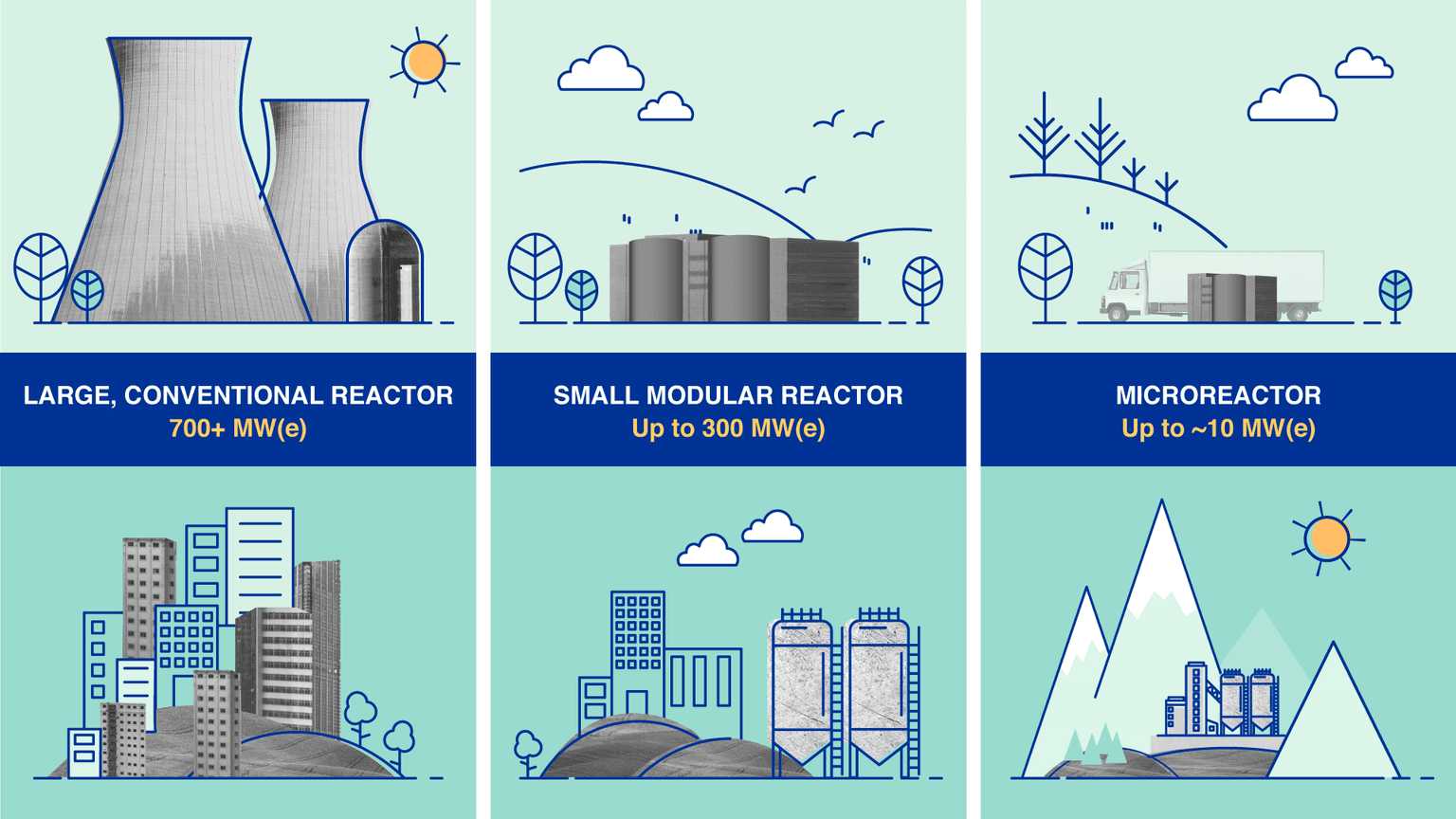
Source: International Atomic Energy Agency
Translation disclaimer
This article is a machine translation of the Czech original and has not yet been fully reviewed. In case of any doubt, please refer to the Czech version.
Sdílejte článek prostřednictvím:
You might also like

28 October 2026, 13:08

28 October 2026, 11:10

28 October 2026, 09:08
