22 September 2026, 14:20
Loading...
States back geothermal energy development at San Salvador conference; new study to help Czechia

Lukáš Lepič
4 October 2022, 09:42
The second conference organised by the Global Geothermal Alliance (GGA) took place in San Salvador in the last week of September. At the end of the conference, participants declared their efforts to strengthen global cooperation in the development of geothermal energy. The main goals of the approved declaration are to strengthen international cooperation in achieving a fivefold increase in installed capacity for geothermal power generation and a threefold increase in geothermal capacity for heating by 2030.
The second GGA conference was held under the auspices of the Salvadoran government in cooperation with the International Geothermal Association (IGA). The main theme of the conference was the opportunities and challenges associated with supporting and developing geothermal energy.
“Geothermal energy is a vital energy source that remains largely untapped for both electricity generation and heating,” IRENA Director-General Francesco La Camera said at the conference. “Realising the full potential of geothermal energy requires political will, cross-sectoral collaboration and substantial investment. The San Salvador Declaration is a significant milestone in accelerating global efforts.”
The San Salvador Declaration, whose conclusions build on the Florence Declaration of 2017, also emphasises the role of the Geothermal Alliance as the main global platform for discussion, cooperation and coordinated action among stakeholders in the geothermal energy sector.
Over the years, the alliance's membership has grown to 49 countries and 54 partner institutions, including multilateral organisations, development partners, international and regional organisations, global financial institutions, academic communities, research institutions and industry associations.
Global geothermal energy development is lagging behind
In 2021, global installed geothermal capacity saw an exceptional increase of 1.6 GW. However, geothermal energy's overall share of the global energy mix remains very low. Only 28 countries worldwide use geothermal energy for electricity or heat generation. It is used for electricity generation in only 26 countries.
According to the International Energy Agency (IEA), geothermal power plants generated a total of 84 TWh in 2020. This is a negligible contribution to total global electricity generation, which has exceeded 25 thousand TWh annually since 2016.
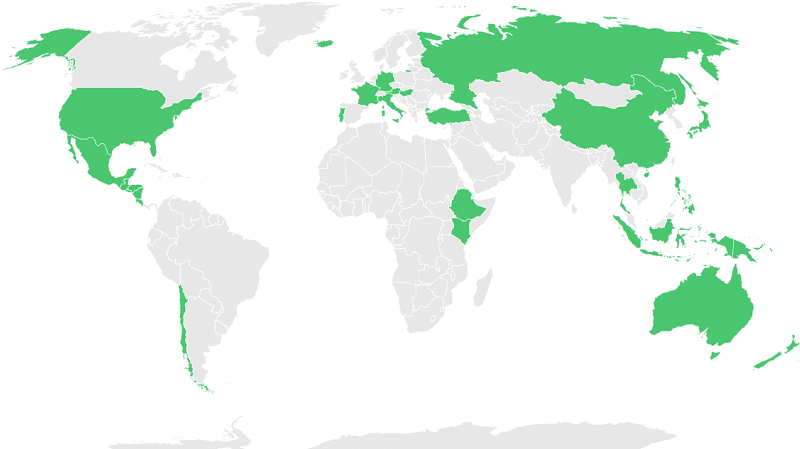
Countries generating electricity from geothermal energy Source: BP Statistical Review
A key barrier to wider development is the fact that geothermal energy can be used only in selected areas with specific geological conditions. Investments are also burdened by high costs and risk, as the return on investment can never be confirmed before exploratory drilling is carried out.
According to the IEA, under an optimistic scenario, global annual geothermal electricity generation could reach up to 330 TWh by 2030. According to the IEA, such a steep increase in installed capacity and generation is hampered, among other factors, by underdeveloped national policies and regulations that would reduce the risk of investment in geothermal resources.
A gradual decline in the costs of geothermal projects and the fulfilment of national and international emissions-reduction targets may help change the current trajectory. The main advantages of this source are its independence from current weather conditions and its very high capacity factor, enabling stable and economically viable electricity and heat generation.
For these reasons, geothermal power plants can supply baseload electricity and, in some cases, provide ancillary services for both short-term and long-term flexibility. This makes them one possible replacement for coal- or gas-fired sources in electricity and heat generation.
Geothermal energy accounts for a significant share of electricity demand in countries such as the Philippines, El Salvador, New Zealand, Kenya and Iceland. In continental Europe, there is significant potential for further development, for example in Hungary and Italy. Outside Europe, potential for further geothermal energy development has been identified, for example, in countries in East Africa.
The United States currently has the largest installed capacity of geothermal power plants. In 2021, it generated more than 16 TWh of electricity, or roughly 19% of total global geothermal power generation.
Results of a new study are expected to support greater development in Czechia
In the Czech Republic, geothermal energy is primarily associated with district heating. Greater potential for geothermal energy use exists in the Ore Mountains, western Bohemia and the Jeseníky region. In the past, construction was considered, for example, in Litoměřice and Liberec, where exploratory drilling was carried out.
As elsewhere in the world, the more significant development of geothermal energy in Czech conditions is hindered by the technical complexity and capital intensity of projects. Projects are also subject to a high degree of risk due to a lack of data on local conditions. Legislative shortcomings are another obstacle.
More accurate data and greater geothermal energy development are expected to result from a project analysing the potential of geothermal energy at medium and great depths in the Czech Republic, the results of which were expected to be known in 2022. The main objective of the research project is to analyse geothermal energy potential in Czechia at depths of approximately 400 to 5000 metres and then refine or newly define promising areas for the use of geothermal energy in direct heat and electricity generation.
The project brief also includes the creation of maps of conflicts of interest related to geothermal potential. This step will identify potential spatial conflicts hampering further development. The results of the study are then expected to help identify an effective way of supporting geothermal resources and developing decentralised heat and electricity generation in the Czech Republic.
Translation disclaimer
This article is a machine translation of the Czech original and has not yet been fully reviewed. In case of any doubt, please refer to the Czech version.
Sdílejte článek prostřednictvím:
You might also like
22 September 2026, 12:50
22 September 2026, 06:09
21 September 2026, 15:25