
28 October 2026, 15:10
Loading...
Uncertainty over gas demand in Europe: A challenge for US exporters

Lukáš Lepič
26 March 2024, 14:24
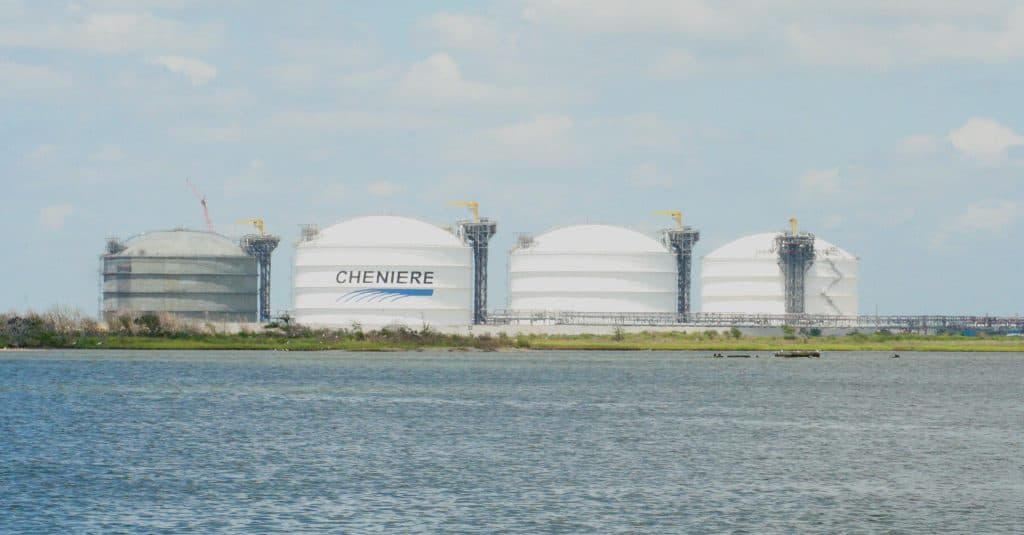
Europe’s efforts to reduce its dependence on Russian gas initially benefited the US liquefied natural gas (LNG) sector. However, long-term market trends and regulatory changes point to a decline in European demand as early as 2030. Scenarios based on the Fit for 55 and RePowerEU plans indicate a reduction in supplies of 29 to 52%. The EU market is therefore unlikely to contribute to growth in demand for US LNG exports.
The decline in Russian gas supplies to less than 15% in 2023 triggered a sharp increase in demand for liquefied natural gas (LNG). This increased the share of supplies to Europe from alternative suppliers. US suppliers benefited significantly from this trend, becoming Europe’s largest LNG supplier in 2023. The US exported 56.2 bcm, or almost 50% of imported LNG, and exports almost tripled compared with 2023.
In response to the war in Ukraine, however, the European Union set a target of reducing overall gas consumption. Its dependence on Russia through pipeline infrastructure is to be completely ended by 2027. Under the RePowerEU plan, overall gas demand is to be cut by as much as half (52%) by 2030 compared with 2019. This target is much more ambitious than the Fit for 55 package, which aims to reduce consumption by 29% by 2030.
According to the Agency for the Cooperation of Energy Regulators (ACER), LNG supplies will adjust to falling demand. If consumption is reduced in line with Fit for 55, total supply volumes will fall from 330 bcm in 2024 to 311 bcm in 2030. The scenario based on the RePowerEU plan forecasts that only 184 bcm will be imported into the EU, with supplies already falling to 312 bcm in 2025.
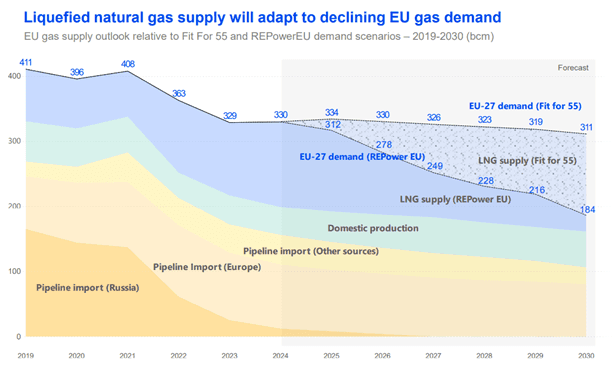
Scenarios for EU gas consumption through 2030. Source: ACER
A challenge for US exporters and investors in Europe
Uncertainty over the future trajectory of gas consumption in Europe poses another challenge for US exporters. The prospect of falling demand in key markets will make it harder for them to sign long-term gas supply contracts. Many projects, however, are not due to be completed until the second half of the decade, when demand in the EU is expected to weaken.
The uncertainty also affects investors in Europe as they plan further investment. Such investment is particularly important to ensure the security, modernisation and transformation of infrastructure. At the same time, natural gas is expected to help many countries bridge the transition away from coal. In Germany, for example, gas was expected to play a key role in the energy transition.
Translation disclaimer
This article is a machine translation of the Czech original and has not yet been fully reviewed. In case of any doubt, please refer to the Czech version.
Sdílejte článek prostřednictvím:
You might also like

28 October 2026, 13:08

28 October 2026, 11:10

28 October 2026, 09:08
