Floating solar panels: The future of Britain's energy sector without taking up land?
Could floating solar panels replace conventional ones? A new report by CBI Economics assesses the technology’s potential for the United Kingdom. According to the study, with the right policy framework, floating solar systems could deliver more than 40 GW of clean energy by 2050 — without taking up a single hectare of agricultural land.
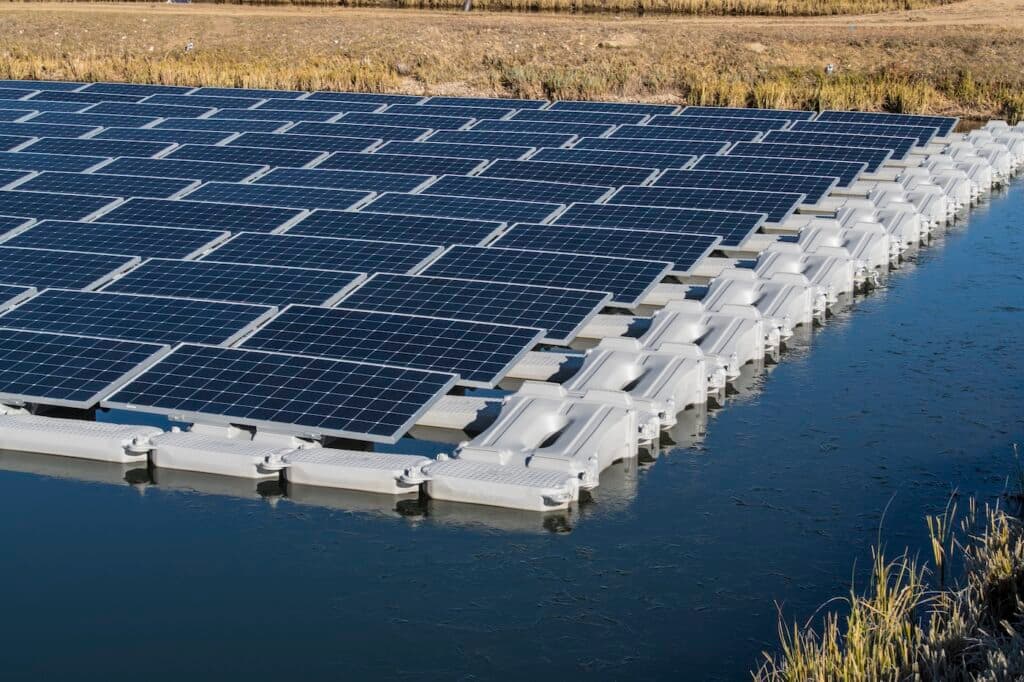
Floating photovoltaic (FPV) systems consist of solar panels mounted on floating platforms anchored to inland bodies of water, such as reservoirs, lakes, former quarries or industrial ponds. The technology for converting sunlight into electricity is identical to that used by conventional ground-mounted installations. The key difference is the supporting structure, which uses modular floating components instead of conventional steel mounts.
The technology has been developing globally since 2008, with more significant growth taking place after 2016. By 2024, global installed capacity had reached 9.2 GW, with around 90% accounted for by Asian markets. In Europe, the Netherlands and France are leading the way, with the technology gaining traction and support. Analyst Wood Mackenzie forecasts that global capacity could reach 77 GW by 2033.
Interest in the technology is also growing because of mounting concerns about ground-mounted solar power. In many countries, including the United Kingdom, large ground-mounted installations face public opposition over their impact on the landscape and use of agricultural land. Floating solar avoids this conflict by using bodies of water that are otherwise often left unused. The study also finds that many suitable bodies of water — up to 47 000 hectares in the United Kingdom — are located close to cities and industrial businesses, and therefore near electricity consumers.
What does the study say?
The study models three scenarios for FPV development, based on the level of government intervention and other market assumptions. The results vary dramatically depending on how actively the government supports the technology.
The pessimistic scenario assumes no support through the Contracts for Difference (CfD) scheme, no simplification of planning procedures and no priority access to the transmission grid. Under these conditions, FPV deployment would be negligible, with total capacity not exceeding 1.1 GW by 2050.
By contrast, the central scenario combines CfD support with planning concessions for industrial and artificial bodies of water, resulting in gradual but significant growth: 3.6 GW in 2030, 18.3 GW in 2040 and more than 40 GW in 2050. Floating solar would reach price parity with ground-mounted solar in the mid-2030s.
The most ambitious scenario, in which the government allocates a specific amount of CfD funding and makes maximum use of available water bodies, would deliver 8.9 GW as early as 2030 and almost 59 GW by 2050. Floating solar would become cost-competitive with ground-mounted installations before the end of this decade. In the ambitious scenario, construction investment would exceed £30 billion and create around 15,000 jobs.
"It is time for Britain to stop letting its solar potential float by. For too long, we have failed to harness the huge opportunities offered by floating solar. As this report shows, floating solar could generate as much power by 2040 as around 11 gas-fired power stations,"said Michael Shanks, the UK’s energy minister.
Benefits beyond electricity generation
Floating solar systems offer more than just clean energy. A study drawing on a systematic review of more than 90 scientific publications conducted by Lancaster University and the UK Centre for Ecology & Hydrology shows that well-designed installations also deliver water-management and environmental benefits.
Every study reviewed found that FPV reduces evaporation, while water surface temperatures typically fall by 1–2 °C during warmer periods. Shading the water also suppresses the growth of cyanobacteria and algae, reducing water-treatment costs. These benefits are particularly relevant in the context of climate change.
For water companies, floating solar systems offer a way to reduce their own energy costs by directly powering their operations, diversify their income and contribute to decarbonisation.
Translation disclaimer
This article is a machine translation of the Czech original and has not yet been fully reviewed. In case of any doubt, please refer to the Czech version.