Japan begins testing ammonia-burning turbines, with market launch targeted by 2030

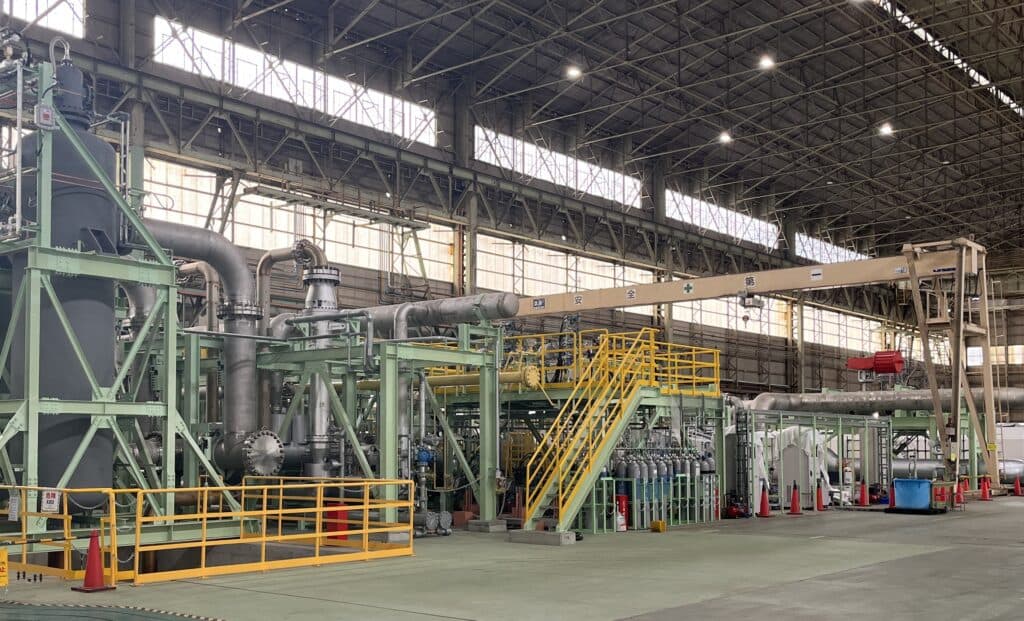
IHI Corporation (IHI) and GE Vernova (GEV) have completed a new facility for testing gas turbines that burn pure ammonia. This is expected to be another step towards bringing the technology to market by 2030. GEV announced the news in a press release.
Japan published a plan to accelerate the development and deployment of technologies for generating electricity from ammonia in mid-2021. The plan covers, on the one hand, coal burners capable of co-firing more than 50% ammonia and, on the other, gas turbines that burn pure ammonia. Both technologies are expected to be ready for commercial use by 2030.
Jera, Japan’s largest power producer, for example, tested co-firing a 20% share of ammonia last year in one of the gigawatt-scale units at the Hekinan coal-fired power plant. According to information released, the three-month test was successful.
Now, following positive news about progress in co-firing ammonia at coal-fired power plants, IHI and GEV have announced the completion of a large-scale test facility for gas turbines that burn 100% ammonia.
"This milestone represents a significant step forward in our technology roadmap, based on the 2024 joint development agreement, which aims to introduce a combustion system capable of burning 100% ammonia by 2030," said Kensuke Yamamoto of IHI.
Under the 2024 joint development agreement, the two companies are seeking to develop a new combustion chamber that would enable pure ammonia to be burned in GE Vernova’s F-Class gas turbines.
"Renewables and electric vehicles cannot solve everything, so we expect significant demand for hydrogen and ammonia in heavy industry, road freight, thermal power plants and other sectors," Japanese Minister of Economy, Trade and Industry Daisuke Hirota said in June.
According to Japan’s updated hydrogen strategy, domestic demand for ammonia is expected to rise from around one million tonnes a year currently to three million tonnes by 2030, and then to 20 million tonnes in 2050.
Translation disclaimer
This article is a machine translation of the Czech original and has not yet been fully reviewed. In case of any doubt, please refer to the Czech version.




