Trump's measures are not working yet: record volumes of solar and batteries are being added in the US

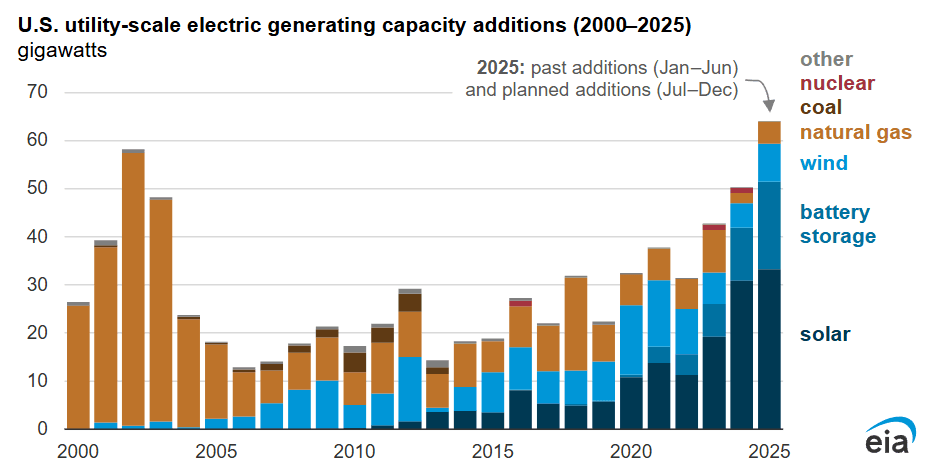
More than half of the newly commissioned capacity in the United States this year is expected to come from utility-scale solar plants, with a record 33.3 GW set to be added. A further 18.3 GW of battery storage, 7.8 GW of wind power and 4.7 GW of gas-fired power plants are expected to come online. That is according to an analysis by the US government agency EIA.
Data released by the US government agency EIA show that developers commissioned 12 GW of utility-scale solar plants in the first half of this year and plan to add a further 21 GW in the second half. If these plans are fulfilled, utility-scale solar plants will account for more than half of the newly commissioned capacity in the US this year.
Strong growth is also expected in battery storage, with more than 18 GW expected to come online in the US this year.
"If the solar plants and battery storage projects planned for this year are completed, it will be the best year on record for both technologies. In both cases, growth is driven primarily by developments in Texas," the EIA said.
The EIA also said that if all the capacity planned for this year, amounting to 64 GW, comes online, it would also be a record year for total newly commissioned capacity. The previous record was set in 2002, when 58 GW of new capacity came online, of which 57 GW consisted of natural gas-fired power plants.
Impact of the "One Big Beautiful Bill"
The figures above show that President Donald Trump's measures targeting the development of renewable energy sources are having the opposite effect for now. The situation is likely to change in the coming years, however. For example, analysts at BloombergNEF have cut their forecast for newly commissioned wind, solar and battery storage capacity in the 2025–2030 period by almost a quarter in response to the passage of the "One Big Beautiful Bill".
The wind power sector is expected to be the hardest hit, with BNEF researchers cutting their forecast for new capacity in 2025–2030 by 50% compared with their forecast from the first half of this year. For solar power, BNEF expects a 23% decline, and for energy storage systems, a 7% decline. In total, new capacity from these sources over the period is expected to reach 395 GW, 23% less than the previous forecast of 512 GW.
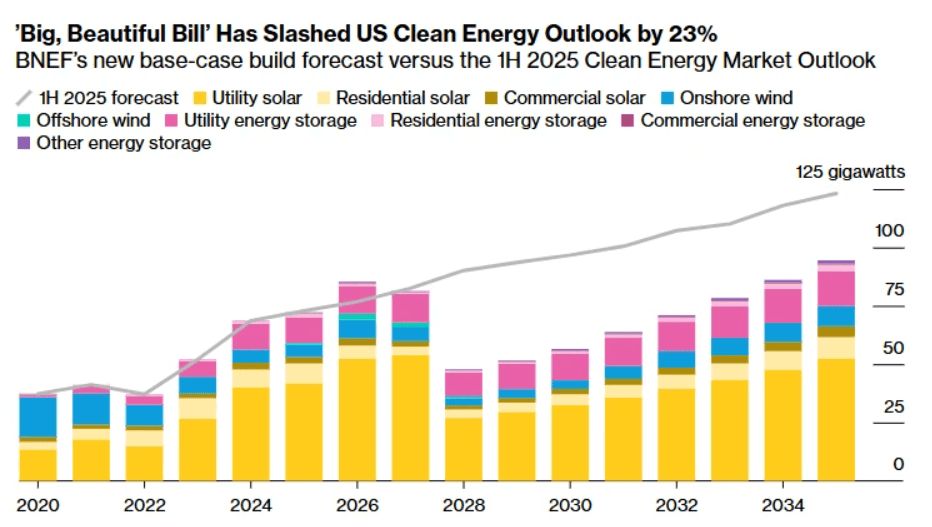
BNEF's analysis shows that project developers have a very short window in which to qualify for tax credits. According to BNEF, construction essentially needs to begin before the end of this year. Starting construction early could also protect developers from the impact of further planned measures aimed at preventing solar and wind developers from accessing support.
"The rush to start construction is forcing developers to take risks when signing supply contracts, securing grid connections, obtaining permits and allocating capital. Most mid-sized developers with a limited appetite for risk may be unwilling to accept these risks given the potentially significant consequences," BNEF added.
Translation disclaimer
This article is a machine translation of the Czech original and has not yet been fully reviewed. In case of any doubt, please refer to the Czech version.




