Wind turbines in some acceleration areas will have to be lower than 185, or even 160 metres. This will lead to a paradoxical situation: for Czechia to achieve the required capacity, it will have to build more turbines.
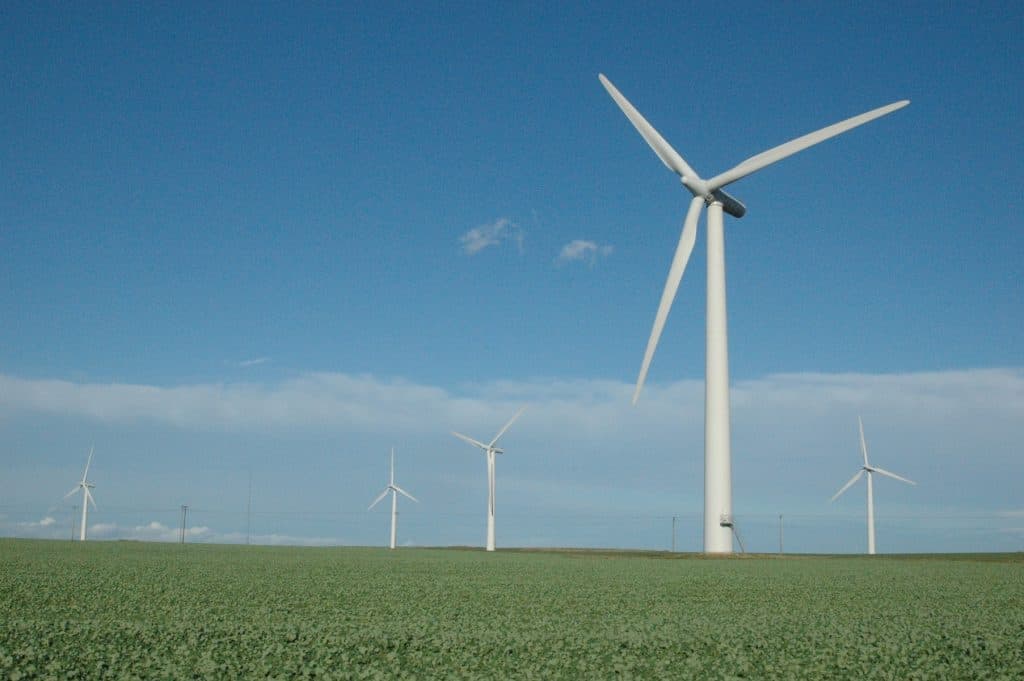
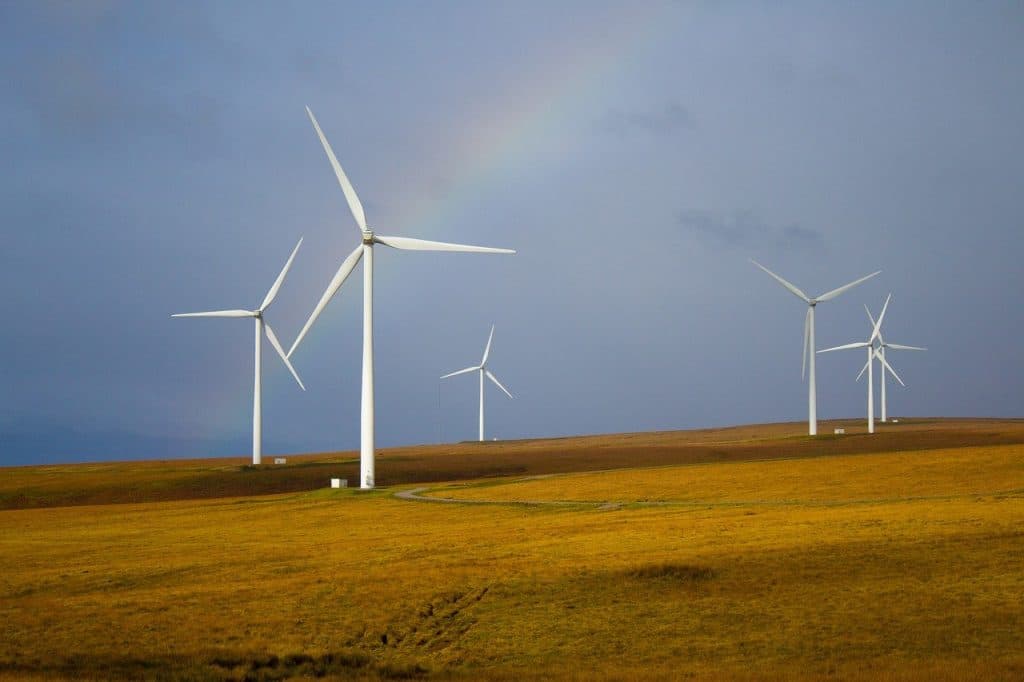
Modern wind turbines commonly reach heights of 200 to 270 metres. Yet in seventeen acceleration areas presented by the state two weeks ago, the maximum height has been set at 185 metres. In the Kryštofovy Hamry zone on the ridges of the Ore Mountains, the state has even set a limit of 160 metres. In total, the state has proposed 94 acceleration zones.
The reason is often “landscape character”, meaning an effort to ensure wind turbines do not disrupt views of a monument, or even views from a monument. For example, in the Ralsko zone, where the 185-metre limit applies, Ještěd, Děvín and, more distantly, Bezděz prevent the construction of taller wind turbines.
“It is necessary to protect the iconic images of the typical Czech ‘romantic’ landscape, with the characteristic landmark of Bezděz Castle and typical volcanic cones, as well as the distant landscape of the Bohemian Central Uplands, Bohemian Switzerland and the Elbe Sandstone Mountains, with the table mountain Děčínský Sněžník and the Lusatian Mountains, and to protect important views of this landscape from the Bohemian Paradise and Ještěd,” the rationale for the Ralsko acceleration zone states. One aim, among others, is therefore to ensure that tourists on Ještěd do not look at tall wind turbines. On the other hand, they already have to look at Liberec.
Petr Holub, the former director-general of the climate protection section at the Ministry of the Environment, discussed protection of landscape character with the Ministry of Culture and the National Heritage Institute under the previous government. “We ultimately agreed that, yes, key views of a monument need to be protected, but it is simply impossible to ensure that no wind turbine can be seen anywhere from a monument; otherwise, we would not build them anywhere,” Holub says.
Construction will become more difficult
Acceleration zones are based on a European Union concept. Czechia has committed to designating these sites, where permitting for renewable energy sources will be simplified so that they can be built more quickly. In recent years, the permitting process for wind turbines often took as long as ten years.
However, if the state has set limits that do not correspond to the actual height of modern wind turbines, this will paradoxically make construction more difficult. “Under the principle of the legislation in question, conditions for an acceleration area should not be set in a way that makes them worse for an investor than outside the acceleration area,” Holub comments.
If someone wanted to build a taller wind turbine in a given acceleration zone, they would not be allowed to do so. This would apply even if they did not use the benefits of acceleration zones. “Once such a spatial measure, which is a measure of a general nature, is established, it also applies to the standard permitting process. So the height limit is set until the spatial planning documentation is changed again,” Holub explains.
“Once Amendment No. 2 to the Spatial Development Plan, defining the acceleration areas, takes effect, the height limits stated in the individual spatial measures will also be binding for permitting projects in an acceleration area pursuant to Section 25 of the Act on Accelerating the Use of Certain Renewable Energy Sources,” says Veronika Lukášová, spokesperson for the Ministry for Regional Development, which is responsible for designating acceleration zones.
“If the conditions under which the limits in question were set change, a motion may be submitted to prepare an amendment to the spatial measure,” Lukášová adds. According to her, a change in conditions could include, for example, an adjustment of airport zones, which are also a reason for wind turbine height limits in some areas.
It should be added that the government has not yet officially designated the acceleration zones. A consultation process is currently under way, and a public hearing is due to take place in two weeks.
They are not selected based on wind
As follows from the 2020 Update of Wind Energy Potential in the Czech Republic, wind speeds are by far the highest in the Vysočina Region. Yet only ten acceleration zones for wind energy have been drawn there. The reason is protection of landscape character.
“The Vysočina Region has its Landscape Character Protection Strategy, in which it has many landmarks that it protects—or rather, it protects views of them—and it also has many landmarks from which it protects the view,” says Štěpán Chalupa, chairman of the Chamber of Renewable Energy Sources and vice-chairman of the Czech Wind Energy Association.
The main factor in deciding on wind turbine construction should be how often the wind blows at a given site. The reality, however, is different. “It is increasingly becoming clear that wind conditions are not the most important criterion for building wind turbines,” says David Hanslian of the Institute of Atmospheric Physics of the Czech Academy of Sciences, who authored the aforementioned update. “The most important thing is to find a site with the least possible conflict with other public interests, whether nature protection, protection of people from noise, military interests and so on,” Hanslian says.
The problem arises when, in an effort to minimise conflicts, areas for wind turbine construction are sought even where there is hardly any wind at all. “Some acceleration zones are in places where there is really very little wind. And if they are also limited in height, wind power projects in those areas simply will not be viable,” Hanslian warns.
Terrain also matters: whether the landscape is hilly or flat, or whether it is a forested area. “A forest is around 25 metres tall on average, so for a wind turbine to be reasonably high above the forest, its blade tip at the lowest point should be at least 50 metres above ground. If you have a height limit of 185 metres, that leaves around 135 metres, and wind turbines of this size are hardly produced any more,” Hanslian says.
Ministry of Defence interests
The lowest limit for wind turbines is in Kryštofovy Hamry. The local wind turbines are to be no more than 160 metres tall, partly in order to protect the interests of the Ministry of Defence.
“The Kryštofovy Hamry area is located within an area designated by the Ministry of Defence, specifically within the Hrušovany radar interest area. The maximum height of a wind turbine in the area concerned could range from 427 to 450 metres above sea level; however, the terrain in this area lies at up to 800 metres above sea level, which intrudes into the aforementioned Ministry of Defence designated area by around 350 metres. Any wind turbine, including the limiting height stated in the measure of a general nature, would therefore interfere with the ministry’s territorial interests and thus threaten national defence and security,” Magdalena Hynčíková of the Defence Ministry’s press department told Ekonews in response to a query.
“We have long been opening a debate with the Ministry of Defence on whether we should at least examine some alternatives, so that sites that may already be in use and trouble-free are not blocked,” Štěpán Chalupa comments.
“So that, paradoxically, we do not push wind turbines into places where their generation will be inefficient or where there will be other problems. Technical solutions exist, such as adjusting plant operations, diverting communication beams, software solutions or relocating the relevant equipment, including radars. Turbines can also help. We need to look at examples of good practice abroad,” the expert says.
They will be visible anyway
Each acceleration zone has an estimated total capacity of wind turbines that could be built there. In the aforementioned Kryštofovy Hamry, the 2.7 square kilometres of acceleration zone are assigned 28 megawatts of capacity. This would mean roughly two modern wind turbines with a capacity of five megawatts per square kilometre. However, if they have to comply with a 160-metre height limit, they will be less powerful turbines, and suddenly there will need to be three per square kilometre—eight for the whole area. “It is better to have fewer turbines that are modern and have higher capacity,” Petr Holub believes.
“The turbines will be visible anyway, whether they are 180 metres or 250 metres tall. So, even from the perspective of landscape character, it would be better to have fewer taller turbines than more smaller ones,” Chalupa says.
There is no direct relationship under which a taller turbine automatically has higher capacity. “However, if you want to install higher unit capacity and generate more electricity, then in most places in the country you need a taller tower, because you need to reach an area with higher wind speeds and more stable airflow,” Chalupa adds.