Wind turbines with larger rotors aim to boost generation. Height limits could hold them back in Czechia

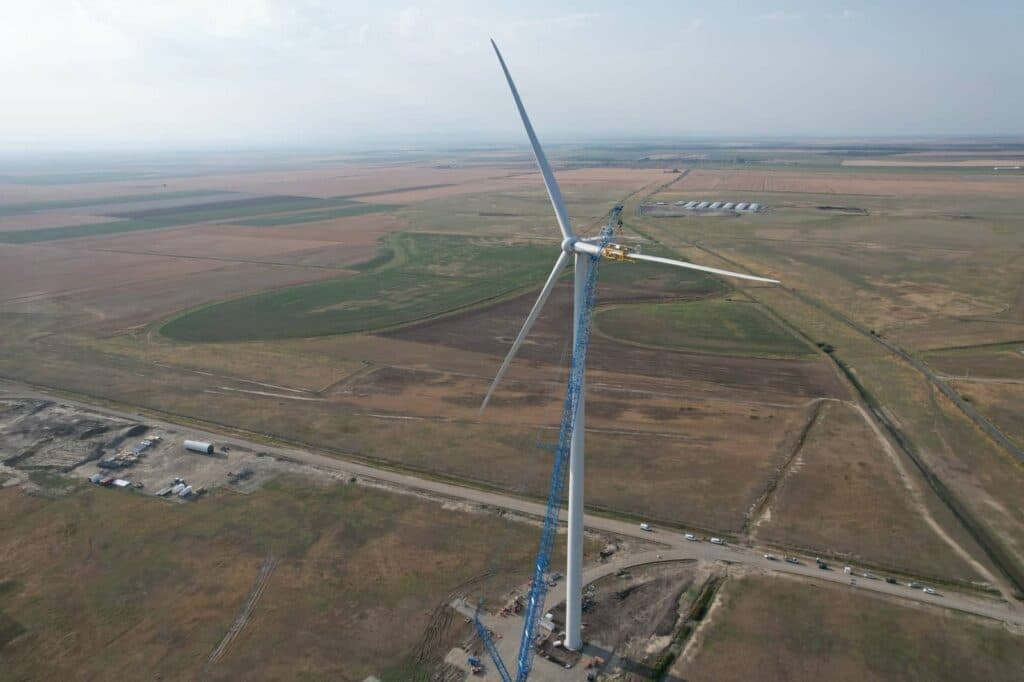
Wind turbine manufacturers are bringing a new generation of turbines to market, designed to generate more electricity even at sites with weaker or moderate wind flows. Instead of further increasing rated capacity, current design development is focused primarily on enlarging rotor swept areas. This could be an attractive direction for investors, as it can significantly boost returns from projects at less windy sites and enable available land to be used more efficiently.
The technological shift was particularly evident at the WindEnergy Hamburg trade fair, where leading European manufacturers Vestas and Nordex showcased their latest models, specifically designed for sites with low to moderate wind speeds. A larger rotor allows a turbine to capture more wind energy even at lower wind speeds, without the need to increase the generator size or the machine's rated capacity proportionally.
Danish manufacturer Vestas unveiled a new model with a rotor diameter of 182 metres, a ten-metre increase over the previous version. The turbine's rated capacity remains unchanged at 7.2 MW. The new model therefore has a considerably larger swept area while retaining the same maximum output. The turbine's specific power—the ratio between its installed capacity and the area swept by the rotor—is 277 W/m². The lower this figure, the better the turbine is at harnessing energy from weaker winds.
According to the manufacturer, the new unit can generate up to six percent more electricity annually, increase its capacity factor by up to two percentage points and achieve a selling price on the market that is up to three percent higher, thanks to a more predictable generation profile.
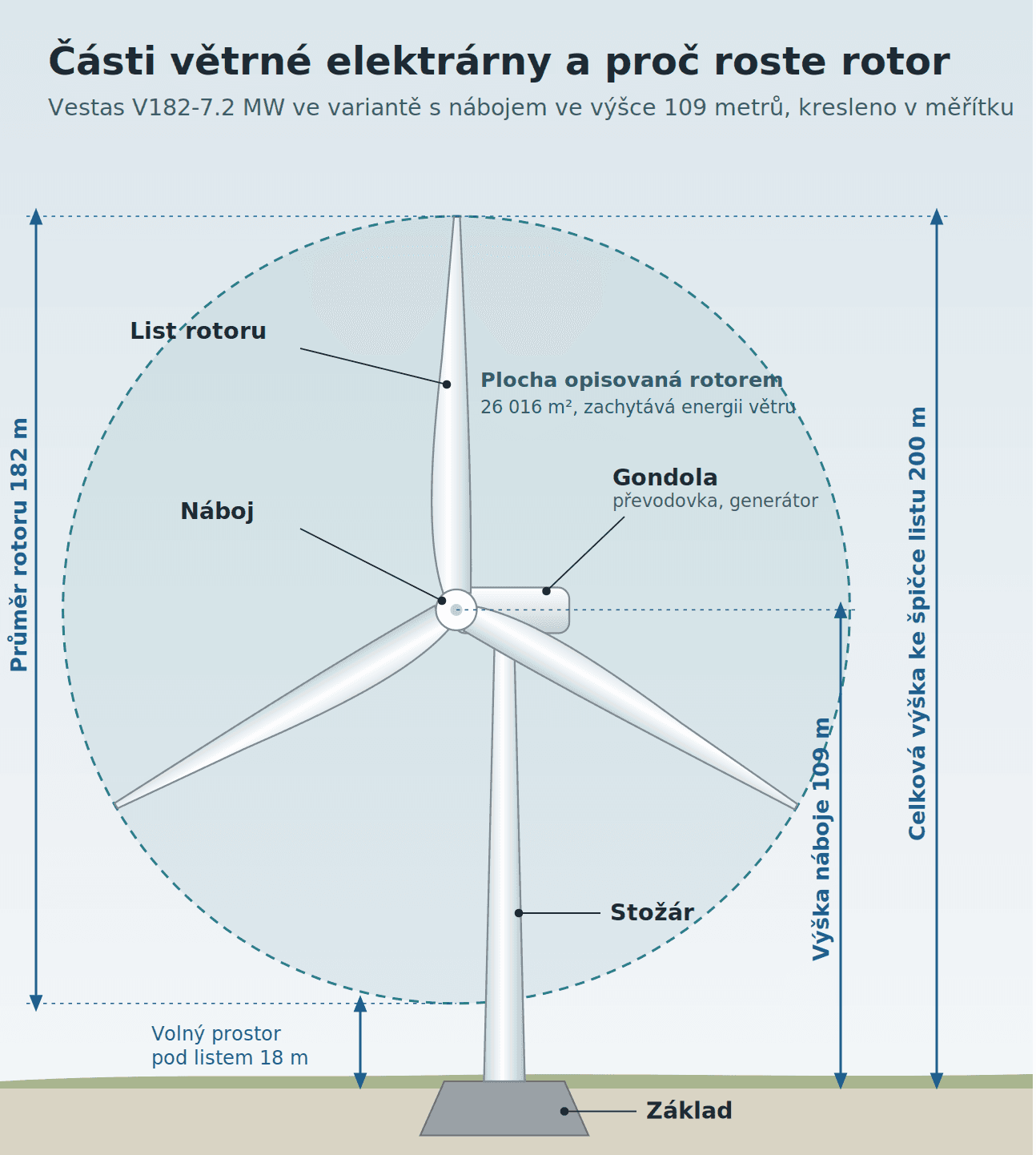
Even larger dimensions are offered by Germany's Nordex with its N193/7.X model, which the manufacturer says can increase annual output by up to 14 percent at typical inland sites compared with its current model. Vestas plans to start series production of its new model at the end of 2027, while Nordex expects to begin production in 2029.
Chinese producer Envision has also adopted the same philosophy. The manufacturers' shared strategy is therefore to maximise actual annual generation under given climatic conditions rather than simply boost peak capacity on paper. What matters for project economics is how many megawatt-hours a turbine actually delivers to the grid and how its operation aligns with the capabilities of the distribution network and market price profiles.
Czech acceleration areas and the clash with on-the-ground limits
While this trend is paving the way for wider deployment of wind turbines in Western Europe and beyond, its practical application in Czechia could run up against strict height limits in newly designated acceleration areas.
The government approved the designation of so-called acceleration areas for renewable energy sources at the end of July 2026 . However, strict height limits have been set in many of them. While a cap of 185 metres applies at selected sites, a limit of just 160 metres in total height has even been proposed for the Kryštofovy Hamry area. This is where efforts to build more efficient machines come into direct conflict with land-use regulations.
That this is not a hypothetical dispute is shown by a project by ČEZ Obnovitelné zdroje near the municipality of Norberčany. The investor originally planned to build six modern turbines, each 240 metres tall, but five of them fall within an acceleration area with a maximum limit of 185 metres. The investor has stated that it will comply with the limits, but expert assessments warn that requiring the installation of shorter turbines would significantly undermine the project's overall economics. The zone would therefore speed up the administrative process while ruling out the use of the most modern and efficient technologies on the market.
The dimensional impact is clear in the case of the Vestas V182 model. According to the manufacturer's standard configurations, the hub height (the centre of the rotor) is 109 or 170 metres. Adding the rotor radius (91 metres) gives a total turbine height of approximately 200 or 261 metres at the tip of the blade at its highest point. The turbine therefore would not fit within the proposed Czech limits in either configuration.
In Czech conditions, where wind potential is mostly moderate, this means a marked decline in profitability. Modern wind turbines commonly reach a total height of 200 to 270 metres. If a project is to achieve its originally envisaged capacity within the height limits, the only option is to install a larger number of smaller turbines. Paradoxically, however, this increases the land take, infrastructure requirements and risk of further conflicts with landscape protection.
When setting the conditions for acceleration areas, it is therefore not enough to calculate only the theoretical installed capacity on paper. The key question is whether the rules allow the deployment of technologies that make economic sense in the moderate wind conditions of Central Europe. Analyses also show that the total planned capacity of Czech acceleration areas is only just above the binding target of three gigawatts—and only if they are used to their full potential.
Translation disclaimer
This article is a machine translation of the Czech original and has not yet been fully reviewed. In case of any doubt, please refer to the Czech version.