23 October 2026, 14:38
Loading...
Czechia chokes on emissions from residential chimneys. People have pulled “prehistoric monsters” out of cellars
Ekonews.cz
30 January 2023, 10:54
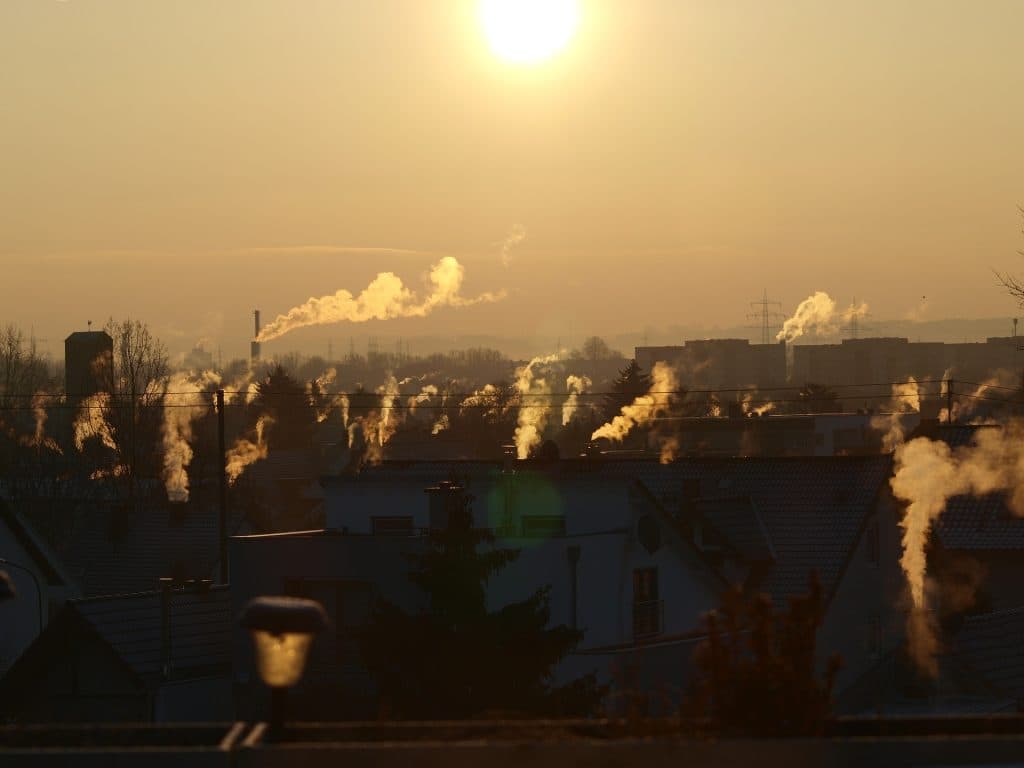
Local heating appliances are among the biggest air polluters. And given high electricity and gas prices, people are burning all sorts of things. They are getting away with it because the state has postponed the requirement to replace non-compliant equipment.
Although air quality in Czechia has been gradually improving, a high share of emissions is released by households using local solid-fuel heating. This accounts for more than a third of heat supplied to domestic households, according to the Czech Republic’s 2021 Environment Report, which was recently published. In terms of emissions, local heating appliances pose problems not only when burning coal, but also wood, wood waste and other materials.
As recently as last November, the situation was relatively stable, according to the Czech Hydrometeorological Institute (CHMI). Its representatives welcomed the improvement in heating quality between 2017 and 2021, alongside a decline in the content of problematic particles. However, by the end of last year, the institute indicated that the energy crisis had worsened the situation. “Preliminarily assessed data from February 2022 have already recorded a certain increase in concentrations of carcinogenic benzo[a]pyrene in PM10 suspended particles at several locations,” said Markéta Schreiberová of the CHMI’s air quality information system department.
This points to a potential deterioration in heating quality. The Hydrometeorological Institute is preparing to publish a report for the whole of last year in the coming days, which is said to confirm a year-on-year deterioration despite a mild winter without many inversion days. A similar trend is indicated by air quality and weather monitoring by Agdata, which is used by many towns and municipalities in Czechia.
“In areas of detached housing, this year we are seeing an average 5% increase in concentrations of airborne dust produced by combustion compared with the previous heating season. This is despite average temperatures being 0.3°C higher in November and 0.5°C higher in December than a year earlier,” says Lukáš Musil, commercial director of Agdata City.
Wood and pellet boilers are currently suitable
According to Petr Cankař, technical director of Jaroslav Cankař a syn ATMOS, a manufacturer of solid-fuel boilers, the worst consequence of rising energy prices is that people have pulled old boilers out of their cellars. “Expensive natural gas and electricity have led people to start heating again with boilers that have been sitting in their boiler rooms for 15 to 25 years. In other words, ‘prehistoric monsters’ that they should have replaced long ago. Their technical condition is deplorable and they pollute the surrounding area with smoke. However, due to the postponement of the mandatory replacement of old boilers in the amendment to the Air Protection Act, they do not have to replace them,” he says.
The current waiting time for a new boiler is said to be about six months, but the situation is improving. The strongest demand is traditionally for wood boilers and combined wood and pellet boilers. Pellet boilers and specialised coal gasification boilers are also selling well. Heating with logs is the cheapest option, followed by lignite and coal briquettes. “Next comes heating with wood pellets, whose price was briefly at a higher level but is now falling sharply,” says Cankař. He would personally recommend that customers choose a combined wood and pellet boiler, ideally connected to a storage tank.
Wet wood does boilers no favours
Jaroslav Schön, president of the Czech Chimney Sweeps Association, believes that above all, people should not put things into boilers that do not belong there. Doing so permanently damages both the boilers and chimneys, while also contaminating the air in the area where they themselves live. “I hope people are beginning to understand that if they destroy their chimney, rebuilding it can cost as much as 50 thousand koruna. The same applies to replacing a boiler,” Schön warns.
“If I have an older coal boiler, there is no point pretending that I will be more environmentally friendly if I burn wood in it. The design of a coal boiler is different. It does not allow wood to be burned efficiently and environmentally,” the expert explains, adding that it is enough to carry out annual inspections as required by fire safety legislation and learn through them how to heat better. “But the problem is households that do not even call us in. There, it is often so clogged with tar that we have to break through the chimney,” he says.
He considers it another offence when people burn wet wood instead of dried briquettes. He also encounters cases where they close the boiler ventilation or air inlets to the room where it is located in order to keep the house at a minimum temperature all day. They save fuel that way, but clog both the chimney and the boiler itself.
Adding fuel to fireplace stoves is also problematic. Ideally, this should be done only once the wood has burned down and glowing embers remain, rather than directly into the flames. Fireplace stove doors should be opened slowly so that cold air does not rush in and the chimney does not suffer a “shock”. This will prevent flue gases from escaping into the room.
Even a new boiler can cause trouble
Veronika Buková, an education officer at the Association for Chimney and Combustion Optimisation (APKOS), points to a significant factor. In her view, people should not assume that every boiler will be suitable for their chimney. “Before purchasing a new boiler, it is essential to have the flue system checked by calculation. That is the only way to find out whether the chimney is optimal for the particular boiler,” she says. If the flue system calculation is not satisfactory, the household cannot obtain the initial inspection certificate from an inspection technician, which every new boiler or stove must have.
Following the collapse of Bohemia Energy, people began buying fireplace stoves en masse, according to Buková. In such cases, sufficient air supply is crucial, specifically an appliance with a separate air intake connection.
Reducing the amount of airborne particles could also partly be addressed by a so-called separator designed for fireplace stoves, open fireplaces and wood boilers. No other miraculous “filter” exists, she says. Unfortunately, a separator is still expensive, costing around 60 thousand koruna. It has become more established in Germany for family homes, where people can receive subsidies to buy one and where it is even mandatory in some parts of the country. In Czechia, separators are used mainly by industrial and energy facilities.
Inspections lack teeth
Field inspections, which can be carried out by municipalities with extended powers, have so far been rather ineffective. First, someone must repeatedly report a problem, but even then it is not clear that the “offender” will be caught. “Inspections in Písek are carried out at random, based on reports. There are around five per year on average. No fine has been imposed because the inspected persons had the necessary documents, for example on boiler inspections and flue-system checks, and nor was it confirmed that they had burned fuel other than that intended for the boiler concerned,” said office spokeswoman Petra Měšťanová.
According to Schön of the Czech Chimney Sweeps Association, analysis of ash and the flue system can reveal whether a household is putting plastic bottles into its boiler. In his experience, however, inspections are becoming less frequent. “I would almost say that people are focused on managing to heat their homes somehow themselves, and perhaps are therefore more tolerant of their neighbours too. They resolve problems more through agreement than through the authorities,” he says.
Boiler subsidies are available in Czechia to replace old boilers in low-income households. An old boiler can also be replaced with, for example, a heat pump through the New Green Savings programme. From 1 September 2024 (originally scheduled for September 2022, editor’s note), it will no longer be possible under the applicable Czech Air Protection Act to operate old, non-environmental first- and second-emission-class boilers in households.
Boiler subsidies are set to continue
The Environment Ministry estimates that around 150 thousand non-compliant boilers remain to be replaced in the country, although some sources put the figure as high as a quarter of a million. “Across all calls under the boiler subsidy scheme, we have approved 117 351 replacements of non-compliant boilers, for a total amount of 12.9 billion koruna,” the Environment Ministry’s press department says. For example, more than 23 thousand heat sources have so far been replaced in the Moravian-Silesian Region, according to Nikola Birklenová, spokeswoman for the regional governor’s office department, while 25 thousand non-compliant boilers remain.
According to the ministry, another round of support for environmentally friendly heating could begin as early as the first quarter. “If the ministry announces the conditions for the next call to regions in the first quarter of this year, it will be possible to open the call for citizens in the second half of the year,” Birklenová says.
Republished from the online portal EkoNews.cz, a website covering business and sustainability.
Translation disclaimer
This article is a machine translation of the Czech original and has not yet been fully reviewed. In case of any doubt, please refer to the Czech version.
Sdílejte článek prostřednictvím:
You might also like
23 October 2026, 11:01
23 October 2026, 06:34