
23 October 2026, 14:38
Loading...
Study: Renewables with batteries can have a larger carbon footprint than a gas-fired power plant with CCS

Jan Budín
6 June 2025, 06:55

The life-cycle carbon footprint of natural gas-fired power plants equipped with CO2 capture technologies may be comparable to that of solar or wind power plants. When battery storage is used to match electricity generation from wind or solar power plants with electricity demand, these renewables fare even worse. This is according to a study by researchers at the Oxford Institute for Energy Studies.
Gas-fired power plants will remain an important part of power systems in the future because of the need for dispatchable generation to meet electricity demand when renewable energy generation is insufficient. However, efforts to reduce CO2 emissions will require them to be “greened”, which can essentially be done in two ways. The first is to switch to a low-carbon fuel, such as biomethane or renewable hydrogen. The second is to use carbon capture and storage (CCS) technologies while ensuring minimal greenhouse gas emissions from fuel extraction and transport.
In their recent study, researchers at the Oxford Institute for Energy Studies assessed the effectiveness of the second approach to greening electricity generation from gas-fired power plants. They concluded that natural gas-fired power plants equipped with CO2 capture technology can have a life-cycle emissions intensity comparable to that of solar or wind power plants. When battery storage is added, wind and solar power plants often fare even worse.
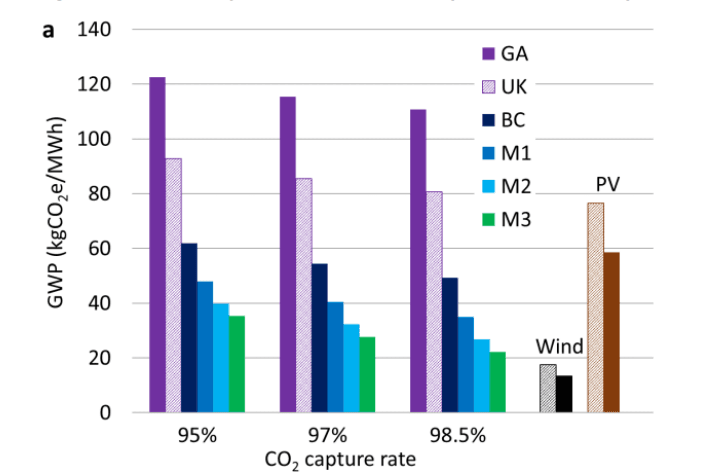
Life-cycle carbon footprint for 6 different electricity generation scenarios at a combined-cycle gas power plant equipped with CCS, compared with wind and solar power plants. The scenarios differ in the carbon footprint of the natural gas supply chain: GA = global average; UK = United Kingdom; BC = British Columbia; M1 = British Columbia (Montney) with natural gas-powered compressors; M2 = British Columbia (Montney) with electrically powered compressors; M3 = British Columbia (Montney) with electrically powered compressors and reduced extraction emissions. Results for solar and wind power plants are shown for British Columbia (hatched bars) and the western United States (solid bars). Source: Oxford Institute for Energy Studies
“The cost of electricity from wind and solar power plants has fallen significantly over the past decade and is now lower in many regions than the cost of electricity from fossil fuel or nuclear power plants. However, variable generation remains a significant disadvantage of wind and solar power plants, so every power system will need a combination of storage and dispatchable generation to maintain a balance between electricity generation and consumption,” the researchers said, noting that seasonal and year-to-year variations in both renewable electricity generation and electricity consumption further underscore the need to maintain a balanced supply-demand balance.
Battery storage significantly increases the carbon footprint
When it comes to electricity storage, battery storage is the technology most often discussed, particularly for short-term (within hours) balancing of differences between electricity generation and consumption. However, according to the Oxford Institute for Energy Studies, pairing battery storage with renewables leads to a significant increase in the cost of electricity generated and a substantial rise in the carbon footprint.
“The carbon footprint of battery storage can significantly affect the life-cycle greenhouse gas emissions of electricity delivered; lithium-ion batteries, for example, have an average carbon footprint of 74 kg CO2e/MWh of electricity delivered,” the study says.
The study’s authors say natural gas will therefore continue to be a widely used fuel in the future, particularly in regions where it is produced in large quantities. Regions with limited production can in turn rely on diversified supplies in the form of liquefied natural gas.
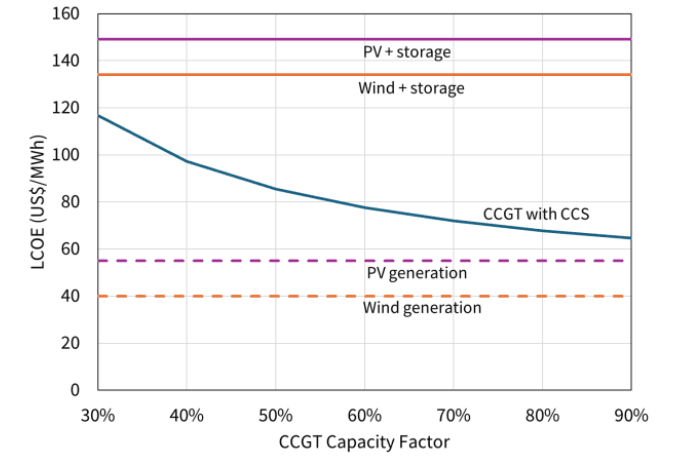
“Combined-cycle gas power plants can be operated flexibly, helping to maintain a balanced power system and respond to short-term changes in electricity prices. Although the cost of electricity generation at a combined-cycle gas power plant, with or without CCS, is negatively correlated with its capacity factor, it remains lower than the current cost of electricity from wind or solar power plants using battery storage,”Levelised cost of electricity from a combined-cycle gas power plant with CCS as a function of its capacity factor, compared with solar and wind power plants with and without battery storage. For solar and wind power plants, no allowance is made for the need to curtail generation due to grid congestion or insufficient electricity demand. Source: Oxford Institute for Energy Studies
Translation disclaimer
This article is a machine translation of the Czech original and has not yet been fully reviewed. In case of any doubt, please refer to the Czech version.
Sdílejte článek prostřednictvím:
You might also like


23 October 2026, 11:01


23 October 2026, 06:34