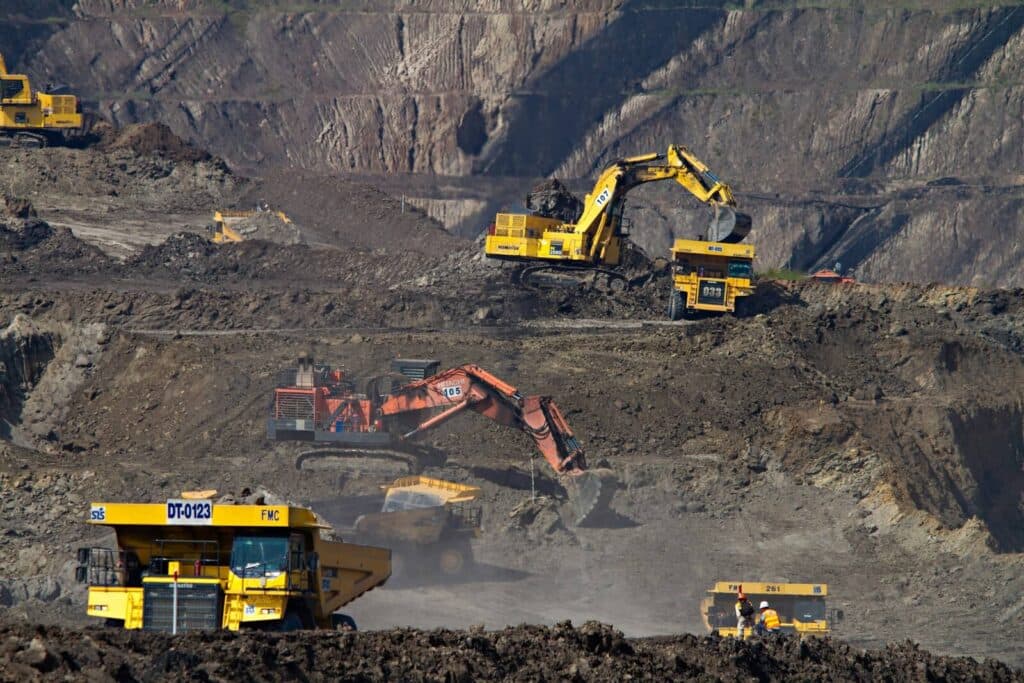
The capacity of newly opened coal mines last year reached its lowest level in the past decade. However, the decline is likely to be temporary due to a number of planned projects that threaten global targets for reducing greenhouse gas emissions.
The production capacity of newly operational coal mines reached 105 million tonnes last year, the lowest level since 2014, according to a report by Global Energy Monitor. This represented a 46% decline from 193 million tonnes in 2023, according to data from the global database of coal mines and planned projects, the Global Coal Mine Tracker.
According to Oldřich Sklenář, an analyst at the non-governmental non-profit Association for International Affairs, the decline in the production capacity of newly operational mines may sound encouraging, but total global coal mining reached a new record last year.
“While the trend of gradually phasing out mining is accelerating in Czechia – domestic lignite production recorded an almost 18% year-on-year decline last year – and similar developments can be seen elsewhere in Europe, other countries are increasing their production. These are primarily India and China, which now account for more than 60% of global output,” Sklenář said. The year-on-year slowdown in Asian countries was mainly caused by delays in approving new projects and easing pressure on production after a sharp increase in capacity over the previous two years.
Solar panels are made using coal
“In China, coal is used not only in the energy sector, but also, for example, to produce synthetic petrol in order to reduce dependence on imports of this commodity from abroad. At the same time, China is by far the largest producer and exporter of green technologies, such as solar panels, batteries, electric vehicles and wind turbines. China exports these technologies on a large scale around the world, including to Europe, while around 98% of solar panels on the European market come from China. Their energy-intensive production is mostly powered by coal-fired electricity,” Sklenář explains.
Miners are now once again increasing their plans, intending to open more than 850 new mines, expand existing ones or restart closed projects. Almost 90% of planned capacity is located in just a handful of countries, with China leading by a wide margin. The capacity of proposed projects, mostly concentrated in the north and northwest of the country, amounts to 1,350 million tonnes of coal per year. India follows with 329 million tonnes per year, nearly half of which falls under state-owned Coal India. Australia ranks third with 165 million tonnes, while Russia and South Africa are also planning significant development, with approximately 98 million and 73 million tonnes of coal per year, respectively.
Globally, coal mines with capacity of 2,270 million tonnes per year are planned, posing a significant risk of increased methane emissions. This greenhouse gas has more than 80 times the global warming potential of carbon dioxide.
It is better to burn methane than release it
Global Energy Monitor estimates that if all proposed coal mining projects go ahead, an additional 15.7 million tonnes of methane could be released into the atmosphere every year. Emissions from existing mining amount to 58.9 million tonnes of methane annually, according to Global Energy Monitor. Total emissions would thus rise to a level comparable with the annual greenhouse gas emissions of the United States, the world’s second-largest emitter after China.
The increase in planned coal mine capacity also conflicts with the goals of the Paris Agreement on climate change. The International Energy Agency and the United Nations have proposed cutting coal mine output by 39% to 75% by 2030 compared with production in 2020, which stood at approximately 7,607 million tonnes. Current plans for coal mine development run counter to these goals.
“The canary is literally and figuratively in the coal mine. Without drastic limits on new mining capacity, the world faces a massive increase in methane emissions that would make achieving the Paris Agreement goals virtually impossible,” says Dorothy Mei, project manager for the Global Coal Mine Tracker at Global Energy Monitor.
“As the report rightly points out, the very least that can be done to reduce the impacts of mining is to cut methane emissions. The necessary technologies are available for both surface and underground mines, and mostly involve capturing the gas and subsequently using it for energy. From a climate perspective, burning it is still better than uncontrolled leaks into the atmosphere during mining or after it has ended,” adds Oldřich Sklenář.
The latest Global Coal Mine Tracker data dates from July this year and covers mines producing one million tonnes of coal per year or more. The tracker provides detailed information on ownership structure, development stage and status, coal type, capacity, production, employee numbers, reserves and resources, methane emissions, geolocation and more than 30 other categories.