Refineries are gaining momentum again. New capacity is heading mainly to Asia and Africa

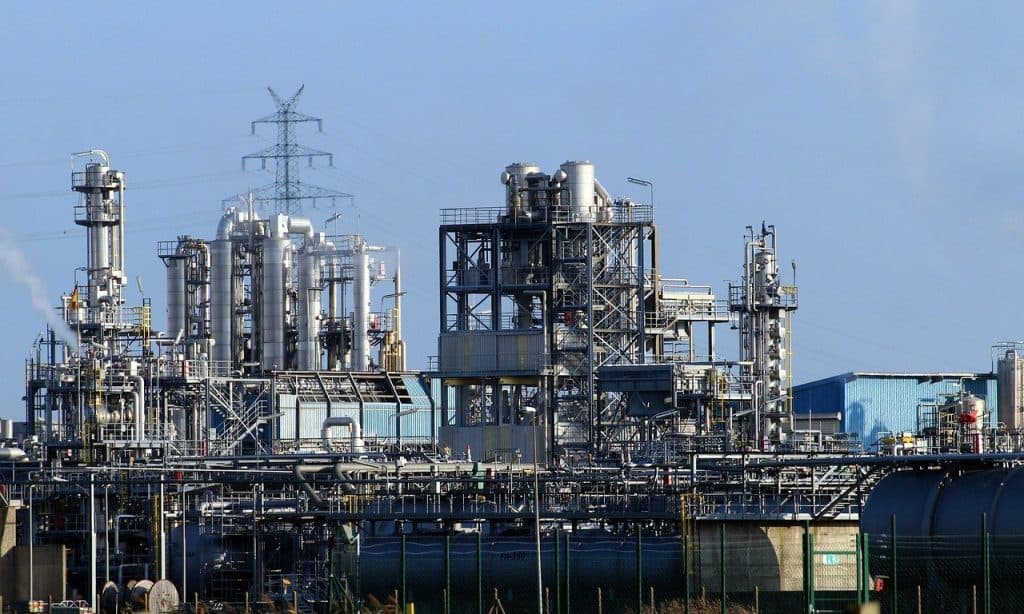
Global refining capacity is set to grow significantly again by 2030, primarily in Asia and Africa. BloombergNEF warns of oversupply and pressure on margins, while OPEC expects the market to tighten and refinery utilization to rise. The differing conclusions show how much will depend on actual demand trends and whether planned projects are completed.
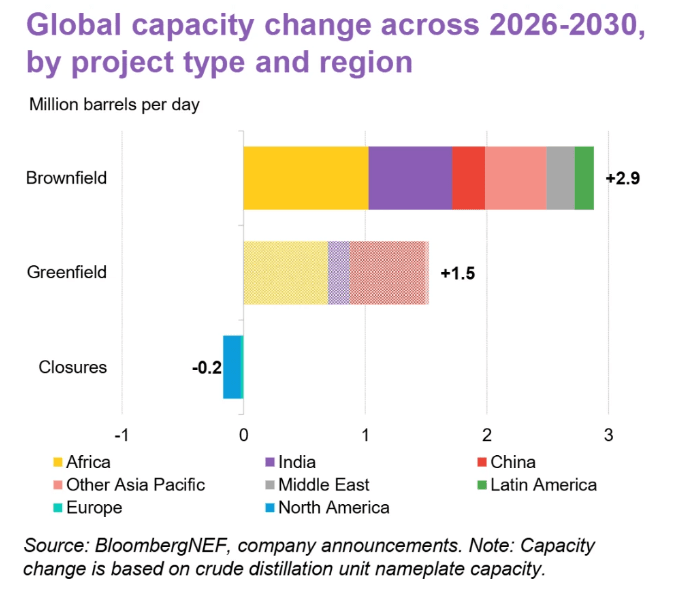
BloombergNEF (BNEF) expects global net refining capacity to increase by 4.2 million barrels per day between 2026 and 2030. The forecast is based on tracking individual assets and includes both new capacity and closures.
According to BNEF, the increase will significantly exceed expected growth in demand for oil products. If the projects go ahead, excess capacity could intensify competition and put pressure on utilization rates and margins, particularly at less competitive refineries.
For the period through 2030, OPEC projects around 4.9 million barrels per day of new capacity. Its outlook also estimates that capacity will be brought online at an average rate of one million barrels per day annually. Including so-called “creep capacity”—the gradual increase in output at existing facilities—the total addition by 2030 comes to 5.3 million barrels per day.
The key difference lies in their projected market balance. OPEC expects global refinery utilization to rise from 80.8 percent in 2025 to around 82.7 percent in 2030, pointing to a tighter market. BNEF, by contrast, highlights the risk of supply outstripping demand.
Growth is shifting to Asia and Africa
According to BNEF, Africa and the Asia-Pacific region will account for around 95 percent of the global net capacity increase. OPEC divides the expected additions somewhat differently: 2.8 million barrels per day in Asia and the Pacific, one million in the Middle East and 0.8 million in Africa. Together, these three regions are expected to account for around 94 percent of global additions.
The investments are driven by expected demand growth, efforts to reduce dependence on imports, and the construction of export-oriented refineries or facilities integrated with petrochemical production. While new capacity can strengthen some countries’ self-sufficiency, export-oriented facilities will also increase competition in international markets.
China and India will play a major role in the coming years. According to BNEF, together they will account for 71 percent of capacity additions in 2026 and 2027. Most of these projects are already operating or under construction. The later part of the outlook is less certain, as a larger share of planned capacity for 2028 to 2030 is still at an early stage of development, making delays or cancellations more likely.
The regional impacts will vary. According to BNEF, China may face an oversupply that could contribute to further consolidation among smaller independent refineries. India and Africa, by contrast, are expanding oil processing to become more self-sufficient, while closures may continue in Europe and the United States. For European facilities, the decisive factor will therefore not be global capacity alone, but also their competitiveness compared with newer and often larger facilities in fast-growing regions.
War in Iran reshapes flows, but not the investment map yet
The conflict in Iran has disrupted flows of oil products from the Middle East as well as crude supplies from the Persian Gulf. According to BNEF, this has affected the products market and strengthened the position of refineries in the Atlantic basin. The short-term supply disruption may therefore benefit facilities outside the affected region that can supply customers more quickly.
BNEF does not yet see a significant impact from the war on refinery capacity projects in the medium term. Instead, it says the conflict strengthens the case for investment in storage, pipelines and logistics infrastructure. For projects under construction, their location, access to feedstocks and ability to get products to market may therefore matter more than any change in the global capacity total.
Translation disclaimer
This article is a machine translation of the Czech original and has not yet been fully reviewed. In case of any doubt, please refer to the Czech version.