10 September 2026, 15:21
Loading...
Czech energy congress: Geopolitical situation and impact on energy sector – part 1
Daniel Grecman
25 April 2023, 14:06
The 22nd Energy Congress, organised by Business Forum, took place on Wednesday 18 April. The first conference session addressed the geopolitical situation and its impact on the Czech Republic’s energy sector. Václav Bartuška, the Foreign Ministry’s special envoy for energy security, called for pragmatism. According to him, this was evident during the current energy crisis and needs to be maintained. Martin Durčák, chairman of the board of ČEPS, explained the situation that the Czech Republic, and indeed the entire EU, will face. Subsequent conference sessions focused on how the market and entities operating in it could or should adapt. The related market changes bring certain pitfalls, but also opportunities, which were also discussed. But first, let us look at the first conference session.
Pragmatism in energy
The first speaker at the conference was Václav Bartuška, special envoy of the Ministry of Foreign Affairs (MFA). He first highlighted how the EU had managed to diversify natural gas and oil supplies since the start of Russia’s aggression against Ukraine, substantially reducing its energy dependence on Russia. As the Ministry of Industry and Trade (MIT) states on its website, no gas from Russia has been delivered to the Czech Republic since the beginning of this year.
“For the first time in the modern history of the Czech Republic, we managed entirely without gas supplies from Russia during the first quarter of the year. This is a major success. I do not know of any other country that has been able to rid itself of almost 100% dependence on Russian gas imports from one year to the next. We all contributed to this, because reduced consumption played a crucial role,” Minister Jozef Síkela said about the situation. “However, this does not mean that we have won. Before this winter, Europe will have less gas available to prepare for winter without Russian supplies than it had before, so it will remain necessary to maintain a responsible approach to gas consumption.”
In this context, and with regard to further possible developments, it is also necessary to take into account natural gas price developments, the mild winter and its impact on lower natural gas consumption, as well as projections for future gas consumption in the context of decarbonisation.
The decarbonisation scenarios of individual EU countries envisage the gradual phase-out of coal, with this fuel to be replaced to some extent by natural gas in its role as a so-called transition fuel. Natural gas is also expected to play a very important role in kick-starting the EU hydrogen market, with natural gas reforming used to produce hydrogen. Growing demand, depending on the development of renewable sources, and limited supply may indicate rising prices.
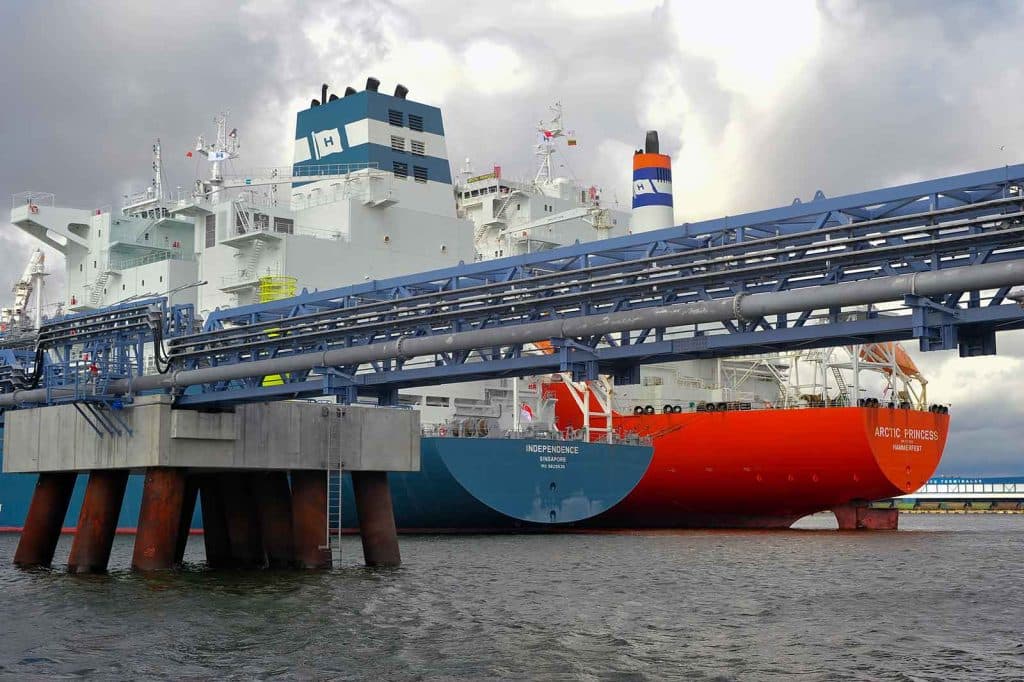
Václav Bartuška pointed out that the situation that arose, namely reduced dependence on Russia, was possible because some EU Member States bypassed or completely ignored their own legislation and permitting processes. The result was, for example, the rapid commissioning of an LNG (liquefied natural gas) terminal in Eemshaven, the Netherlands, where no EIA (environmental impact assessment) was prepared. A similar approach was reportedly taken in other countries. In Václav Bartuška’s view, none of the new terminals could have been commissioned in record time without the involvement of the respective governments. Thanks to all the measures taken and other factors, the EU has managed to keep gas storage levels at a very good level, as illustrated by the chart below.
Development of renewable energy sources
He then also related the situation to the development of renewable energy sources (RES). He was highly critical of the length of permitting processes, the number of permits required and the number of entities that need to be contacted when building new sources. Given the strategic importance of energy for the state and the current geopolitical situation, he also raised the question of what role the state should play in the energy sector. He cited the trend towards nationalising large energy companies: Germany – Uniper, France – EDF.
Regarding the development of RES, it should be noted that discussions are already underway at EU level on the creation of so-called go-to zones, where permitting processes would be considerably accelerated and simplified. However, questions remain as to when they will be created, how large they will be and who will have access to them, also in view of the available transmission line capacity.
Translation disclaimer
This article is a machine translation of the Czech original and has not yet been fully reviewed. In case of any doubt, please refer to the Czech version.
Sdílejte článek prostřednictvím:
You might also like
10 September 2026, 10:37
9 September 2026, 15:05
9 September 2026, 13:24