25 September 2026, 09:51
Loading...
Lithium market faces surplus, project economics at risk

Jakub Malý
21 August 2025, 07:29
The lithium market has undergone dramatic fluctuations in recent years. Record price growth in 2022, when the price of lithium carbonate climbed above USD 80,000 per tonne, was followed by a collapse to levels around USD 10,000/t in 2025. The main reason is not weakening demand, but a sharp increase in supply, particularly from China, which has outpaced the growth of electric mobility and energy storage technologies. The result is a market surplus that could last until 2027 and threatens the economics of many projects.
Developments in the lithium market are a textbook example of commodity cyclicality. Low prices in 2020 discouraged investors from developing new capacity, leading to supply shortages and a meteoric rise in prices in 2022. Producers responded with a massive expansion of mining and chemical plants, but their full capacity will only come online with a time lag. This “delayed response effect” has now resulted in overproduction, pushing prices well below the economic viability threshold for many producers. China has played the largest role, with massive growth in the extraction of spodumene, lepidolite and brines, alongside rising lithium chemicals production capacity.
According to consultancy Wood Mackenzie, the surplus could persist at least until 2027, despite continued strong growth in global demand. The automotive sector and the large-scale energy storage segment are shifting to lithium iron phosphate (LFP) batteries, which use substantial quantities of lithium carbonate. Nevertheless, the current pace of supply expansion is too high for demand to absorb. The result is a market imbalance that threatens the financial sustainability of many producers outside China.
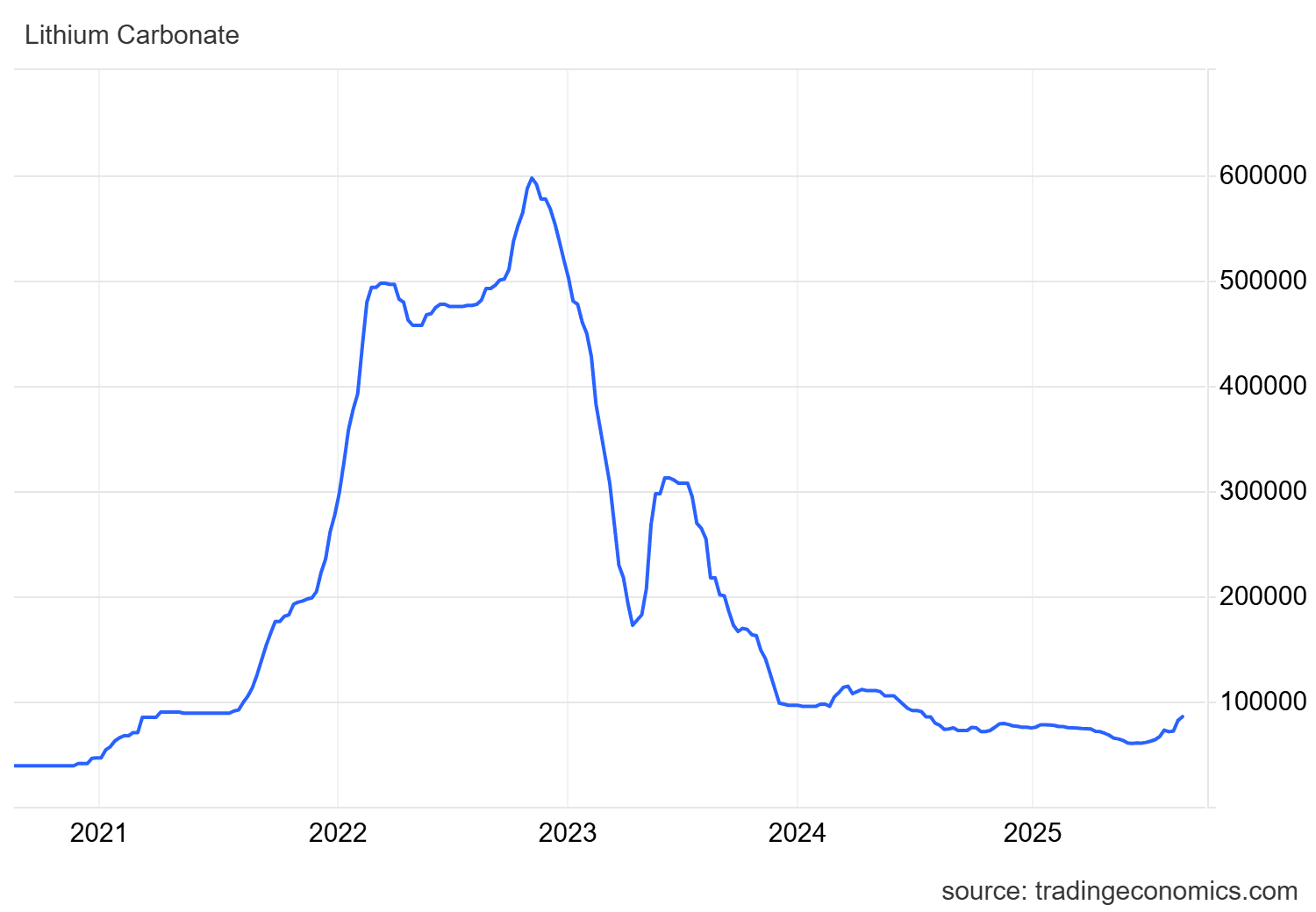
Lithium carbonate price since 2021. Source: Trading Economics
Lithium in the Czech Republic
The lithium issue also has direct implications for the Czech Republic. Europe’s largest lithium deposit is located at Cínovec and has repeatedly become the subject of political debate. ČEZ Group, through its subsidiary Geomet (in cooperation with Severočeské doly), is preparing underground mining projects. A feasibility study for the mine and processing plant is due to be completed in the second half of 2025, while the mining permit itself is expected in mid-2027 and extraction could begin by the end of 2030. The lithium processing plant was originally planned for Újezdeček in the Teplice region, but was moved to the site of the former Prunéřov power plant near Kadaň following protests by local municipalities.
The mining and processing projects for the local orebody promise to create a new high-value-added industry, but the current situation on the global market raises fresh questions. If lithium prices remain at around USD 10,000/t, the economic returns from mining may be more challenging and require stronger support from the state and the European Union. At the same time, domestic lithium resources could strengthen Europe’s energy security and reduce its dependence on Asian supply chains in the long term.
It is therefore no surprise that the debate on Cínovec concerns not only technical feasibility, but also the strategic question of whether the Czech Republic should become an active player in Europe’s battery industry. Success will depend not only on ore extraction itself, but above all on creating a downstream processing and battery cell manufacturing ecosystem that could make a significant contribution to Czech economic growth.
Translation disclaimer
This article is a machine translation of the Czech original and has not yet been fully reviewed. In case of any doubt, please refer to the Czech version.
Sdílejte článek prostřednictvím:
You might also like

24 September 2026, 11:23

24 September 2026, 10:30
24 September 2026, 06:56