24 September 2026, 10:30
Loading...
Data centres to get energy label as EU seeks to curb growing electricity and water demand
Veronika Jurcová
24 September 2026, 10:30

The European Commission is introducing a new rating system for data centres. Data centres with installed capacity above 500 kW will publish information on their energy and water consumption. Brussels is also preparing mandatory minimum standards. The aim is to enable the rapid expansion of infrastructure for artificial intelligence without further data centre growth increasing pressure on European power grids, according to a Commission press release of 21 September.
Data centres in Europe are expected to expand significantly in the coming years. The EU envisages tripling their capacity over the next five to seven years, partly due to the development of artificial intelligence and efforts to strengthen Europe’s technological and digital sovereignty. However, rapid growth brings a problem: data centres consume ever more electricity and water and may place strain on local power grids.
“Digital sovereignty must go hand in hand with a responsible approach to energy,” said Energy Commissioner Dan Jørgensen.
The European Commission therefore presented a common system for rating their sustainability on 21 September. It will apply to individual data centres with installed capacity above 500 kW. The rating is intended to increase transparency and make it possible to compare how individual facilities manage energy and water.
Energy, water and waste heat use to be assessed
The label is to take into account factors such as energy efficiency, water consumption, use of low-emission electricity sources, flexibility in relation to the power grid, and the ability to reuse waste heat. According to the Commission, heat in particular may represent a significant untapped resource. If roughly half of data centres’ waste heat in Europe were reused, it would, according to the Commission, be equivalent to the heating needs of four million households.
According to the Commission, data centres in the EU consumed around 68 TWh of electricity in 2024. By 2030, this consumption could rise to 114 TWh, or more than three percent of total EU electricity consumption. The main driver of growth is the rapid development of artificial intelligence.
Unlike traditional cloud services, artificial intelligence applications are significantly more demanding in terms of computing power, leading to rapid growth in both electricity consumption and connection requirements for new data centres.
The debate does not concern only total energy consumption. In many cases, the capacity that data centres require when connecting to the grid is more important. Large projects may require capacity comparable to the consumption of smaller cities, and in some regions of Europe they are already encountering limited connection options. The development of data centres is therefore increasingly raising the question of necessary investment in transmission and distribution infrastructure.
The Commission also wants to monitor whether data centres contribute to the expansion of clean electricity generation. Montel News notes that the rating may reflect, for example, the use of power purchase agreements (PPAs) from new or substantially modernised renewable or nuclear sources. Under the proposed rules, these must be in the same bidding zone as the data centre or interconnected with it.
This aspect may have broader significance than the sustainability rating itself. If data centre operators seek a better rating, it could increase demand for long-term contracts for electricity supplies from new low-emission sources. Data centres could thus become a significant driver of investment in both renewable and nuclear projects.
Transparency today, mandatory standards tomorrow
The Commission therefore does not want to stop at transparency alone. It has also launched a public consultation on minimum performance standards for data centres. This will run until 14 December 2026, with legislative proposals expected in the second quarter of 2027.
This second phase may be more significant for operators. While the new rating will primarily make data more transparent and publicly available, future standards may set binding minimum requirements for new or modernised data centres.
An interesting element of the new system is also its emphasis on flexibility in relation to the power grid. The Commission wants to support in particular facilities that can adapt part of their consumption to the current situation in the energy system, for example by shifting certain computing tasks to periods of higher renewable generation or reducing demand during peak-load periods. Data centres are thus gradually becoming not only major electricity consumers, but also potential partners in system management.
The new rating system has a simpler legislative route. The Commission adopted it as a delegated regulation. The European Parliament and the Council of the EU have two months to object, but cannot amend the text. If they do not object, the regulation will enter into force. The first labels for individual data centres are expected in 2027. The Commission is to conduct its first assessment of the system’s effectiveness by the end of 2028.
Part of a broader effort towards sustainable AI development
The new system is intended to be more comprehensive than similar ratings used, for example, in Australia or Singapore. Europe is thus addressing a difficult trade-off. It needs data centres for the development of AI and digital infrastructure, but at the same time does not want their growth to increase pressure on the energy sector and complicate decarbonisation.
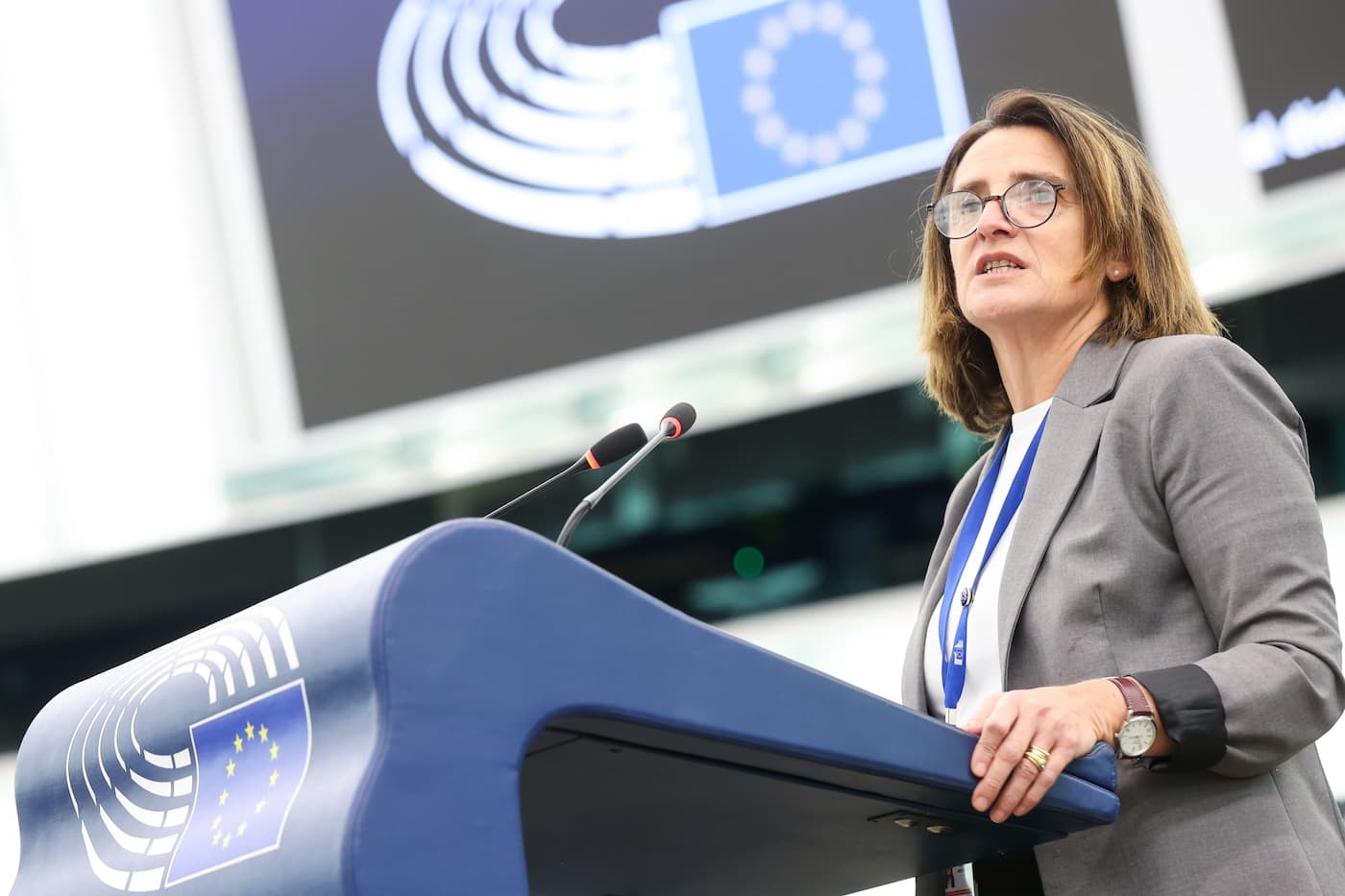
Source: EP: Teresa Ribera, Executive Vice-President of the European Commission for a Clean, Just and Competitive Transition
“Tripling the capacity of our data centres cannot mean tripling the pressure on our grids, water and energy bills,” said Commission Executive Vice-President Teresa Ribera.
The new rules are not merely a measure to support sustainability. With them, the European Commission is for the first time creating a framework that links the development of digital infrastructure with energy policy. It is seeking to prevent the rapid development of AI and data centres from increasing the cost of developing energy infrastructure and complicating the integration of renewable sources.
Data centres are thus gradually becoming not only part of the digital economy, but also an active element of the European energy system. The minimum performance standards planned for 2027 will show whether Brussels will stop at transparency or move towards more direct regulation of the energy and environmental impacts of their operation.
Translation disclaimer
This article is a machine translation of the Czech original and has not yet been fully reviewed. In case of any doubt, please refer to the Czech version.
Sdílejte článek prostřednictvím:
You might also like
24 September 2026, 06:56
23 September 2026, 17:27
23 September 2026, 17:24
23 September 2026, 13:48