25 September 2026, 09:51
Loading...
Acceleration zones to facilitate renewables development
Martin Abel
29 April 2025, 13:00

The Chamber of Deputies is debating a bill on the accelerated deployment of renewable energy sources (known as lex ZOZE), which introduces new “acceleration zones” into Czech law to enable faster construction of solar and wind power plants. What specific benefits will these zones bring investors? And will they genuinely speed up permitting for projects that are desperately missing from the Czech energy mix? This article provides a detailed overview of legislative changes to date and an analysis of the expected impacts of lex ZOZE.
A bill on the accelerated deployment of renewable energy sources (known as lex ZOZE) has reached the Chamber of Deputies, transposing key provisions of the RED III Directive into Czech law. The bill also legally establishes “areas for the accelerated deployment of renewable energy sources”, better known as “acceleration zones”. Under the RED III Directive, Member States must designate acceleration zones in their spatial planning documentation by 21 February 2026. Given the tight deadline and the end of the parliamentary term, on 24 April the government decided to submit the bill under Section 90(2) of the Chamber of Deputies’ Rules of Procedure, meaning that it will seek its approval already at the first reading.
The purpose of acceleration zones is to significantly simplify and thereby speed up the permitting process for solar and wind power plants in areas where relatively minimal impacts on the environment, public health and other public interests can be expected. Paradoxically, to make this possible in line with the Constitution and other legislation, officials from the Ministry of the Environment and the Ministry for Regional Development involved in drafting the bill had to devise legal constructs that appear complex at first sight. Many observers therefore question whether the long-prepared acceleration zones will ultimately fulfil their purpose. Such doubts are understandable, particularly as lex ZOZE also modestly simplifies construction proceedings outside acceleration zones, following on from the JES Act, lex OZE 1 and the currently debated Lex Plyn, all of which aim to simplify renewables construction throughout the Czech Republic.
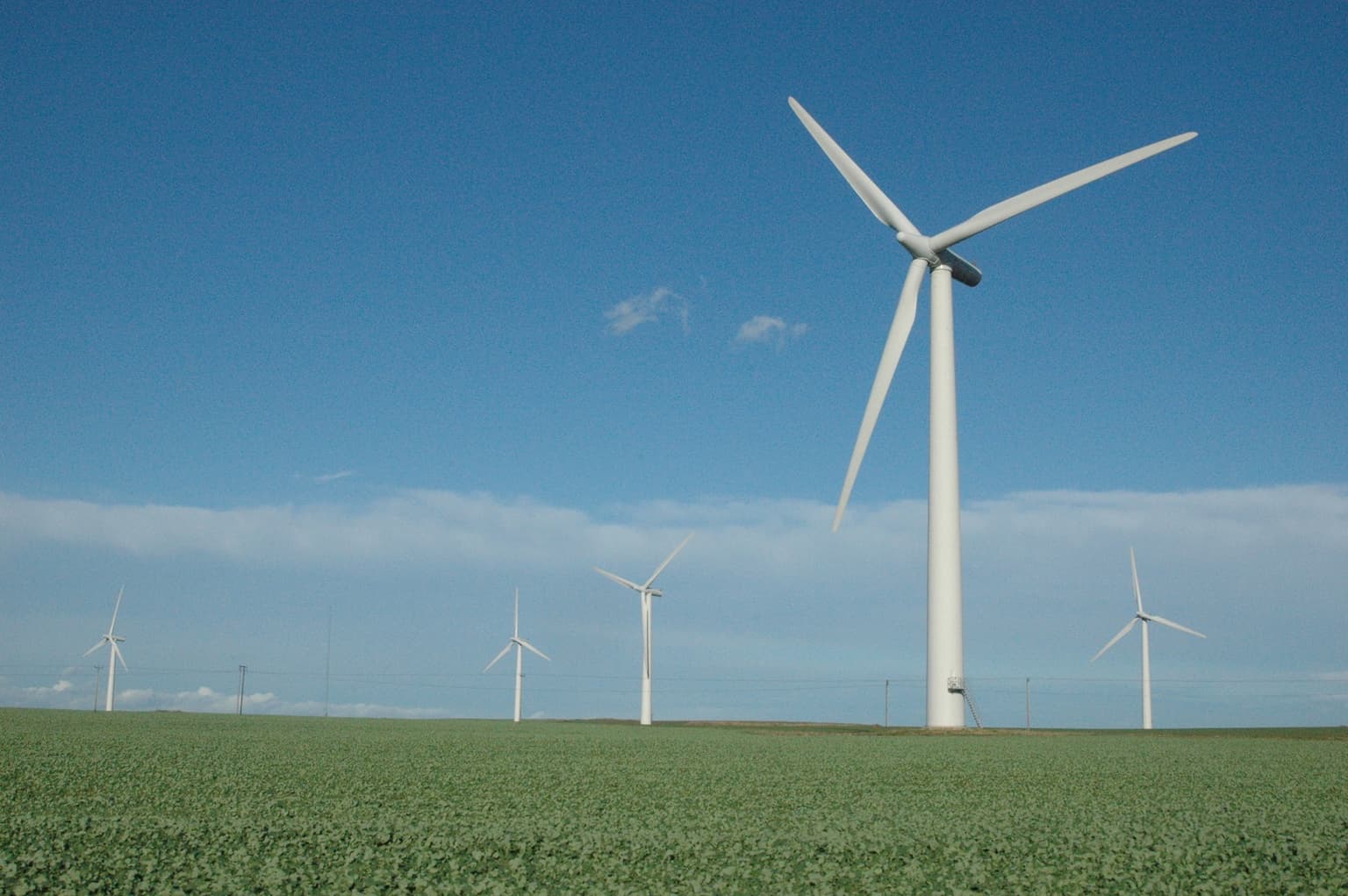
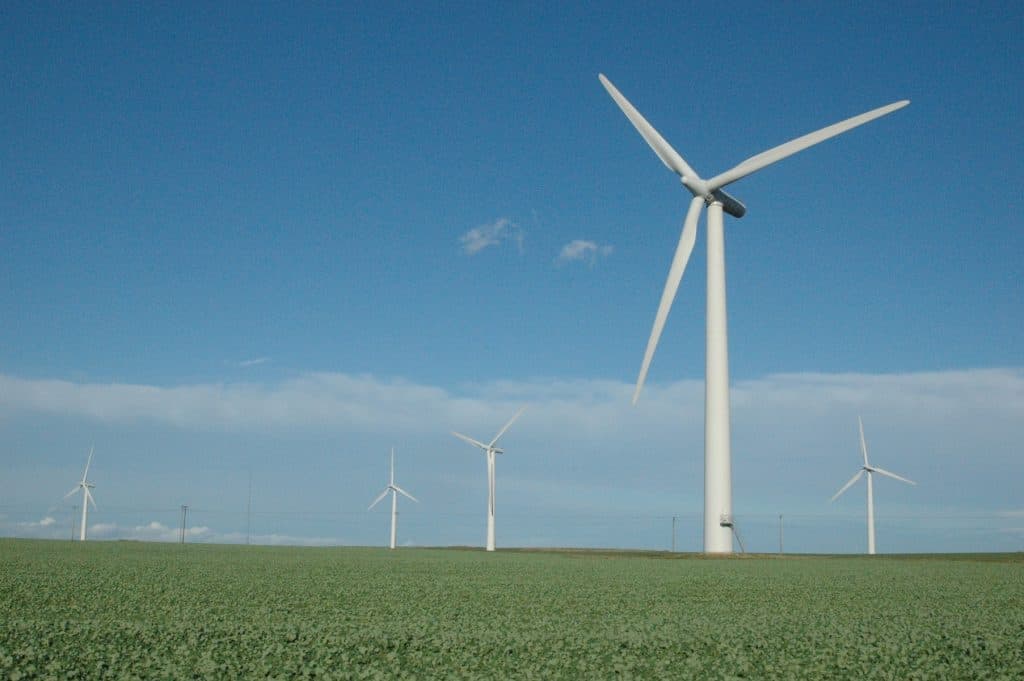
Wind power plant. Source: Tom Corser / Wikimedia Commons / CC-BY-SA-3.0
Will the rules for construction proceedings therefore motivate solar and wind power investors to build primarily in acceleration zones? Let us compare the promised legal framework in acceleration zones with the legislative changes made so far to support renewables construction.
- Lex OZE 1 (Act No. 19/2023 Coll., effective from 24 January 2023) classified renewable power plants with capacity of 1 MW and above as public technical infrastructure. Since then, such plants may be permitted in undeveloped areas provided they are compatible with the character of the area and are not excluded by spatial planning documentation. This enables the installation of renewable electricity generation facilities with capacity of 1 MW and above across most of the Czech Republic without a prior amendment to the spatial plan.
- The new Building Act (Act No. 283/2021 Coll., effective from 1 January 2024) classified solar power plants with capacity of 5 MW and above, and other renewable sources with capacity of 1 MW and above, as so-called reserved structures. Reserved structures are permitted solely by the specialised Transport and Energy Construction Authority, through which legislators sought to improve, standardise the quality of and, where sufficient capacity exists, accelerate the assessment of renewables projects. The new Building Act also set statutory time limits for decisions in construction proceedings, which may only be extended with justification by a special resolution.
- An amendment to the EIA Act (Act No. 465/2023, effective from 1 January 2024) added a rule that wind power plants with no more than 3 masts (roughly up to 15 MW) do not require an EIA report or screening procedure, unless further conditions in points 7a–c of Annex 1 to the Act are also met (in particular, the distance from the nearest protected building area, etc.).
- The Act on the Single Environmental Statement (Act No. 148/2023 Coll., effective from 1 January 2024) introduced the principle of a single stamp for the environmental assessment of projects, with positive implications for investors in large-scale renewables as well.
- Regulation (EU) 2022/2577 of the European Parliament and of the Council (effective from 22 December 2022 to 30 June 2025) added a rule that renewable power plants no longer have to demonstrate, in proceedings under EU directives on habitats, water and the conservation of wild birds, that they constitute projects of overriding public interest. This was intended as a temporary measure until Member States transposed the RED III Directive.
- Lex Plyn (Parliamentary Print 883, approved by the Chamber of Deputies at third reading on 23 April 2025), if promulgated, will designate wind power plants with capacity of 15 MW and above as energy security structures (as is already the case for nuclear power plants). Under Act No. 416/2009 Coll., on accelerating the construction of strategically important infrastructure (formerly the “Linear Construction Act”), administrative procedures for energy security structures are kept to a minimum: time limits for issuing binding opinions and decisions are shortened, while rights of appeal and judicial review are restricted. In line with an amendment proposed by Ivan Adamec, these structures will also no longer require a further landscape character assessment if this has already been assessed as part of the EIA (power plants with up to 3 masts already enjoyed this benefit under certain circumstances).
Let us now focus on wind power plants, which are so lacking in the Czech energy mix, and compare the conditions for their construction with another energy facility that places significant demands on its surroundings, such as a waste incinerator. If we set out all the advantages side by side, as I have done in Table 1, we can see that wind power plants with up to 3 masts (approximately 15 MW) enjoy several privileges compared with an incinerator. Wind power plants with capacity of 15 MW and above will enjoy a whole range of additional procedural privileges if the Chamber of Deputies’ version of Lex Plyn is approved. In addition, Section 29 of lex ZOZE (the government version) provides that renewables investors generally across the country will not need to obtain special permits under the Nature and Landscape Protection Act if they adopt sufficient measures to protect wild birds and specially protected animals.
7–10 years. That is how long, according to frequently cited figures, the entire wind power permitting process takes on average in the Czech Republic. Only investors know how meaningful this average really is. And only investors know the time and financial savings that the above changes mean for them, or will mean if the proposed changes are approved. In many cases, shorter deadlines are less helpful than eliminating the possibility that a process will get stuck with an uncooperative authority or an overburdened court. However, two fundamental planning and construction-law barriers to building large wind farms—the requirement to amend regional spatial development principles and the requirement for an EIA report—have so far remained unchanged. Acceleration zones introduce these changes.
Source: Unsplash
Wind farms with installed capacity of 15 MW and above will have the same advantages in acceleration zones as outside them. In addition, however, they will have 5 further advantages arising from the proposed ZOZE Act, which transposes Articles 16 et seq. of the RED III Directive:
- Neither an EIA assessment nor a screening procedure is automatically carried out. The regional authority will only conduct a basic screening to determine whether the project is in close proximity to state borders or whether it could result in significant unforeseen adverse effects on the environment and public health that cannot be ruled out through additional conditions. If these conditions are not met, no EIA is required. If they are, the EIA report will be prepared concurrently with the procedure leading to the JES. The authority will have 6 months for the EIA and JES, with the possibility of an extension by a further 6 months.
- The conditions for obtaining consent for a project in an acceleration zone will be known in advance. Investors will know in advance the conditions for receiving a positive JES, as well as the conditions for removing land from the agricultural or forest land fund and other requirements for a successful application. These will be set out in a spatial measure issued separately for each zone, based on prior coordinated mapping of the area, an assessment of impacts on sustainable territorial development, a biological assessment, an SEA and opinions from the relevant authorities. It will be sufficient for the developer to demonstrate that its project complies with the spatial measure.
- Compliance of the project with all legislation will not be assessed, only compliance with the conditions in the spatial measure issued for the given acceleration zone. Projects outside an acceleration zone must obtain various positive opinions from the nature conservation authority or the forest protection authority (if located on forest land). In an acceleration zone, a positive single environmental statement alone will suffice, incorporating these aspects of the project.
- A fixed deadline for the building authority’s decision. The building authority will either issue or refuse the permit within 60 days. However, it will not be able to extend this deadline repeatedly, as is possible outside acceleration zones.
- The project location will be agreed in advance with local and regional authorities. Municipalities and regions will anticipate that power plants are likely to be built in an acceleration zone. They will participate directly or indirectly in designating the zones. In theory, a situation may arise where municipalities or regions do not agree with an acceleration zone and exclude project placement in the relevant areas through their spatial planning documentation (Section 122(3) of the Building Act). However, if an acceleration zone is designated there by higher-level documentation—Regional Spatial Development Principles for a municipality, or the Spatial Development Plan for a region—the higher-level plan prevails. But as I say, in practice it will still be impossible to locate projects without the consent of municipalities and regions, which either decide directly or provide opinions in subsequent proceedings. Most of them will take acceleration zones into account following prior consultation.
These are the fundamental advantages that, under the proposed ZOZE Act, wind farm projects in future acceleration zones will have. If, as an investor, I enter an acceleration zone and prepare my project exactly in accordance with the requirements of the spatial measure, I can expect that, unless something fundamentally changes, (a) no EIA assessment will be conducted, (b) I will not have to obtain approvals under other laws, (c) I will receive a positive JES, (d) the building authority will decide within 60 days, and (e) only a minimum of matters will remain to be resolved with the region and municipalities. This always saves either time, money or the investor’s nerves. I therefore conclude that the proposed ZOZE Act genuinely accelerates and simplifies construction in acceleration zones and incentivises their use.
Source: Unsplash
On the other hand, the notion that investors will “flock” to acceleration zones mistakenly assumes they are not already there. Investors themselves have a fairly good understanding of the locations where favourable natural conditions are combined with a minimum of public-law and private-law barriers. Whatever the final acceleration zones look like, if suitable technical conditions genuinely exist there, investors are likely already reserving grid capacity, negotiating easements and securing support from local authorities, or have already completed these steps. In the case of wind power plants, this could involve sites for 300–500 new facilities in 2026 that could be installed by 2030. If acceleration zones genuinely speed up permitting at these locations, the Czech Republic will contribute not only to meeting its commitments under RED III, but above all to achieving its climate and energy targets and reducing electricity prices for consumers.
Martin Abel, AMO Klima analyst
Translation disclaimer
This article is a machine translation of the Czech original and has not yet been fully reviewed. In case of any doubt, please refer to the Czech version.
Sdílejte článek prostřednictvím:
You might also like
24 September 2026, 11:23

24 September 2026, 10:30
24 September 2026, 06:56