25 September 2026, 09:51
Loading...
aFRR balancing capacity prices in ALPACA: Minima converge, German daily market drives peaks
Patrik Peťovský
29 October 2025, 11:20
This year, attention in the area of prices for providing balancing services has focused on automatically activated frequency restoration reserve (aFRR) capacity. Cross-border cooperation under ALPACA plays a significant role in its development, linking price formation in Czechia and Germany more closely than before. During night-time hours, differences are minimal and prices nearly overlap. However, price peaks tend to be higher in Germany, particularly in the upward direction.
The most visible effect is in the upward direction. The German balancing capacity market operates on daily contracts and trades in six four-hour blocks. Czechia has also had four-hour blocks since 3 September 2025, but part of the balancing capacity is still procured on an annual basis, with around one-third of capacity contracted annually and two-thirds daily from the beginning of 2025.
Following the interconnection, the daily price is highly sensitive to cross-border price signals. During the observed period, the minimum accepted prices (night-time blocks) in both countries practically overlap. Peaks, however, remain higher in Germany. In tight hours, prices spike more sharply, with the difference from the Czech curve reaching several tens of €/MW/h for aFRR+. This effect is related to block-based daily trading, market size and immediate demand for capacity. The Czech annual component also naturally dampens part of the volatility.
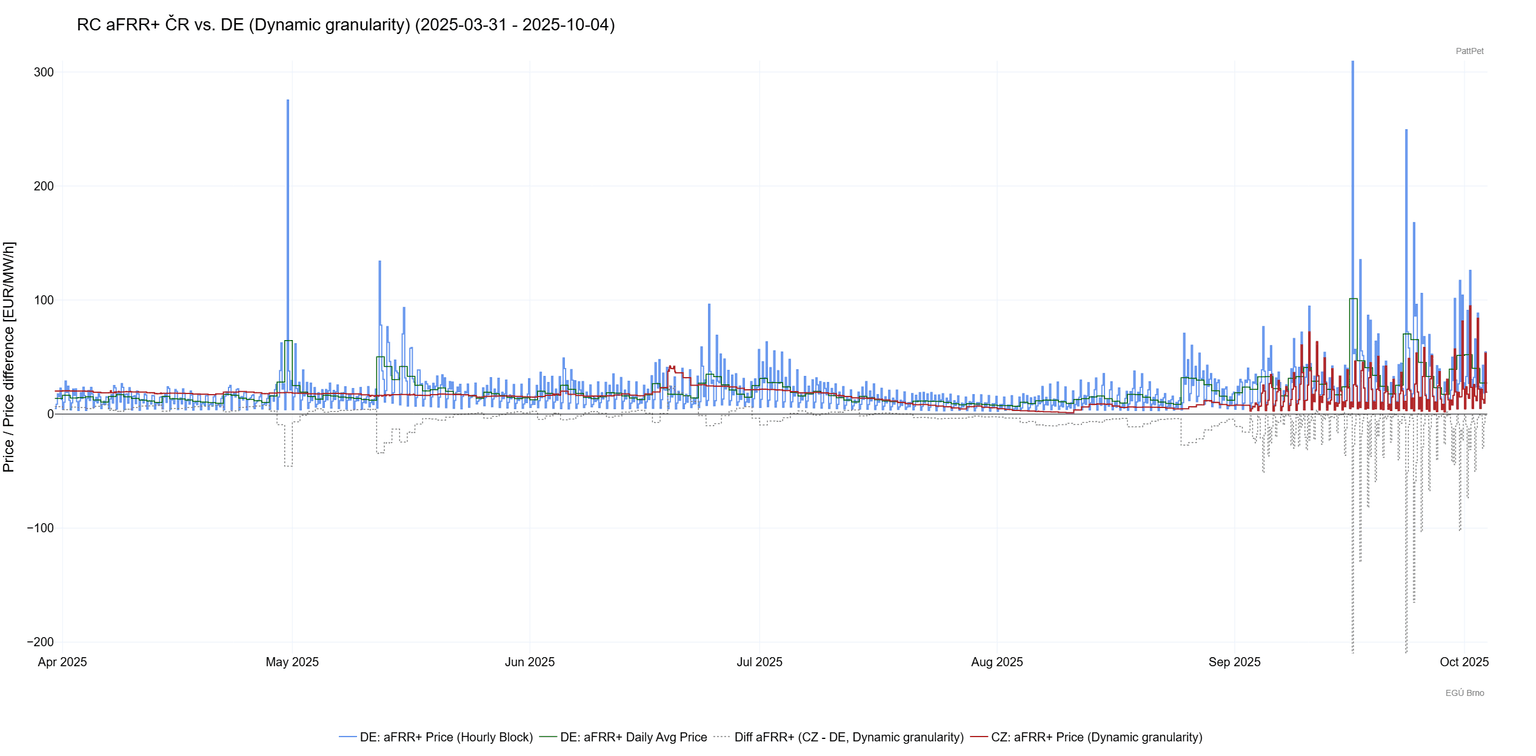
Development of the daily price for aFRR+ balancing capacity, source: own calculations
In the downward direction, approximately half of capacity in Czechia has been contracted annually and half daily since the second quarter of 2025. Following the interconnection, minima have converged significantly, and on many days the difference practically disappears. Peaks remain more frequently higher in Germany, but with a smaller amplitude than in the upward direction. The block structure, the load and generation profile, and the daily impact of photovoltaics all play a role. Annual averages for 2025 show an effective equalisation between the countries.
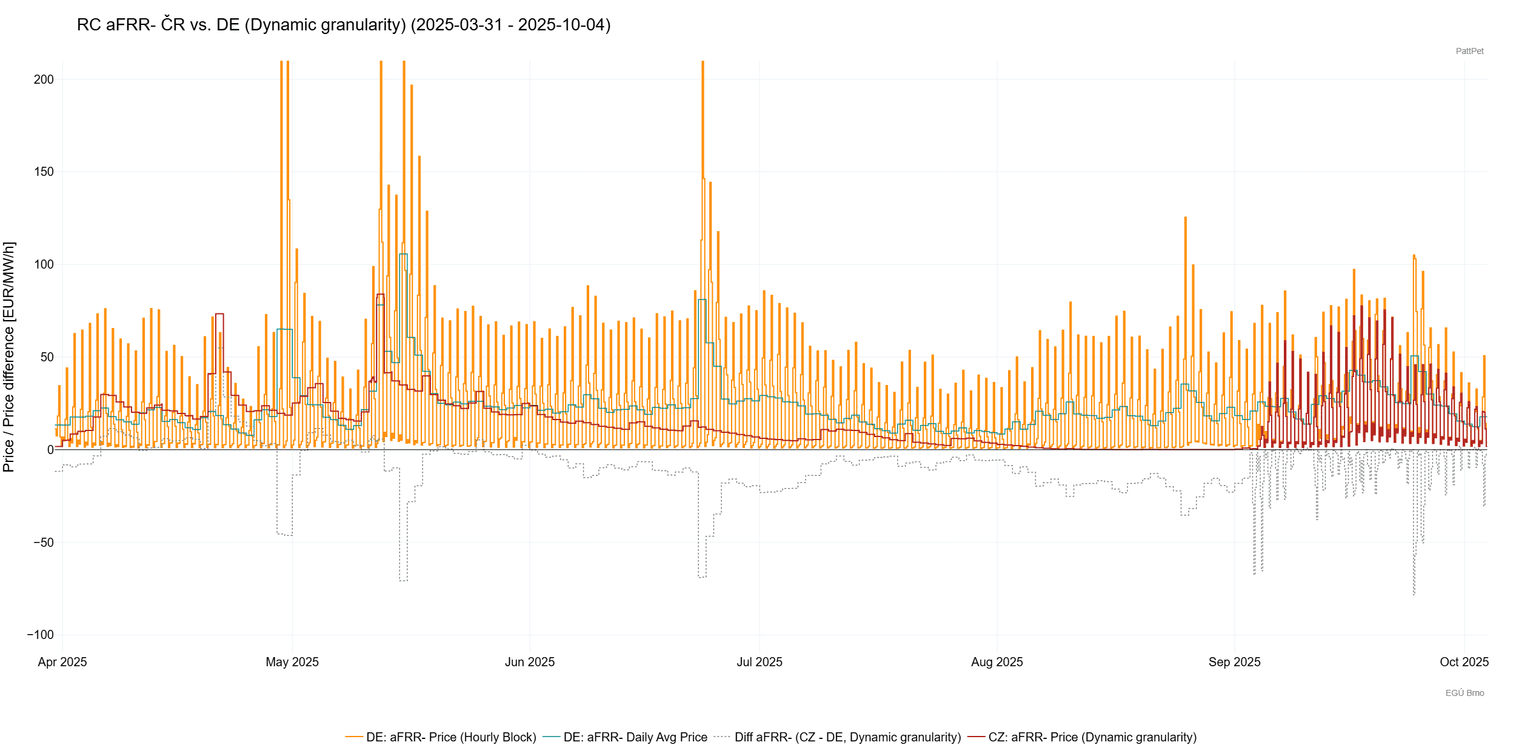
Development of the daily price for reserved capacity in aFRR-, source: own calculations
In 2024, the average price (daily and annual contracts) for balancing capacity in Czechia was approximately 27 €/MW/h for aFRR+ and 19 €/MW/h in the downward direction. In Germany, it was around 16 and 13 €/MW/h, respectively. Czechia therefore exceeded Germany by 11 and 6 €/MW/h.
In 2025, the average price in Czechia is approximately 20 €/MW/h for aFRR+ and 16€/MW/h in the downward direction. In Germany, it is approximately 15 and 16 €/MW/h, respectively. The difference in the upward direction has therefore narrowed to around 5 €/MW/h, while in the downward direction it has practically disappeared.
The figures confirm significant market convergence, particularly in the range of minimum prices, mainly in night-time blocks from 20:00 to 8:00 in the morning. However, it should be noted that the summer decline in the price of reserved capacity was massive and unprecedented in recent years – prices fell almost to zero. From this perspective, the interconnection with Germany may be seen as stabilising the daily market.
Looking ahead, a gradual transition to a purely daily market is expected, which will increase sensitivity to cross-border prices and competition. For transmission system operators, the interconnection broadens competition and creates pressure for a lower average balancing capacity price.
Further developments in differences between the countries will be determined by the availability of cross-border profiles, current technical constraints and the distribution of domestic flexibility resources, including battery storage. The current price of long-term profiles between Germany and Czechia is above 6 €/MWh; before Covid, the price was half as high.
Source: Pexels
Overall, lower average revenues per MW/h can be expected compared with previous years, when prices, and thus returns, were highly attractive for various technologies. It is therefore necessary to design and operate any technology so that it can take advantage of other markets. Relying on just one market is not sustainable in the long term when the price for reserved capacity will be very low in certain periods.
Summary
ALPACA has brought close convergence of minimum aFRR balancing capacity prices between Czechia and Germany. Peaks are more frequently higher in Germany, most notably in the upward direction. Compared with 2024, the difference between the markets has narrowed significantly and has practically disappeared in the downward direction. In practice, this means managing the mix of annual and daily capacity more carefully and adapting revenue expectations to the new distribution profile. From a system perspective, lower average prices can be expected amid greater competition. The remaining difference will be determined by technical profiles and market structure on both sides.
Translation disclaimer
This article is a machine translation of the Czech original and has not yet been fully reviewed. In case of any doubt, please refer to the Czech version.
Sdílejte článek prostřednictvím:
You might also like

24 September 2026, 11:23

24 September 2026, 10:30
24 September 2026, 06:56