
23 October 2026, 14:38
Loading...
CVVM: More than three quarters of Czechs support further construction at Dukovany

oEnergetice.cz, ČTK
9 January 2025, 12:33
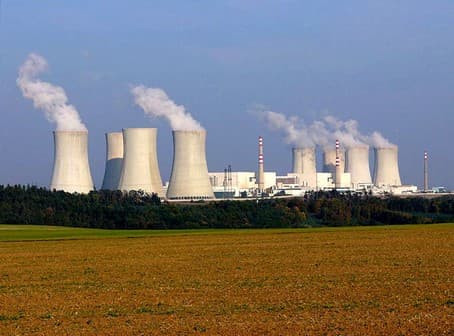
More than three quarters of people in Czechia support the construction of a new unit at the Dukovany Nuclear Power Plant. Fifty-eight percent of people trust the government to make decisions on nuclear energy, and almost two thirds think that nuclear power’s share of electricity generation should increase in the future. Thirty-four percent have no concerns about the use of nuclear energy, while 41 percent have only minor concerns. The findings come from a survey conducted last year, whose results the Centre for Public Opinion Research (CVVM) provided to the Czech News Agency (ČTK) today.
CVVM did not compare the results with previous surveys because it had changed its methodology for selecting respondents. According to an earlier survey, however, in 2023 more than half of people did not trust the government to make decisions on the development of nuclear energy in Czechia. In the current survey, ten percent said they definitely trusted the government in this regard and 48 percent said they rather trusted it, while 38 percent expressed distrust. CVVM noted that this result contrasts with generally low levels of trust in the current government. According to the researchers, it may have been influenced by the government’s selection of South Korea’s KHNP as the winner of the tender to build at Dukovany shortly before the survey began.
Seventy-eight percent support further construction at the Dukovany Nuclear Power Plant, 16 percent oppose it and the remainder said they did not know. Sixty-three percent of people want nuclear power’s share of electricity generation in Czechia to increase, 22 percent want it to remain at its current level and 11 percent want it to decrease. “Of the decision-making factors, only the price of electricity, and to a lesser extent the reliability of supply and economic competitiveness, positively influence support for nuclear energy. By contrast, the importance of carbon dioxide emissions as a decision-making factor works against increasing nuclear energy’s share of electricity generation,” CVVM said.
Four percent of people have major concerns about the use of nuclear energy in Czechia, while 19 percent have moderate concerns. By contrast, three quarters of those surveyed expressed minor or no concerns. “A more detailed analysis shows that women express somewhat greater concern than men, as do respondents without a secondary school leaving certificate. Concerns also correspond quite strongly with general attitudes towards nuclear energy,” the researchers noted.
Half of people in Czechia consider the transition to cleaner energy a success, while 43 percent consider it unsuccessful. “The development of photovoltaics and nuclear energy are most often cited as the transition’s greatest successes. High energy prices, the pace of nuclear energy development being too slow, and the excessive expansion of solar power plants—occupying high-quality agricultural land, burdening the public budget and driving up electricity prices for consumers—are most often seen as failures,” CVVM said.
Forty-two percent of people consider the energy system in Czechia fair in terms of how its benefits and disadvantages are distributed among different groups in society, while 46 percent consider it unfair. Among respondents who described the energy system in Czechia as fair, almost two thirds were unable to give a specific reason for their view. Those who considered it unfair said this was due to excessive profits by electricity producers, often benefiting from subsidies; high or varying prices; an unfair distribution of the costs and impacts of the transition to cleaner energy; and large differences between production costs and prices for consumers.
For the survey, CVVM questioned 1022 people aged 15 and over from 2 to 11 August.
Translation disclaimer
This article is a machine translation of the Czech original and has not yet been fully reviewed. In case of any doubt, please refer to the Czech version.
Sdílejte článek prostřednictvím:
You might also like


23 October 2026, 11:01


23 October 2026, 06:34