23 October 2026, 14:38
Loading...
New nuclear build: Czech firms’ involvement is key to the domestic economy
oEnergetice.cz
12 October 2023, 18:49
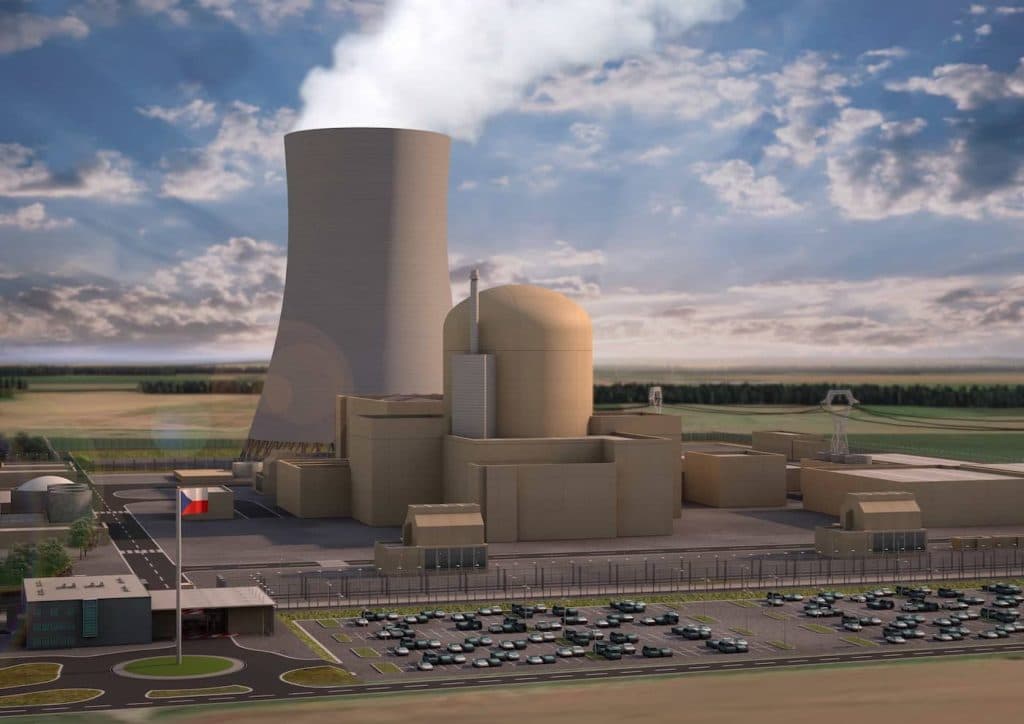
The planned construction of new nuclear reactors in Czechia is not only a matter of energy self-sufficiency and meeting climate targets, but also an opportunity to create significant economic value within the national economy. The macroeconomic and microeconomic effects were examined in the study “New energy for the national economy and local development”, prepared by the Centre for Economic and Market Analyses (CETA), whose findings were presented at the International Engineering Fair in Brno.
The impact on the national economy will be driven primarily by the number of new nuclear units to be built. Relative economic and social effects will arise from every koruna invested. Their structure also depends on several other key factors, namely:
- the extent of domestic companies’ involvement in the project (localisation)
- subsequent opportunities for Czech companies to supply nuclear projects abroad (exports)
- the extent to which domestic human resources are used (education and retraining)
- project design that contributes to creating lasting value at the site of implementation (region)
“The construction of new units at Dukovany should not be discussed as a national project taking place in a particular region, but as a regional project with a national impact. The investment should be carefully planned to enrich local communities and ensure that both tangible and intangible benefits are deeply and permanently rooted in the region,” says Aleš Rod, research director at CETA.
The study reached the clear conclusion that the construction of new nuclear power plant units will bring economic benefits to the relevant region and the entire Czech economy many times greater than the investment itself.
This will be particularly the case if Czech companies secure a significant share of the total contract value, with Czech industry associations calling for Czech companies’ involvement to reach 65%. A range of other economic activities generating additional benefits and opportunities is linked to the construction of the new units, expressed in particular through so-called multiplier effects.
The total multiplier in this case reaches 3.27. This means that every CZK 1 invested in the construction of a new nuclear unit delivers a total benefit to the Czech economy of CZK 3.27, through a combination of direct, indirect and induced effects.

The approved principles for updating the State Energy Policy and the draft Climate and Energy Plan envisage the construction of at least three large nuclear units. If the investment value reaches CZK 750bn (based on the public estimate of CZK 250bn for one unit) and 65% of this amount is allocated to Czech suppliers, the estimated total impact on Czech GDP is CZK 1,594bn, while additional tax revenues for the state budget would amount to CZK 548bn.
The greatest benefit for the Czech economy is associated with the indirect impact of construction (indirect output multipliers): CZK 1 generates CZK 1.97 here. This primarily involves the activation of supply chains providing mechanical and electrical equipment, engineering activities, and other types of products and services.
The induced multiplier effect generated by household consumption, stimulated by employment income that construction of a nuclear unit at Dukovany would secure directly and indirectly within supplier and customer chains, amounts to almost CZK 0.30 for every koruna invested.
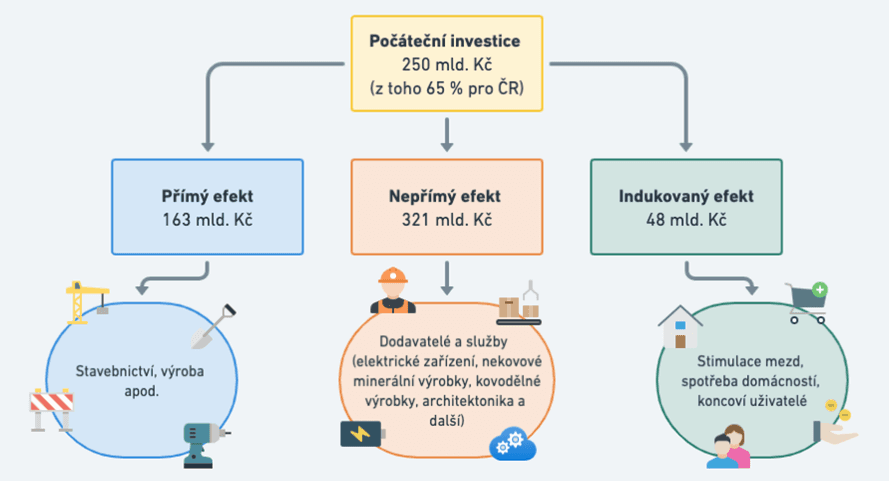
The multiplier values can be applied to different scenarios depending on the size of the initial investment:
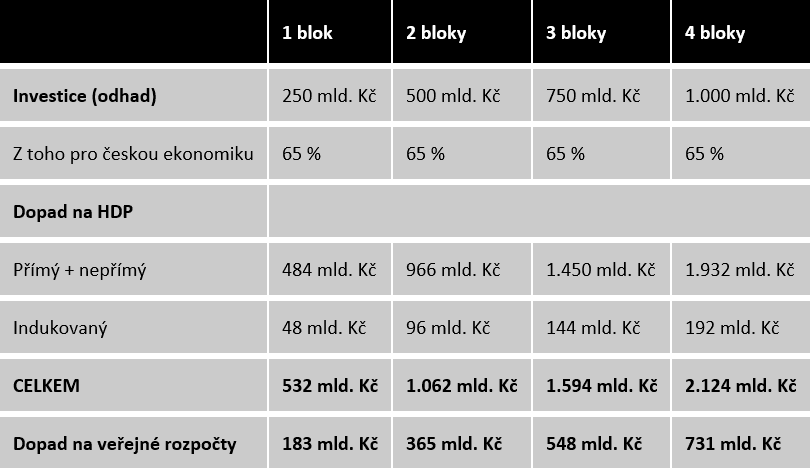
Source: CETA calculations based on Czech Statistical Office data (input-output analysis)
Business opportunities abroad are closely linked to the extent of Czech companies’ involvement in the project. Participation in this contract may open doors for these firms in other similar projects, as also confirmed by CETA’s survey of businesses in the region around Dukovany Nuclear Power Plant conducted this year: 47% of respondents consider it one of the expected benefits for the region. They also regard a positive contribution to regional education as one of the main long-term benefits. Maximising the benefits of construction will therefore not depend solely on the amount invested.
The issue of education and preparing human resources is crucial to the success of the Czech nuclear programme, particularly in light of the ongoing nuclear renaissance in a number of other European countries. The study therefore devotes a separate chapter to it, reaching an unequivocal conclusion: timely preparation and coordination of extensive education programmes are key.
Czechia will need thousands of highly qualified workers – construction of one reactor is estimated to require around five thousand people at the peak of construction. To achieve a positive socio-economic effect, it is necessary to ensure that the largest possible share consists of people working in the Czech Republic on a long-term basis, rather than experts or workers hired from abroad for a short period. The better the timely preparation of domestic specialists, the easier it will be for them to become involved in other ongoing projects in Europe. This will allow the region and the country as a whole to benefit in the long term, rather than seeing these effects disappear immediately after construction work ends.
Faster internet?
The planned construction of new units at Dukovany Nuclear Power Plant should be understood not only as an energy project, but also as an opportunity to raise living standards in the region. For example, through the development of high-quality internet connectivity or a network of electric vehicle charging stations.
The construction and subsequent operation of the expanded power plant will require the modernisation of local roads and bridges. This need can be used in line with the “dig once” approach and combined with further innovations in infrastructure networks. For example, if road construction requires excavation work, fibre-optic cables can be installed at the same time or water supply and wastewater systems can be upgraded. However, these elements must be taken into account from the outset in preparing the entire project, and the work must be coordinated with the suppliers of these networks.
“Infrastructure development projects will then be more efficient and less costly. At the same time, they can have a fundamental impact on residents’ satisfaction and economic growth in the region, as high-speed internet connectivity, for example, is essential for deploying new technologies and improving services,” says Michael Fanta, lead analyst at CETA.The study was supported by EDF Nuclear Czechia, the Czech branch of EDF, which is one of the participants in ČEZ’s tender for the construction of a new unit at Dukovany Nuclear Power Plant.
Translation disclaimer
This article is a machine translation of the Czech original and has not yet been fully reviewed. In case of any doubt, please refer to the Czech version.
Sdílejte článek prostřednictvím:
You might also like
23 October 2026, 11:01
23 October 2026, 06:34