25 September 2026, 09:51
Loading...
ENTSO-E: Risks to Europe’s electricity supply security cannot be ruled out this winter

David Vobořil
2 December 2019, 07:37
The European Network of Transmission System Operators for Electricity (ENTSO-E) has published its electricity supply security outlook for Europe for the coming winter. Under normal conditions, no risks to electricity supply security should arise. However, in the event of cold spells and low availability of generation resources, supplies may not be secured in several countries, particularly during January.
Under extreme conditions, probabilistic simulations indicate that France and Belgium in particular may face electricity supply security problems. Both countries would be highly dependent on electricity imports from neighbouring countries and, in some cases, would have to rely on out-of-market measures and regional cooperation to avoid disconnecting consumers.
“Such conditions would require strict monitoring of system reliability closer to real time, supported by regional security coordinators (RSCs). This close cooperation will be particularly important if significant unplanned outages of generation or transmission capacity occur in combination with extremely cold weather conditions and low renewable generation,” the study states.
Development of generation capacity
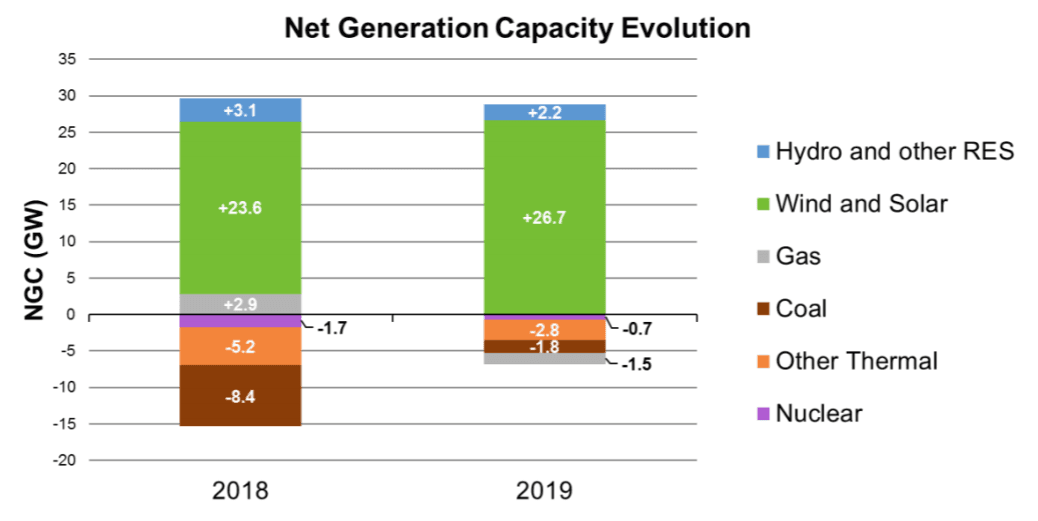
While renewable energy generation capacity recorded a slightly higher increase this year than last year, with European wind and solar power plants adding almost 27 GW, the decline in conventional generation capacity was less than half as large.
Generation adequacy in the coming winter
As the following chart shows, under normal conditions (the left-hand part of the chart), generation capacity and market-available demand-side response are sufficient to cover peak electricity demand in individual weeks in European countries, with the exception of several countries that require electricity imports. These are Austria, Finland, Hungary, Italy, Lithuania and, in three weeks, Northern Ireland.
Under extreme conditions (the middle part of the chart), accompanied by higher electricity demand and potentially lower available generation capacity, the number of countries requiring electricity imports to cover their own consumption increases. In the second and third weeks of January 2020, part of consumption in Belgium, Germany, Finland and France cannot be covered even by available electricity imports. The red arrows on the map show areas where cross-border transmission lines become congested.
When strategic reserves are used (the third column), the electricity supply problems are resolved and the affected countries are able to meet electricity demand using electricity imports.
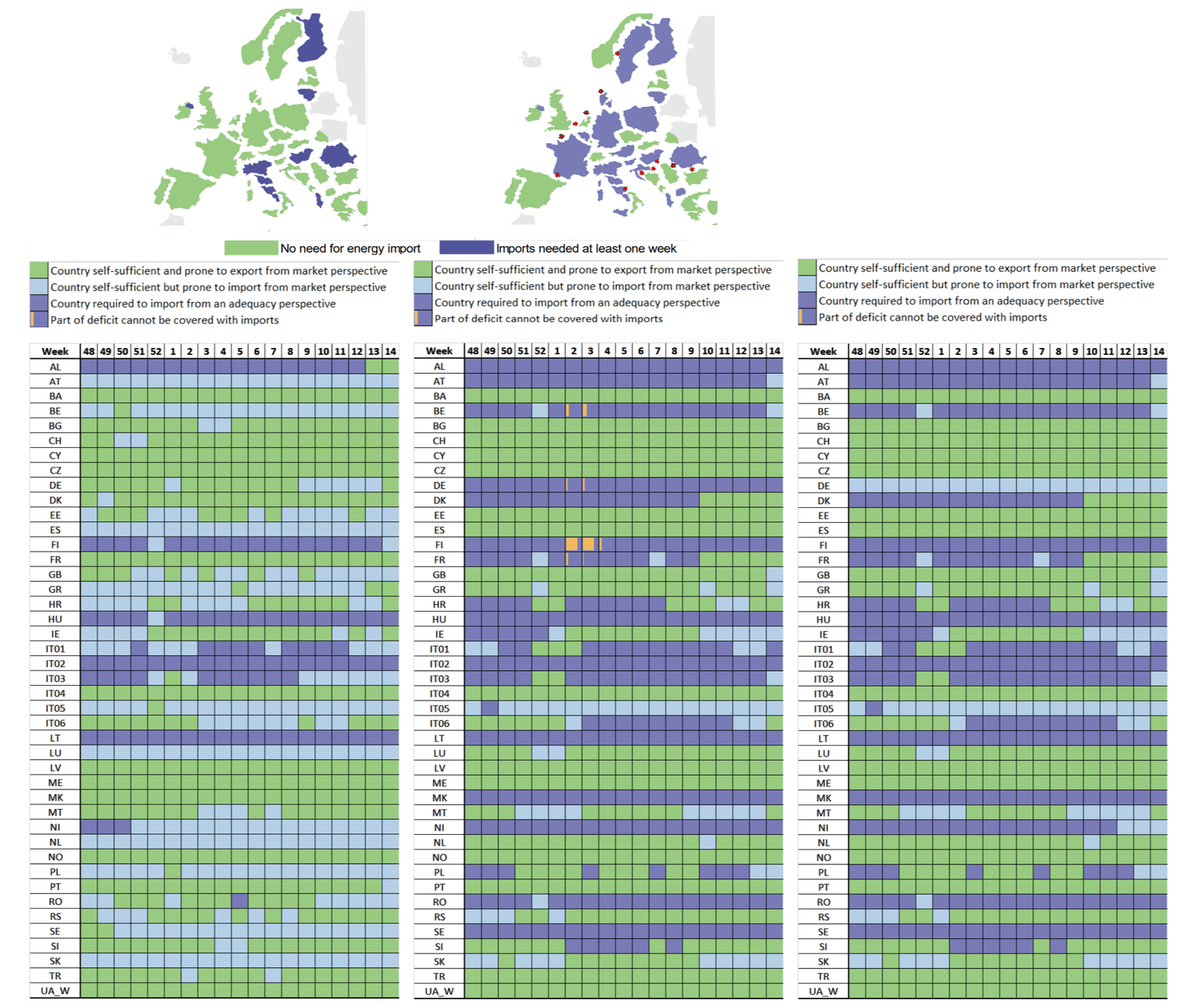
The Czech Republic, as a country with considerable excess generation capacity, need not worry as usual. ČEPS therefore expects no problems with generation or system adequacy in the coming winter period.
Negative flexibility of generation capacity
An important parameter of generation resources in the system is also their ability to reduce output during periods of low electricity demand – that is, to provide negative flexibility.
The problem traditionally arises in Germany during periods of high renewable energy generation and low electricity demand over the Christmas and Easter holidays. Under the merit order, electricity generation from renewable energy sources takes priority over sources with higher marginal costs, so conventional power plants must respond by reducing their output to the level of current electricity demand. However, not all resources are able to reduce their output cost-effectively, and electricity prices therefore often fall into negative territory.
The following chart shows that Belgium, Bulgaria, Germany, Denmark, Ireland, Italy, Northern Ireland, Poland and Sweden will face this problem in daytime hours (the left-hand part of the chart) and nighttime hours (the right-hand part of the chart). The worst situation is in parts of Italy, Ireland and Germany, which will be unable to export surplus generation abroad in all 19 weeks examined.
Compared with a shortage of generation capacity, resolving this situation is relatively straightforward and is limited to curtailing renewable energy generation; however, renewable generators must be financially compensated for the “unproduced” electricity when such curtailments occur.
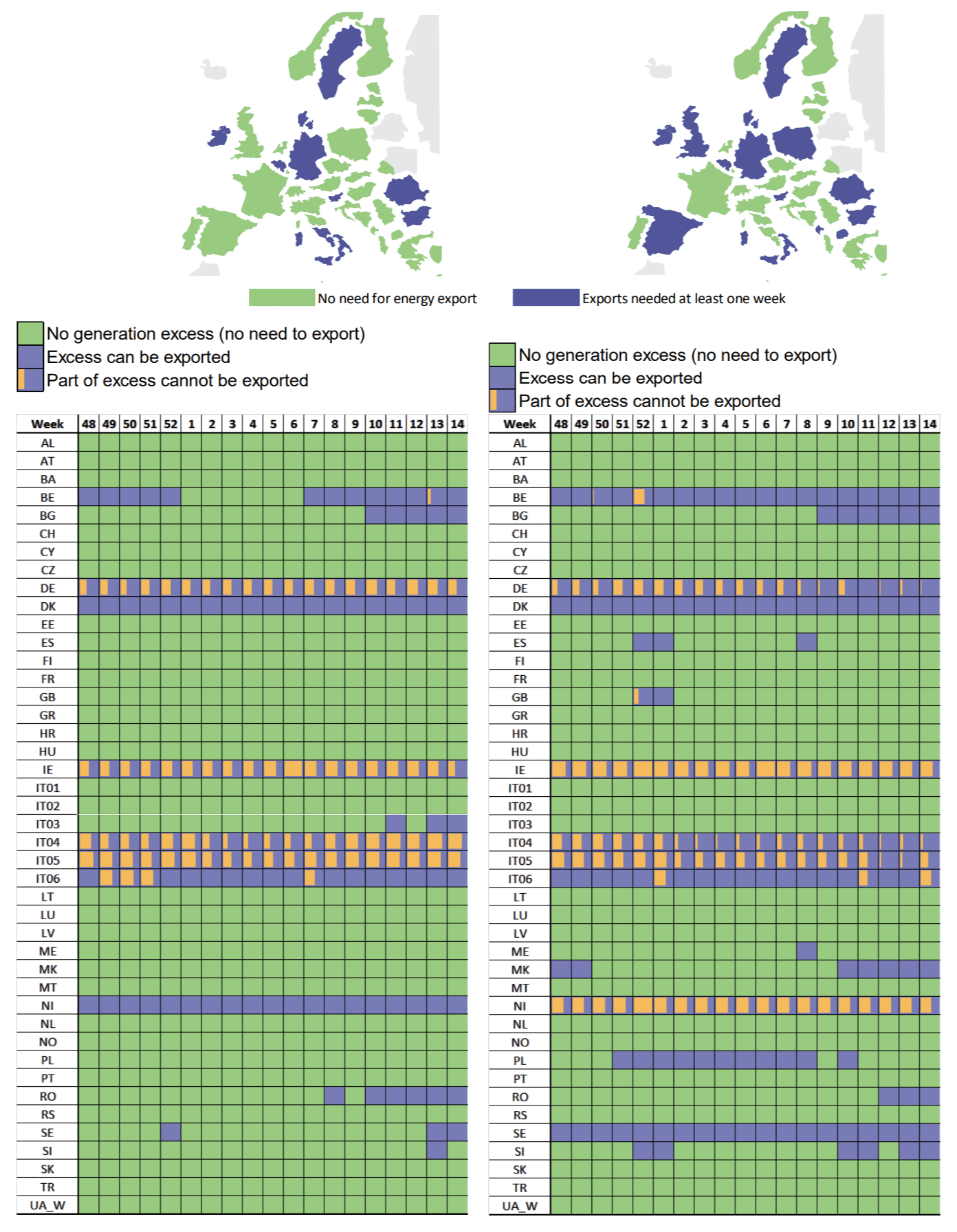
Methodology used considers extreme events occurring once every 20 years
Since its 2017 study, ENTSO-E has modified its methodology based on experience from the previous winter, when problems arose primarily due to a combination of cold spells and low availability of nuclear generation in France. France is an important variable in the simulation due to the high electrification of heating. For this winter, ENTSO-E assumes that consumption in France will increase by 2,4 GW for every degree Celsius by which the temperature falls.
The analysis now includes a worst-case scenario that considers situations occurring on average once every 20 years, instead of the previous study, which considered situations occurring once every 10 years. ENTSO-E analysed the situation if extreme events were to occur simultaneously across Europe.
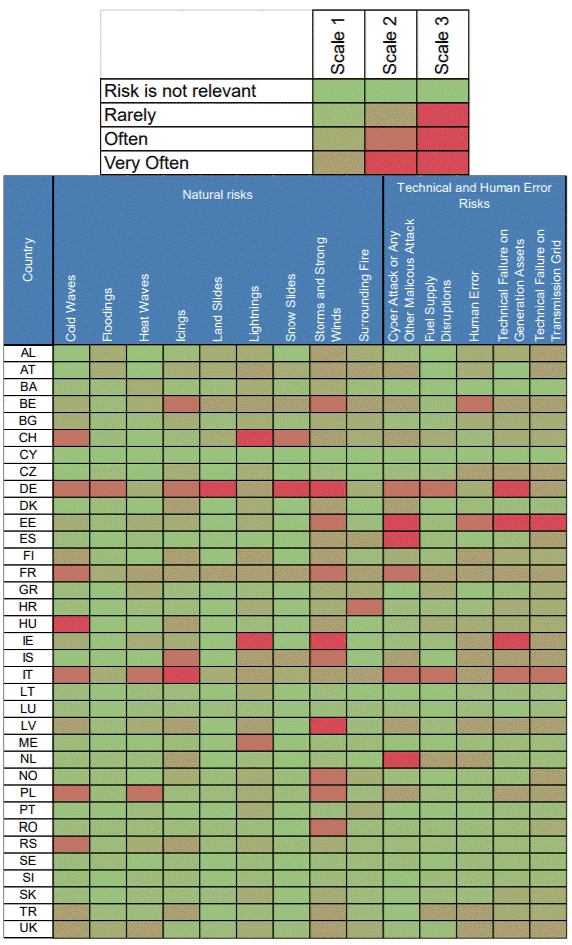
According to information from individual transmission system operators, strong winds and storms are the most likely risk. However, the most serious risk is Europe-wide cold spells. Snow avalanches and ice accretion are also considered risks that may have serious consequences. This finding underscores the importance of assessing multiple outages of generation resources and transmission lines at once using probabilistic simulation.
Translation disclaimer
This article is a machine translation of the Czech original and has not yet been fully reviewed. In case of any doubt, please refer to the Czech version.
Sdílejte článek prostřednictvím:
You might also like
24 September 2026, 11:23

24 September 2026, 10:30
24 September 2026, 06:56