23 October 2026, 14:38
Loading...
Czech transmission and distribution system – Part 1: Electrification and operating principles
Jakub Šmíd
4 October 2019, 15:05
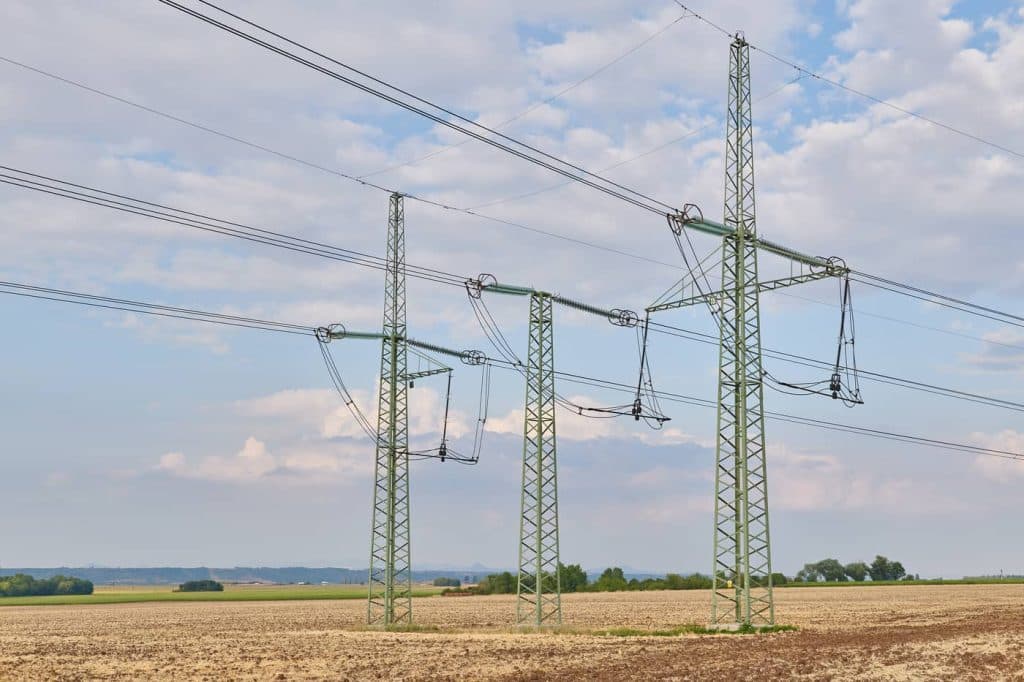
This article launches a miniseries on the transmission and distribution system. In this instalment, you will learn how the Czech Republic was electrified during the nineteenth and twentieth centuries, as well as the basic principles behind how the transmission and distribution system operates today.
Electrification of the Czech Republic
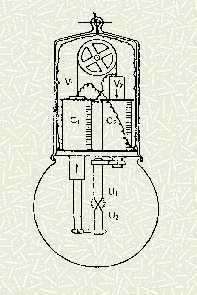
When electricity was first used in the Czech lands, in 1878 in Moravská Třebová, where it was used to light a linen weaving mill with arc lamps, there was no need for a transmission system because the electricity generated was consumed directly at the point of generation. However, from the following years onwards, as more and more facilities were electrified, electricity needed to be distributed from the point of generation to other consumers. This was primarily done using overhead lines at various voltage levels, although electricity distribution was generally still local.
Over time, so-called municipal power plants emerged, which not only generated electricity but also distributed it, primarily providing public lighting in municipalities. Households were subsequently connected to the resulting network. The first such power plant was built by the Prague district of Žižkov in 1889. It involved the installation of a dynamo at the local gasworks.
All the first power plants were direct-current plants. It was not until the end of the nineteenth century (1897) that a project to build the first power plant supplying alternating current was approved, and in 1900 the first three-phase generator was commissioned in Prague's Holešovice district. The power plant building can be seen in the period photograph below.
At the establishment of the Czechoslovak Republic in 1918, 11 % of towns and municipalities, home to 34 % of the population, had been electrified. The most important impetus for the creation of the transmission and distribution system as it is known today was the adoption of Act No. 438/1919 Coll., “On state support for the launch of systematic electrification”. Twenty-five public-service electricity companies were established, with an obligation to supply electricity to anyone in a given area who requested it, unless connecting that customer was demonstrably uneconomic. A network voltage of 3x380V/220V at a frequency of 50 Hz was selected, along with primary distribution network voltages of 22 kV and 100 kV.
From the first half of the twentieth century onwards, the electricity system moved towards large, interconnected power plants. This trend meant that the backbone transmission system was virtually completed in the 1980s.
How do the transmission and distribution systems basically work today?
The electricity transmission system is a system of facilities that ensures the transfer of electrical energy from large sources (power plants) to large substations. The part of the electricity system running from these substations to individual customers is called electricity distribution and is served by the distribution system.
Alternators at power plants generally operate at voltages of only a few kV. As a result, currents of up to tens of kA flow from alternators at large generating units. Such high currents would create two fundamental problems. First, conductors carrying such currents would need extremely large cross-sections and would be subject to substantial mechanical stress from magnetic forces. The second problem is that line losses are proportional to the square of the current. For these reasons, it is more advantageous to use a higher transmission voltage for long-distance transmission, as a lower current is sufficient to transmit the same output.
Alternator voltage is stepped up to a higher voltage level using generator transformers, generally located directly on the power plant site. Step-down transformers are installed at the outlet of the transmission system, supplying electricity to the distribution network at various voltage levels. You will learn more about the voltage levels used in the Czech distribution system in the next part of this miniseries.
Electrical energy is exceptional in that it cannot be stored on a large scale, making it essential to maintain a balance between generation and consumption at all times. For transmission efficiency, it is also desirable to maintain a low phase shift between voltage and current; special compensation equipment is therefore installed in the transmission system.
In the near future, more significant development of HVDC transmission can also be expected, as it has lower losses and requires less land area for the same transmitted output.
Problems in the transmission system are often one of the main causes of widespread power outages. They may be caused, for example, by damage to important overhead lines due to adverse natural conditions such as ice accretion or strong winds, as well as by overall system overload. The transmission system must therefore be equipped with elements that ensure the disconnection of predefined customers if there is a risk of grid collapse as a result of overloading. Otherwise, there would be a real possibility of a so-called cascading failure: disconnecting an overloaded line increases the overload on the rest of the grid, and further network elements are progressively disconnected. The final stage would be the complete collapse of the entire transmission system, also known as a blackout. For economic reasons, it is advisable to first disconnect those customers for whom a potential power outage would cause the least economic damage.
That concludes this brief journey through the history of the Czech electricity system and its basic operating principles. In the next instalment, you can look forward to facts about Czech extra-high-voltage lines, substations and much more.
Sources: ČEPS a.s., ČEZ a.s., lectures by FEL ČVUT
Featured image source: www.ceps.cz
Translation disclaimer
This article is a machine translation of the Czech original and has not yet been fully reviewed. In case of any doubt, please refer to the Czech version.
Sdílejte článek prostřednictvím:
You might also like
23 October 2026, 11:01

23 October 2026, 06:34