23 October 2026, 14:38
Loading...
Pumped-storage hydropower plants in Czechia

David Vobořil
3 January 2017, 17:43
Pumped-storage hydropower plants (PSHPPs) play a very important role in ensuring the reliability of electricity supplies. Their importance is also rising considerably with the growing share of generation from renewable energy sources, particularly solar and wind power plants. This is particularly evident from the record output of Czech PSHPPs in recent years (see below).
Despite long-standing efforts to develop new solutions, this remains the most widely used electricity storage technology in power systems in terms of installed capacity.
A PSHPP is a system of two reservoirs at different elevations connected by a penstock, with a reversible turbine (or a turbine and a pump) and a motor-generator located at its lower end. During periods of surplus electricity in the grid, it can be used to pump water from the lower reservoir to the higher upper reservoir; conversely, during periods of shortage, electricity is generated by water flowing from the upper reservoir through the turbine. You can find out more about the principle and configuration of PSHPPs in our previous article.
History of pumped-storage hydropower plants in Czechia
In 1930, the first PSHPP in Czechia was commissioned: the Černé jezero power plant, built by Škoda Works Plzeň in Hojsova Stráž in the Šumava region. It had a capacity of 1.5 MW, although pumping operations were curtailed in 1960.
The second PSHPP was the Pastviny plant, which was commissioned in 1938 but was later converted into a run-of-river plant.
This was followed by the Štěchovice II PSHPP in 1947. In the 1970s, it was no longer sufficient to cover sharp changes in the system, and the Dalešice PSHPP was therefore commissioned in 1978. The newest Czech PSHPP is the Dlouhé Stráně plant, which was commissioned in 1996.
There are currently three PSHPPs in operation in Czechia – Dlouhé Stráně, Dalešice and Štěchovice II – all owned by ČEZ.
Štěchovice II pumped-storage hydropower plant
The Štěchovice PSHPP is located in the Central Bohemian Region, around 30 km south of central Prague. It lies on the Vltava River and, together with other hydropower plants, forms the so-called Vltava Cascade. The plant was commissioned in 1947 and, after generating 1 650 GWh of electricity, was shut down in 1991 due to obsolescence.
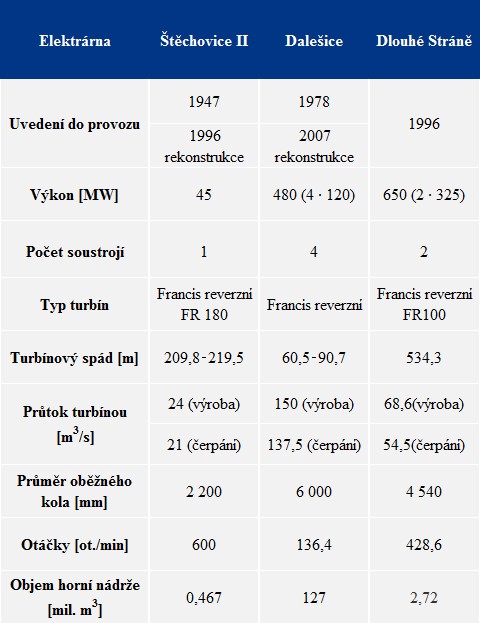
Construction of a new PSHPP began the following year and lasted five years. It uses the original upper reservoir at Homole, with a capacity of 500 000 m3, and a large part of the original steel penstocks, 590 m long and 1.7-2 m in diameter. Two generating units were replaced by one featuring an FR-180 Francis reversible turbine from ČKD Blansko, located in a powerhouse 45 m underground. The plant's total capacity increased by 4 MW to its current 45 MW.
Dalešice pumped-storage hydropower plant
The Dalešice pumped-storage hydropower plant is part of the Dukovany complex and is located in western Moravia, southeast of Třebíč. The entire hydropower scheme was built in 1970‑78 and consists of the upper reservoir at Dalešice, with a volume of 127 million m3; the Mohelno balancing reservoir; the Dalešice pumped-storage plant; and the Mohelno run-of-river hydropower plant. The upper reservoir is formed by a 100 m-high and 350 m-long rockfill dam with a clay core, and is the tallest of its kind in Czechia. Water is conveyed to the plant, which is located together with the switchyard at the foot of the dam, by 4 steel pipes with a diameter of 6.2 m.
There are 4 generating units with reversible Francis turbines for a 90m head. Following refurbishment in 2007, total capacity increased from the original 450 MW to the current 480 MW. Capacity is sized to replace one unit of the Dukovany nuclear power plant in the event of an outage. Electricity generation and pumping operation are provided by synchronous generators with a voltage of 13.8 kV and bidirectional rotation.
As with the Dlouhé Stráně PSHPP, it is controlled from the control centre in Prague. Full output can be reached from a standstill in just 55 seconds, making it the fastest-starting PSHPP in Czechia.
Dlouhé Stráně pumped-storage hydropower plant
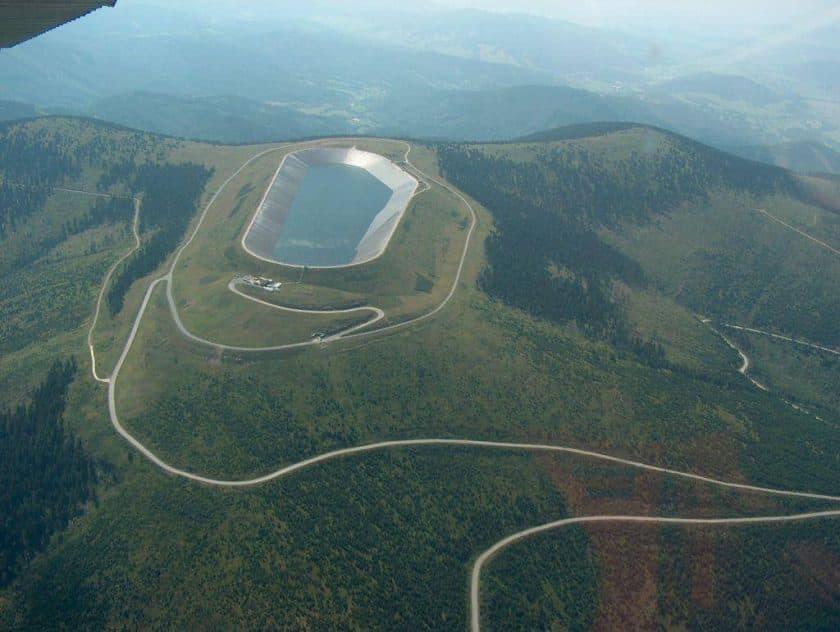
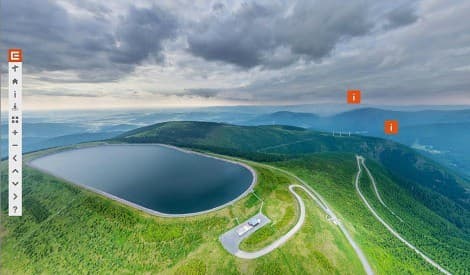
The Dlouhé Stráně plant is located in Moravia's Hrubý Jeseník mountains, in a protected landscape area, making it a highly controversial project. To integrate it into the landscape as sensitively as possible, all operations are located underground; as a result, the plant received awards as one of Europe's most environmentally friendly energy projects. Despite all efforts and awards, it represents a very significant intervention in the landscape, as can be seen in the image above and in the following virtual tour.
Construction of the plant began in May 1978, but was halted by the central authorities in the early 1980s. The project was subsequently modernised, and in 1989 it was decided to complete construction. The plant has been in operation since 1996.
From a technological perspective, it is a highly remarkable project, boasting Europe's largest reversible turbine, with a capacity of 325 MW; the largest head in Czechia (510.7 m); and the largest installed capacity of any hydropower plant in Czechia.
The upper reservoir, with a total volume of 2.72 million m3, is located at an elevation of 1350 m on the summit of Dlouhé Stráně mountain and is connected by two penstocks, 3.6 m in diameter and 1547 m and 1499 m long, to two reversible turbine-generator units. The units consist of a starting pony motor, a generator and a Francis turbine with a capacity of 325 MW in turbine mode and 312 MW in pumping mode. At full output, 68.5 m3 of water flows through each penstock per second. The lower reservoir, with a total volume of 3.4 million m3, is located on the Divoká Desná stream and is connected to the plant by two tailrace tunnels with a diameter of 5.2 m and lengths of 354 m and 390 m.
Plant operation is fully automated and controlled from a dispatch centre in Prague. It can reach full output in under 100s and supply electricity continuously for 6 hours. It can switch from pumping to turbine operation in 150 s, and from standstill to pumping operation in 400 s. Filling the upper reservoir to its full capacity takes 7 hours.
To cover its own electricity consumption, the plant uses the small low-head Dlouhé Stráně II balancing plant, with a 163 kW Francis turbine located at the outlet of the lower reservoir.
Parameters of pumped-storage hydropower plants in Czechia
A summary of the basic parameters of pumped-storage hydropower plants in Czechia is provided in the following table.
Development of pumped-storage hydropower generation in Czechia
The following chart shows the development of gross electricity generation at Czech PSHPPs from 2006 to 2015, according to statistics from the Energy Regulatory Office. The chart shows that electricity generation at Czech PSHPPs has grown significantly since 2008, exceeding 1 TWh for the first time in 2014. Between 2008 and 2015, generation increased by 924 GWh, or more than 260%.
Planned pumped-storage hydropower plants in Czechia
One of the biggest challenges in building new PSHPPs is their large scale, the associated high construction costs and the significant impact on the landscape. For this reason, Czechia tends to invest in existing PSHPPs by installing more powerful and modern generating units.
A new pumped-storage plant is to be built at the Orlík-Kamýk waterworks system. ČEZ had considered converting the Orlík hydropower plant into a pumped-storage facility for several years, but the conversion did not begin due to low wholesale electricity prices and uncertainty over their future development. Management was unsure whether the investment of two to three billion would be worthwhile at the time. However, an environmental impact assessment had already been secured during earlier preparations.
This pumped-storage plant, which is expected to operate similarly to Czechia's best-known pumped-storage plant, Dlouhé Stráně in the Jeseníky mountains, was expected to enter operation by 2023 (according to information from the second half of 2023). Its supplier, which will carry out the conversion of the Orlík hydropower plant into a pumped-storage hydropower plant, was also expected to be selected by the end of 2023.
The most recent pumped-storage hydropower plant in Czechia was commissioned in the underground premises of the former Jeremenko mine in Ostrava in July 2015. However, this plant does not serve the same function as the three Czech PSHPPs mentioned above. It is only a pilot facility operated for research purposes.
Translation disclaimer
This article is a machine translation of the Czech original and has not yet been fully reviewed. In case of any doubt, please refer to the Czech version.
Sdílejte článek prostřednictvím:
You might also like
23 October 2026, 11:01
23 October 2026, 06:34