23 October 2026, 14:38
Loading...
This year’s milestones in Russian nuclear power
Vladimír Wagner
5 September 2016, 20:00
This year, Russian nuclear power is expected to achieve several key successes. These could be decisive for the further development of the sector not only in Russia, but around the world. The first achievement is the start of a chain reaction at the first unit of the second phase of construction at the Novovoronezh nuclear power plant. The Novovoronezh II-1 unit (sometimes referred to as Novovoronezh 6) has been completed and is now undergoing operational testing at gradually increasing power levels. It is the first VVER1200/V392M reactor to be started up and thus also the first Generation III+ reactor. The second milestone should be the start of commercial operation of the BN-800 sodium-cooled fast reactor.
Generation III and III+ reactors
First, some clarification is needed. Generation III reactors emerged through the evolution and improvement of Generation II designs. They should represent a major advance in terms of the safety and efficiency of their construction and operation. For safety, the priority is a transition to passive safety features that do not require electricity or human intervention. In an emergency, the reactor should be able to withstand the loss of power supplies and staff intervention for as long as possible. From the perspective of operating economics, the emphasis is on modularity and standardisation in construction, as well as achieving the highest possible fuel burn-up and using recycled fuel. An older, more detailed popular description of these reactors can be found in this article from 2008.
This also shows that the deployment of these reactors is several years behind schedule. Generation III reactors include Japan’s ABWR boiling water reactors. Two such units are at the Kashiwazaki-Kariwa (Kashizawaki-Kariwa) plant, namely its sixth and seventh units. The first Korean APR1400 pressurised water reactor was recently started up as the Shin Kori 3 (Shin Kori 3) unit, which is also classified as Generation III. Russian VVER1000/V-412 (AES-92) designs, completed at India’s Kudankulam plant and representing an improvement on the designs known from Temelín, are described as being very close in their parameters to Generation III. The first unit there entered commercial operation in December 2014, while the second was started up this year. At the end of August 2016, it began operating at 245 MW and started supplying electricity to the grid.
Reactors designated as Generation III+ are even more advanced, particularly in the area of passive safety. These include AREVA’s EPR reactors under construction, Westinghouse’s AP1000 and Rosatom’s already mentioned VVER1200 design.
The first Generation III+ unit to be started up
And it was the first VVER1200 unit that was recently started up at the Novovoronezh plant. This plant is among the oldest. Its first unit began operating in 1964 and was the first VVER reactor. The first two VVER210 and VVER365 units began operating in 1964 and 1969 and ran until 1984 and 1990 respectively. The next two units were already of the VVER440 type, known from Jaslovské Bohunice and Dukovany. They began operating in 1971 and 1972 and are still in service. In 1980, the fifth unit was commissioned, one of the first VVER1000 units. Following modernisation, which mainly improved its safety, it is expected to operate beyond 2035.
Since 2007, two new Generation III+ VVER1200/392-M (AES2006) reactors have been under construction there. On 20 May, a fission chain reaction began in the first of these units. Initially, it ran at the lowest possible power level, representing roughly 1 % of nominal output. The first operational tests began to verify that everything was in order and performing as expected. Above all, they checked whether the core parameters met requirements and whether all safety systems were operating reliably. Output was gradually increased. On 5 August, the turbine was started and the first electricity was supplied to the grid. Initially, the unit had an output of 240 MW, but this is gradually being increased. It is therefore highly likely that the reactor will enter commercial operation this year. Another unit of the same type at this plant should be started up next year.
Two more VVER1200 units, this time the VVER1200/491 (AES2006) variant, are being completed at the Leningrad nuclear power plant. They are needed to gradually replace four RBMK units of the type used at Chernobyl. These have so far operated very reliably, so they can be expected to last their full projected 45 years. The first RBMK unit will therefore most likely be shut down in 2019. Given the region’s energy needs and the capacity for exporting power from the plant, it will be sufficient for the new units to enter operational service only in a few years’ time. However, they are expected to be completed gradually next year and the year after. It should be recalled that two further VVER1200 units are also to be built at the Leningrad nuclear power plant, with construction expected to begin in 2018 and 2019.
Another four RBMK units at the Kursk nuclear power plant should be replaced by the improved VVER-TOI design, an enhancement of the VVER-1200 model. On 9 June 2016, a construction permit was obtained there and preparations subsequently moved into actual construction. Excavators removed soil and a sand base is being prepared for the concrete foundation slab. Concrete pouring itself should begin in May 2018, with the first unit expected to start up in 2022.
The opportunity to demonstrate the first operating Generation III+ reactors is also very important for their sales abroad. Two such units are currently under construction in Belarus, which still has to import a considerable share of its electricity. Once the Belarusian Ostrovets nuclear power plant is completed, it will even have electricity available for export. Construction of the first reactor began in 2013 and it should be completed in 2019; for the second, the respective years are 2014 and 2020. By 2020, Belarus would like to introduce a free electricity market and complete its integration with the common market of the Eurasian Economic Union. It would also like to begin exporting electricity to the European Union. This should be helped not only by the nuclear power plant, but also by new decentralised sources. So far, construction has proceeded smoothly and according to plan. However, the recent incident shows that problems can arise. While the reactor vessel was being installed, it slipped and landed more heavily. It is currently undergoing a careful inspection. Safety is the most important consideration, so there are two possibilities. Either it will be conclusively proven that everything is in order, or the relevant equipment will be replaced.
Generation III+ VVER reactors are planned for Turkey’s Akkuyu plant, where preparatory work is currently under way and construction of the first of four units should begin this year. Various earthworks and other work are also under way at Finland’s Hanhikivi, where one unit of this type is planned. Construction is likewise being prepared for two units at Hungary’s Paks plant, Bangladesh’s Rooppur plant and Vietnam’s Ninh Thuan plant, and they should also be added as Units 3 and 4 to the pair of already mentioned reactors at India’s Kudankulam plant. Units similar to the first ones at Kudankulam are being prepared as further units at Iran’s Bushehr plant. Feasibility studies are also being completed for a plant in Jordan.
Russia thus already has a number of foreign projects under development, and in many of them it also acts as an investor. Given the country’s current economic problems, this may create difficulties, as the case of Turkey shows. On the other hand, nuclear power is a sector in which Russia is at the global technological forefront and which will allow it to replace exports of raw materials with exports of complex, highly demanding technologies. In addition, Russia has technologies covering all areas and the entire nuclear electricity generation cycle: from the development and construction of modern plants, through fuel production, refurbishment and repair of existing units, to fuel recycling and decommissioning of retired units. Rosatom, for example, is currently also entering the US market with its fuel.
The BN800 sodium-cooled fast reactor is at full power
That Russia is truly at the forefront is also demonstrated by another key event this year: the sodium-cooled fast reactor BN-800 reaching full power. The reactor is located at the Beloyarsk nuclear power plant as its fourth unit. One sodium-cooled reactor, the BN-600 type, with an output of 660 MWe, is already operating at this plant. It is the only fast reactor that has served as a conventional commercial power reactor for more than 35 years.
Experience from its operation was also used in designing the larger BN-800 reactor. Preparation of the project and the construction site began as early as 1984, but the project was suspended for financial reasons. The situation changed in 2005, when the project resumed, and concrete pouring for its foundation slab began the following year. In 2010, all the reactor’s main components were delivered. Filling the reactor vessel with sodium was completed in 2013. At the beginning of 2014, fuel was loaded and, at the end of June, a controlled fission chain reaction was started for the first time.
The advantage of reactors using fast, unmoderated neutrons is their ability to produce plutonium-239 from uranium-238 and thus produce fuel from this isotope, which accounts for more than 99 % of natural uranium. Another advantage is the efficient burning of plutonium-239. The BN-800 reactor is expected to be used to burn fuel with a high plutonium-239 content, including weapons-grade plutonium. Although partial plutonium burning had also been envisaged for the BN-600 reactor, it was not ultimately tested with fuel assemblies containing high levels of plutonium-239 until 2015.
The BN-800 reactor, described in greater detail in an article on Technet, is expected to use a core consisting of MOX fuel containing plutonium-239. However, development of the required fuel assemblies was delayed. The reactor therefore started with a mixed core consisting of fuel assemblies based on MOX as well as those using conventional uranium fuel. Such a core behaves somewhat differently, requiring certain modifications. Some shortcomings therefore became apparent during the first physical start-up. These had to be gradually resolved, particularly by fine-tuning the properties of the fuel assemblies.
After the core was rebuilt, the second physical start-up began in June 2015. At the beginning of August 2015, the physical start-up was completed and the reactor’s behaviour met all the required characteristics. In November, it reached the required output of around 35 % and could begin preparing to generate electricity. On 25 November 2015, the first steam was produced and the turbine turned for the first time; on 10 December 2015, the reactor was connected to the grid and began supplying electricity. In mid-April 2016, tests at 85 % of nominal output (roughly 730 MWe) were completed and the reactor moved to maximum output. On 10 June 2016, it completed generation of its first terawatt-hour of electricity. Comprehensive tests took place in August, and on 17 August the unit reached full power, completing comprehensive tests under these operating conditions on 2 September. It is now preparing for commercial operation, which should begin in the second half of September 2016.
The BN-800 fast reactor project has two main tasks. The first is research into the efficient production and burning of plutonium-239, which should lead to closing the fuel cycle. This would allow all uranium to be used and dramatically reduce the volume of nuclear waste. The second task is to demonstrate the economic efficiency of the unit: to confirm that it is competitive with conventional reactors. From this perspective, the development of new nitride-based fuel types and their planned operational testing are also very important.
Experience with the BN-800 unit should be applied to work on the larger BN-1200 design. This is intended to be a commercial unit produced in series and offered abroad. A major part of the project should be completed this year, with its main objective being to use operating experience from the BN-800 reactor to improve the safety and economic parameters of the sodium-cooled fast reactor. The reactor will use larger fuel assemblies and have a simpler fuel replacement process. In terms of safety and efficiency, it should represent a major step towards a Generation IV reactor.
There are efforts to build the first BN-1200 unit once again at the Beloyarsk nuclear power plant. For now, the question of project financing remains open. The decision on whether and when the BN-1200 project will be implemented depends heavily on experience from operating the BN-800. Although a decision may already have been made in August, when the Russian government declared that two BN-1200 units would be built in the first phase. One will be at Beloyarsk and the other at the planned South Urals nuclear power plant. Its completion is planned by 2025.
Conclusion
By starting up the first Generation III+ unit and successfully commissioning the BN-800 sodium-cooled fast reactor, Russia has confirmed that it is at the forefront of technological development in nuclear power. Rosatom is among the companies building the most reactors abroad. For Russia, this is one of the relatively few areas in which the European Union and the United States are beginning to lag significantly behind technologically. This is also why experts from countries such as France are so interested in the Beloyarsk nuclear power plant. In addition to the two BN-1200 units mentioned, Russia plans to build another 9 entirely new units by 2030. This number does not include units already under construction and mentioned above. The vast majority will be Generation III+ VVER-TOI units. Crucial to meeting these plans and to the success of Russian nuclear technologies abroad will be how the newly started Generation III+ VVER-1200 unit and the BN-800 fast reactor perform in real operation.
Technology production should reduce Russia’s dependence on raw material exports. If it is indeed shown that carbon dioxide has dramatic impacts on climate development and that its production must genuinely be reduced as quickly as possible, then, at least in my opinion, Europe and the United States will have to not only rapidly replace their ageing reactors but also massively increase electricity generation from nuclear power. Given the crisis caused by ideological interventions in this area in the regions mentioned, this will represent a huge opportunity for Russian nuclear suppliers. However, they already have markets secured, especially in developing regions.
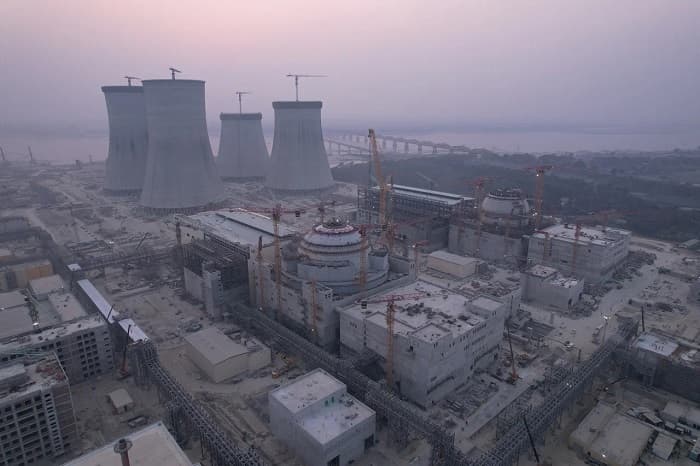
Opening photograph: construction of new units at the Novovoronezh nuclear power plant (source: Rosatom)
Translation disclaimer
This article is a machine translation of the Czech original and has not yet been fully reviewed. In case of any doubt, please refer to the Czech version.
Sdílejte článek prostřednictvím:
You might also like
23 October 2026, 11:01
23 October 2026, 06:34