Winter energy consumption of an electric car compared with a diesel in Czechia
In the previous two articles, I described my own experiences with electric mobility. Especially during the winter months, the range and energy consumption of an electric car at lower temperatures were much-discussed topics. This prompted me to document winter energy consumption and compare the data with an internal combustion vehicle as well. It should be noted that this is not precise laboratory testing across all driving modes and temperatures, but a rough comparison of the two types of propulsion on real journeys. I had two vehicles available during the winter: a Hyundai Kona BEV with a 40 kWh battery and heat pump, and a Škoda Octavia II 2.0 TDI internal combustion car. Both cars are in a similar class, with power output of around 100 kW.
Winter operation has its specifics regardless of the type of propulsion. Especially after a frosty night, the car is cold, and both the power unit and the vehicle interior need to be warmed up to the required temperature after starting. Both vehicles are parked outdoors without shelter, so it was sometimes necessary to remove snow and roughly scrape at least the windows needed for visibility before setting off. Both vehicles therefore had comparable conditions in the morning. On journeys at lower temperatures, journey length also has a significant impact on the vehicle’s overall consumption. In addition to consumption itself, I therefore recorded ambient temperature, journey length and, for the internal combustion car, engine temperature.
Comparing energy consumption is somewhat more complicated. The units used for both types of propulsion need to be aligned. Since it makes no sense to measure an electric car’s consumption in litres of fuel, I chose kWh/100 km for both types of propulsion. The calorific value of diesel fuel is 43.6 MJ/kg, which, at a density of around 0.84 kg/l, amounts to approximately 36 MJ/l. This value must then be divided by 3.6, giving roughly 10 kWh per litre of diesel. If we want to convert consumption from litres of diesel to kWh, the value in litres can simply be multiplied by ten. A consistent methodology must also be used to compare the two types of propulsion. Under the TTW (tank-to-wheel) methodology, vehicle consumption is compared from refuelling onwards. For the internal combustion car, I therefore used the standard consumption figure from the onboard computer. For the electric car, charging efficiency also had to be taken into account. I have measured this over the long term using my wallbox, and over a period of approximately 1.5 years it has been around 85%. The consumption figure shown by the onboard computer must therefore be divided by 0.85, and the resulting numbers can then be compared.
Results
During the period from mid-January to mid-March, a total of 90 journeys covering around 2,000 km were recorded with both vehicles. The actual distance travelled was higher, but some journeys could not be included, for example because the car was driven with skis or a trailer, which would have artificially increased the resulting consumption. The average distance per journey was 22.4 km, with a median of 17.8 km. Only 2 journeys were longer than 200 km. These were therefore predominantly shorter distances.
As for temperature, only 7% of journeys took place at sub-zero temperatures, 29% at up to 5°C, 47% in the 6–10°C range and 17% in the 11–15°C range. Although these temperatures do not cover the entire winter period, as data collection only began in January, the figures reflect today’s reality, in which winter temperatures have risen significantly compared with the past.
Average consumption values for the entire period were 17 kWh/100 km for the electric car and 57 kWh/100 km for the diesel car. At exclusively sub-zero temperatures, average consumption was 18.7 kWh/100 km. Compared with the long-term average, this represents an 8% increase for the electric vehicle. At exclusively sub-zero temperatures, the increase is around 18% compared with the long-term average. For the diesel vehicle, consumption increased by roughly 6% during this period. The increase in consumption is therefore higher for the electric vehicle, but even so, the diesel vehicle’s energy consumption in this mode is more than three times higher than that of the electric vehicle. The shape of the trendline for both types of propulsion is also interesting. Both vehicles need to warm up after starting, which consumes a certain amount of energy as a one-off, after which average consumption falls. In the electric car, however, it is apparent that route length itself does not have a particularly significant impact on final consumption. This is probably due to the nature of shorter journeys, where slow, economical driving offsets the energy needed for warming up. The opposite is visible in the diesel vehicle. On short routes, consumption is evidently much more affected by the low efficiency of a cold engine. Consumption then falls significantly only after tens of kilometres, when the engine reaches operating temperature and begins working at an acceptable efficiency.
Electric cars also show a relatively wide spread of consumption values. By its nature, an electric car is far more efficient than a diesel. The vehicle is therefore much more sensitive to driving conditions – speed, temperature, driving style and so on. For example, route gradient also has a noticeable effect on consumption, as changes in elevation are quickly reflected in energy use. This is not inherently a bad thing, but these factors need to be taken into account when planning charging on longer routes, especially in the mountains.
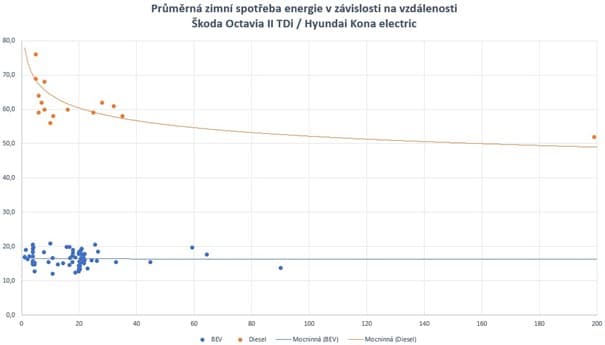
As can be seen from the measured values, an electric car’s consumption in winter does indeed rise as temperatures fall, and in more severe frosts the difference can reach up to 20% compared with the long-term average. This is due to several factors. Electric propulsion is highly efficient, and in winter it is not possible to use waste heat to heat the interior. A heat pump is therefore used for heating, but it must draw energy from the traction battery, which subsequently increases energy consumption. However, it should be added that the heat pump’s power draw is in the hundreds of watts, so the total energy consumption for heating is not extreme in the end. At low temperatures well below freezing, the heat pump operates with a very low coefficient of performance, or not at all. This is why an electric car’s consumption rises more significantly at very low temperatures. The effect of air density is less well known. It depends on temperature, and at 0°C air is roughly 6% denser than at 15°C. Especially at higher speeds, the higher density of the surrounding air has a negative impact on consumption. The higher rolling resistance of winter tyres also has a partial effect. In an internal combustion engine, its low efficiency can be partially exploited in winter, as waste heat can be used for heating. The effect of air density and winter tyres is partially offset in an internal combustion engine by higher engine efficiency at lower temperatures. The increase in fuel consumption in winter is therefore not as noticeable in an internal combustion engine. For diesel propulsion, the optimal driving mode is motorway driving, when the engine is warmed to operating temperature and runs at higher output at optimal revs.
As the measured data show, an electric car’s consumption is noticeably lower than that of an internal combustion vehicle even in winter. The main reasons include the high efficiency of electric propulsion, a lower aerodynamic drag coefficient (Cx), and, last but not least, the ability to recuperate braking energy.
The increase in consumption associated with reduced range can admittedly be inconvenient in some cases, but under real-world conditions it is ultimately not as dramatic as it is sometimes portrayed in the non-specialist press. Really severe frosts with a more substantial increase in consumption now occur only for a few days a year. If I need to travel farther on the motorway on those days, I choose a slower pace, which partially offsets the increase in consumption. Given the predominance of short journeys, I generally find driving an electric car in winter more pleasant than using an internal combustion vehicle, because the vehicle warms up very quickly and in many cases there is no need to scrape the windows at all. Overall, there is no need to be concerned about winter operation of an electric car.
Translation disclaimer
This article is a machine translation of the Czech original and has not yet been fully reviewed. In case of any doubt, please refer to the Czech version.