30 October 2026, 06:33
Loading...
Battery storage is heading for more records. Growth spreads beyond China and the US

Jan Budín
30 October 2026, 06:33
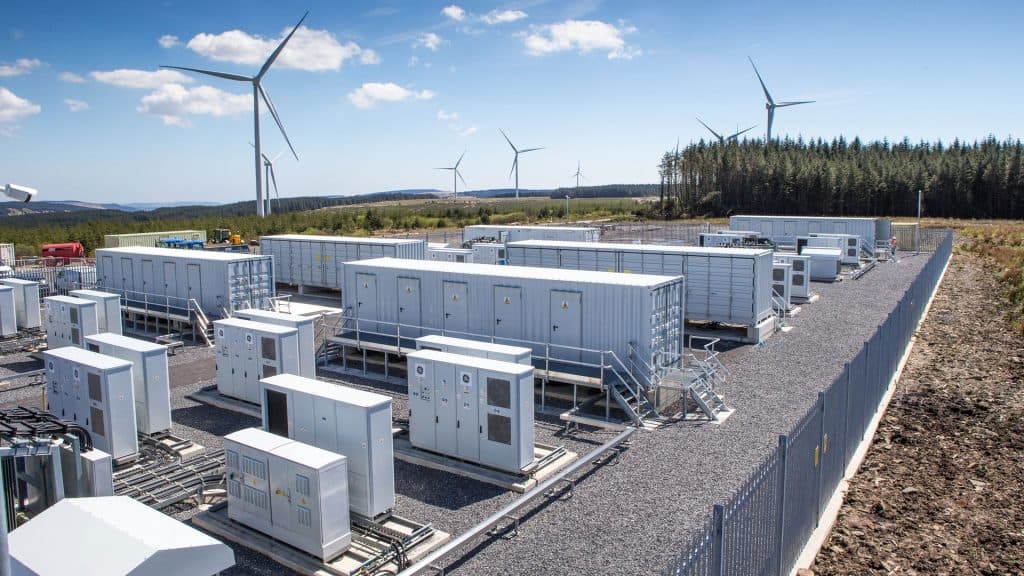
BloombergNEF expects a record 188 GW of new battery storage capacity to be commissioned worldwide this year, with the market surpassing 200 GW in 2027. While China and the United States remain the largest growth hubs, India, Australia and other European and emerging markets are gaining ground faster. Supply chains are also changing as countries provide greater support for local manufacturing and reduce their dependence on Chinese suppliers.
China, the United States and Australia are expected to account for a combined 62% of new installed battery storage capacity this year. This is set to reach a record 188 GW, with capacity totaling 535 GWh. Growth is continuing despite China scrapping last year a rule requiring storage to be paired with new renewable energy sources. According to BloombergNEF, support measures are now offsetting the uncertainty associated with the shift to other business models. These include requirements for wind and solar projects to ensure more reliable electricity supply, as well as a target to build a total of 300 GW of storage by 2030.
In the United States, construction is being supported by retained tax credits and data centers’ demand for storage at the point of consumption. The trend shows that batteries are being used not only as part of the power system, but also as a way to ensure the operation of energy-intensive consumers.
Among fast-growing markets, India is set to record the sharpest increase this year. Its annual addition is expected to be 26 times higher than last year and exceed 6 GW, compared with just a few hundred megawatts in the previous year. Growth is being driven primarily by capacity procured through tenders.
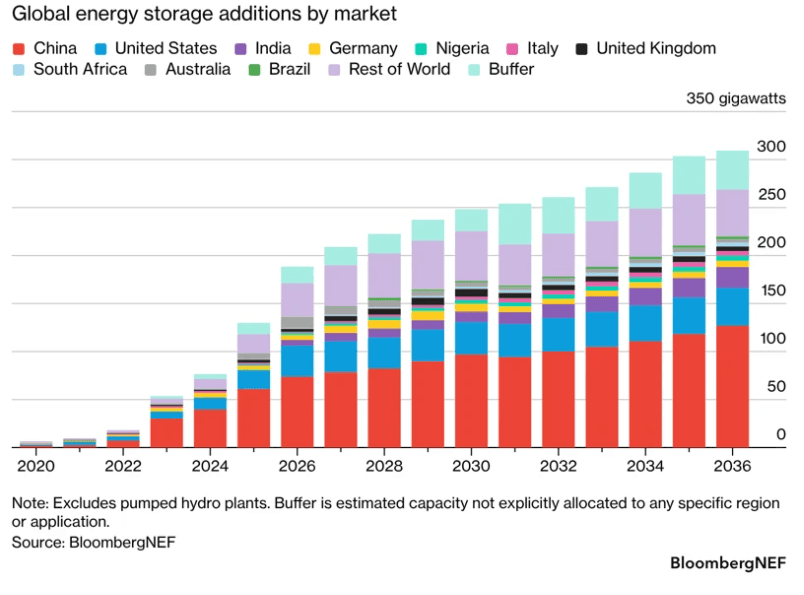
Historical and projected new installed battery storage capacity by region. Source: BNEF
Growth spreads to other regions
In Europe, the development of battery storage last year was driven mainly by the United Kingdom, Germany and Italy. This year, additions of new capacity are also expected to exceed the gigawatt mark in Bulgaria, Romania, Poland, France, Greece, the Netherlands and Ukraine.
In 2027, the global addition is expected to reach 209 GW of power and 638 GWh of capacity, representing year-on-year growth of 11% in new installed capacity. Alongside today’s leading markets, Spain, the United Arab Emirates, Chile and Japan are among those expected to grow faster.
By 2036, growth hubs are also expected to shift to Latin America, sub-Saharan Africa, Southeast Asia and other European countries. Installed capacity is expected to reach 3 TW and storage capacity 11 TWh by 2036.
Sodium is attracting attention, but LFP remains the main choice
Interest in sodium-ion batteries is growing, partly in response to rising prices for materials used in lithium iron phosphate cells, known as LFP. Sodium batteries have a lower fire risk and can operate across a wider temperature range, reducing the need for liquid cooling as well as their own energy consumption.
However, their wider adoption is being held back by limited manufacturing capacity and, for now, weaker cost competitiveness. BNEF therefore expects LFP to remain the main choice for stationary energy storage over the next decade, thanks to its price, long lifespan and established supply chain. Sodium cells could broaden the range of options, but the outlook does not yet see them as a replacement for this dominant technology.

RWE’s large-scale battery. Source: RWE Press
Countries seek more local manufacturing as Chinese companies look to other markets
The expansion of storage is accompanied by efforts by countries to exercise greater control over the origin of equipment and strengthen domestic supply chains. The United States is using tariffs and incentives for domestic manufacturing and restricting the use of equipment linked to Chinese supply chains. Similar concerns about cybersecurity and security of supply are also shaping the policies of the EU and Japan.
Chinese suppliers are therefore looking for opportunities in markets with fewer barriers, particularly in the Middle East, Latin America and sub-Saharan Africa. South Korea, India and Brazil also have protective measures, but according to BNEF, they are less stringent than those in the United States. The result is a market where the pace of construction is determined not only by costs and the need for flexibility, but also by rules on technology origin and local manufacturing.
Translation disclaimer
This article is a machine translation of the Czech original and has not yet been fully reviewed. In case of any doubt, please refer to the Czech version.
Sdílejte článek prostřednictvím:
You might also like

29 October 2026, 16:16
29 October 2026, 11:22
29 October 2026, 10:12