ČEZ prepares Sonnenbatterie’s entry into the Czech market, launches pilot projects

Energy storage methods have recently become one of the most frequent topics in the energy sector. This technology appears to be crucial, especially at a time when renewable electricity sources with variable generation are gaining ground worldwide. Electricity storage systems are an ideal complement to them, which is why they are increasingly being seen as having a promising future.
One of the leading companies in this field is Germany’s Sonnenbatterie, founded in 2010, in which ČEZ recently acquired a stake through its subsidiary Inven Capital.
For ČEZ, this investment is the first it has made through Inven Capital, and it has high expectations for it. A minimum return of 15-20 % is required across Inven Capital’s portfolio.
“Pilot projects combining Sonnenbatterie products with ČEZ products have already been launched.”
Petr Míkovec, head of Inven Capital
Sonnenbatterie does not yet generate a profit, but according to Christoph, this is not currently the company’s goal:
“We are currently focused primarily on the company’s growth and expansion, and therefore invest heavily. If you grow by 100 % every year, it is not possible to generate a profit at the same time.”
Christoph Ostermann, one of the founders of Sonnenbatterie GmbH
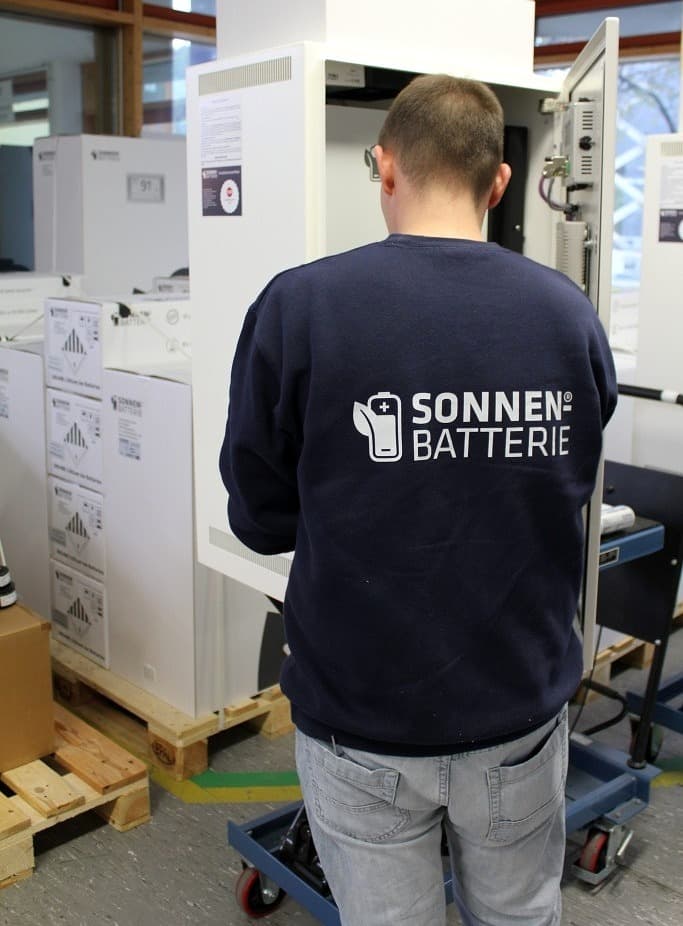
On the very last day of summer, we had the opportunity to visit the place where Sonnenbatterie is based and where these batteries are made.
“Our main added value is software, not hardware”
From one of the company’s founders, we learned, among other things, about the beginnings of Sonnenbatterie’s business. Initially, it largely involved assembling complex battery systems from supplied materials.
The company has now progressed further and works primarily on the software side of the product, which it considers its main advantage.
The entire system is highly sophisticated and includes weather forecasting (especially cloud cover), enabling the battery to correctly assess when it is time to charge and when it is instead appropriate to use electricity from the battery. This makes it possible to save more than 90 % of electricity drawn from the grid.
All data are transmitted via a modem built directly into the system. The data are also displayed in an online user section and in a mobile app, which every owner of the system can access.
Virtual power plants
Sonnenbatterie is seeking to go a step further than merely providing batteries to store generated electricity. This is the idea behind creating virtual power plants, which Christoph Ostermann ranked among the significant added values of the Sonnenbatterie system.
Just imagine it:
With sufficient market penetration of batteries of this type, it would be possible to “activate” batteries at individual owners’ premises when there is a shortage of capacity in the grid. This would be possible precisely because all batteries are connected in real time and the data are monitored in case of faults or servicing.
All that is needed is to wait for a sufficient number of batteries on the market, suitable regulation and market design, and virtual power plants will be here.
According to the founder, the average capacity of a battery sold is approaching 8 kWh, and 8 500 units have now been sold. Together, this means around 68 MWh of installed battery capacity. This is not enough at the current scale, as the power plants need to be more locally concentrated and capacity needs to be significantly higher.
But why could this not be a step towards the future?
Sonnenbatterie’s commercial segment
Just as Tesla has the Powerpack, Sonnenbatterie has its own product for large-scale commercial use. However, it cannot be described as being used for grid stabilisation, as the capacity of such batteries ranges from 24-240 kWh. The target market for this product is therefore mainly small businesses, restaurants, shops and others.
Nor can it be said that this market is driving the German company. It accounts for only a minority of the volume of batteries sold. According to Ostermann, around a hundred such units are currently in operation.
Tesla is also now active in this segment with its Tesla Powerpack product, although it can achieve significantly higher storage capacity (up to 10 MWh when batteries are combined).

Sonnenbatterie’s financials
What probably interests most people is how the batteries of this German company stack up financially and whether the investment as a whole pays off.
In this respect, it is very difficult to compare conditions in the Czech Republic and Germany, particularly because of the German subsidy for energy storage equipment and differing electricity prices for end customers, which are approximately twice as high as in the Czech Republic.
The financial side of the project can be illustrated by the example of Mr Hartmann from Wildpoldsried, who is a small business owner.
He uses several plotters to produce large-format prints for his business, so his consumption is significantly higher than that of an average household. This is also why he decided to buy a Sonnenbatterie system with the largest possible storage capacity, which is 16 kWh. He also has his own 9,7 kWp solar power plant on the roof.
The entire system cost him 29 000 euros, which is around 800 000 Kč. To this price, it is necessary to add the approximately 30% subsidy provided by the German government to support the development of electricity storage systems.
More important, however, is the payback period for the entire system, which, including the subsidy, is approximately 11 years (around 14 years without the subsidy).
Thanks to the system, he saves more than 90 % of the electricity he would otherwise have to draw from the grid on summer days.
Control systems
In our view, a major strength of the Sonnenbatterie system is its system for managing energy storage and its use over time. In this case, this primarily involves forecasting based on expected weather and cloud cover, which the system processes and uses to control battery charging or discharging accordingly.
Consumption planning is also ideal. In the test house, the aforementioned plotter, dryer and washing machine were connected to the control system, and it was possible to schedule when they would be switched on.
In addition, the web application was useful, with every owner having their own account and access to data on their battery. It is currently possible to monitor energy savings, generation and consumption. According to company representatives, this system motivates customers to plan their consumption.
Translation disclaimer
This article is a machine translation of the Czech original and has not yet been fully reviewed. In case of any doubt, please refer to the Czech version.