Czech utilities to connect standalone batteries to distribution grid, applications total thousands of MWh

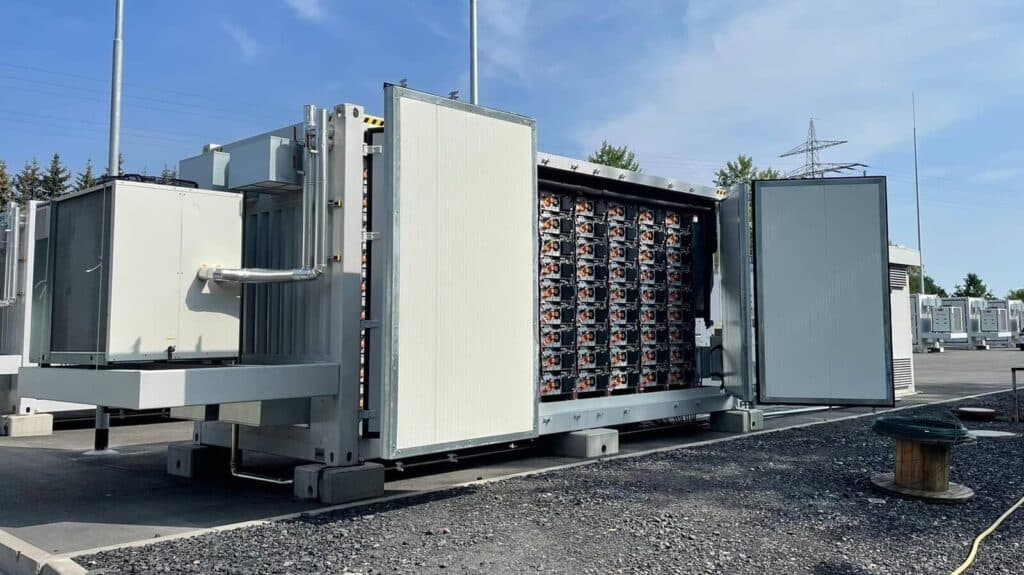
From October, energy companies will begin connecting standalone battery storage systems to the distribution grid in Czechia. Czech applicants have so far requested capacity reservations for thousands of megawatt-hours (MWh) of storage. These include large systems with capacities of several hundred MWh. The largest storage facility commissioned to date has a capacity of 29 MWh, the Czech Energy Storage Association AKU-BAT said. At present, only large storage facilities operating in combination with other energy sources can be connected.
The option of connecting standalone battery storage systems to the grid stems from this year’s approved amendment to the Energy Act, Lex OZE III, which after years of discussion set out rules for energy storage, aggregation and flexibility in Czechia.
The association says this opens up opportunities in Czechia especially for large-scale battery storage systems, generally defined as systems with a capacity of more than one MWh. According to the association, these are still relatively rare in the country because there has been no legislative framework or financial support for them. Several larger systems are in operation, but only in combination with other energy sources, most commonly at heating plants and power stations, alongside gas-fired generation or with solar power.
“That will soon be a thing of the past. Applications for capacity reservations for battery storage systems already total thousands of megawatt-hours,” said Jan Fousek, the association’s director.
The largest battery storage facility in the country to date, developed by LG Energy Solution, Siemens and LTW Battery, has a capacity of 29 MWh. “In the coming months and years, however, large systems with capacities of hundreds of megawatt-hours will be added,” Fousek said.
According to the association, the new conditions are attracting new investors to energy storage, often from other sectors. Their main motivation is the opportunity to provide balancing services, helping Czech transmission system operator ČEPS stabilise the grid and balance differences between electricity generation and consumption.
“But the potential for providing balancing services is not unlimited, and here too the capacity of planned projects is already exceeding the needs for these services,” Fousek warned.
The association says it is also worth considering so-called trading flexibility. For example, storage could be used when there is a surplus of electricity on the market and prices are low. Later, when electricity is in short supply and prices are high, the stored energy would be sold, helping to balance prices.
“In Western European countries, which have extensive experience with storage and providing flexibility, trading flexibility is the primary business focus. This is the case, for example, in the UK, where there are large parks with capacities of hundreds of megawatt-hours, and providing balancing services accounts for only 10 to 15 percent of their purpose. Ideally, this should also be the case here in the future,” Fousek added.
Translation disclaimer
This article is a machine translation of the Czech original and has not yet been fully reviewed. In case of any doubt, please refer to the Czech version.