
23 October 2026, 14:38
Loading...
Historic milestone: global battery demand topped 1 TWh for the first time last year

Jan Budín
21 March 2025, 06:05
The global battery market is developing rapidly as battery pack prices continue to fall, and demand exceeded 1 TWh for the first time last year. On the supply side, after years of investment, manufacturing capacity reached 3 TWh and could triple over the next 5 years if all announced projects go ahead. This is according to an analysis by the International Energy Agency (IEA) published in early March.
The International Energy Agency said global electric vehicle sales rose 25% year on year to 17 million units last year, bringing battery demand above the 1 TWh threshold. Growth in demand for electric vehicles is being driven, among other things, by falling average battery pack prices, which fell below USD 100/kWh for the first time last year.
"Cheaper minerals are an important driver of this decline. Lithium prices have fallen by more than 85% from the record highs reached in 2022. The rapid development of the battery industry is also helping to push prices down," the agency said.
According to the published data, total global manufacturing capacity among battery suppliers reached 3 TWh last year. Most of this capacity is in China, where three-quarters of the batteries sold last year were manufactured, according to the IEA.
China's dominance and the rise of the US
Despite China's current dominance, manufacturing capacity is also expanding in other regions.
"Korea and Japan are already key players in the global battery industry, home to major battery manufacturers and specialist suppliers focused on NMC batteries. Both countries have limited domestic production, but have made a number of investments abroad," the IEA added.
Korean companies have the largest overseas manufacturing capacity, with a total of 400 GWh. Japan ranks second in this area, with 60 GWh, followed by China with 30 GWh.
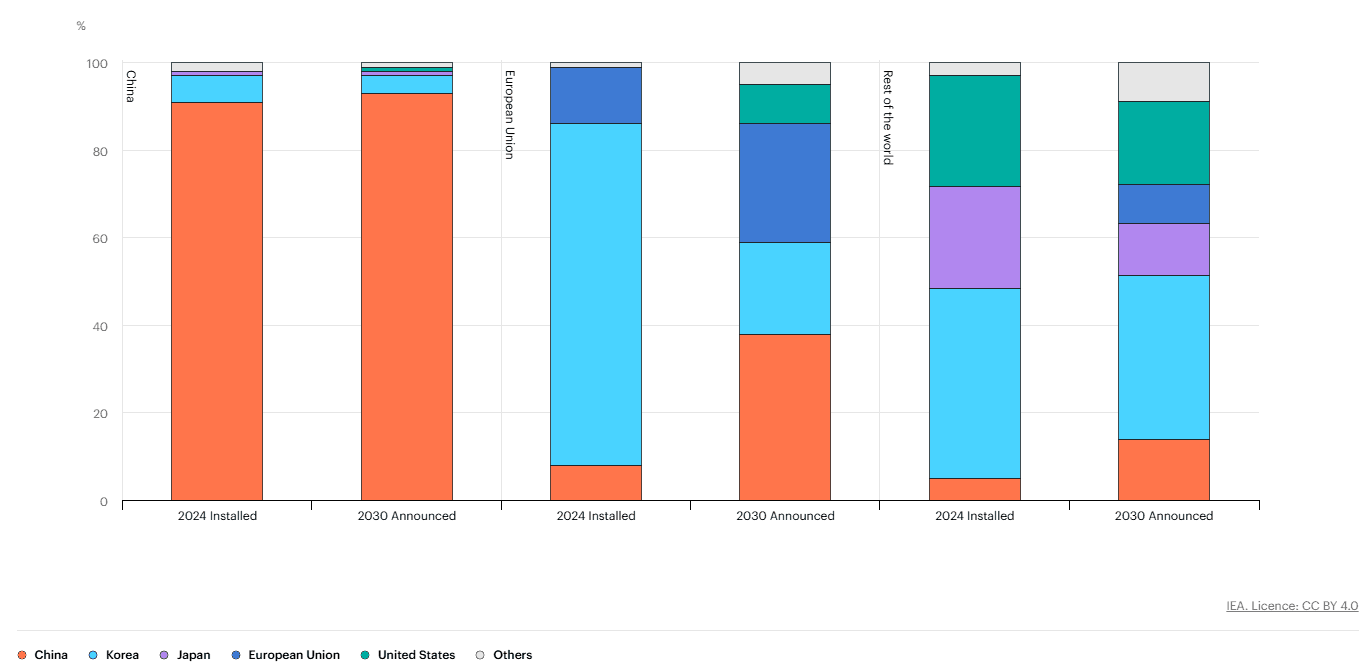
Battery manufacturing capacity in China, the EU and the rest of the world in 2024, and the outlook for 2030, by the manufacturer's country of origin. Source: IEA
The battery industry has also expanded rapidly in the United States, where manufacturing capacity has doubled to 200 GWh over the past two years, thanks to tax incentives for battery manufacturers. Another 700 GWh of manufacturing capacity is under construction.
"Around 40% of existing manufacturing capacity in the US is operated or has been built by established battery manufacturers in close cooperation with carmakers. The development of domestic manufacturing capacity for battery components is progressing more slowly, meaning that most demand for anodes and cathodes is still met through imports," the agency added.
A turning point for Europe
According to the IEA, Europe's battery storage supply chain ecosystem remains quite vulnerable. One of the problems is the ongoing shortage of specialist workers. The bankruptcy of Europe's battery hope Northvolt only confirms the industry's lack of competitiveness compared with Asian manufacturers.
The International Energy Agency said, however, that there are still ways to build a more competitive battery industry in Europe. The first step should be strong domestic demand, giving battery manufacturers certainty about sales and time to fine-tune production processes.
"Over the past two years, Korean manufacturers, which have long been Europe's largest battery producers, have lost almost a quarter of their market share in the European Union, falling from nearly 80% in 2022 to 60% in 2024, partly as a result of the growing success of LFP batteries made in China," the IEA said, adding that some Korean companies have already begun investing in LFP battery production in Europe to better compete with Chinese manufacturers.
In the meantime, Chinese battery manufacturers are expected to increase their share of battery sales in Europe, including through new partnerships. Projects such as the joint venture between Stellantis and CATL could, however, accelerate the uptake of LFP batteries in the region, improve Europe's battery ecosystem and potentially narrow the cost gap between Europe and China.
Translation disclaimer
This article is a machine translation of the Czech original and has not yet been fully reviewed. In case of any doubt, please refer to the Czech version.
Sdílejte článek prostřednictvím:
You might also like


23 October 2026, 11:01


23 October 2026, 06:34