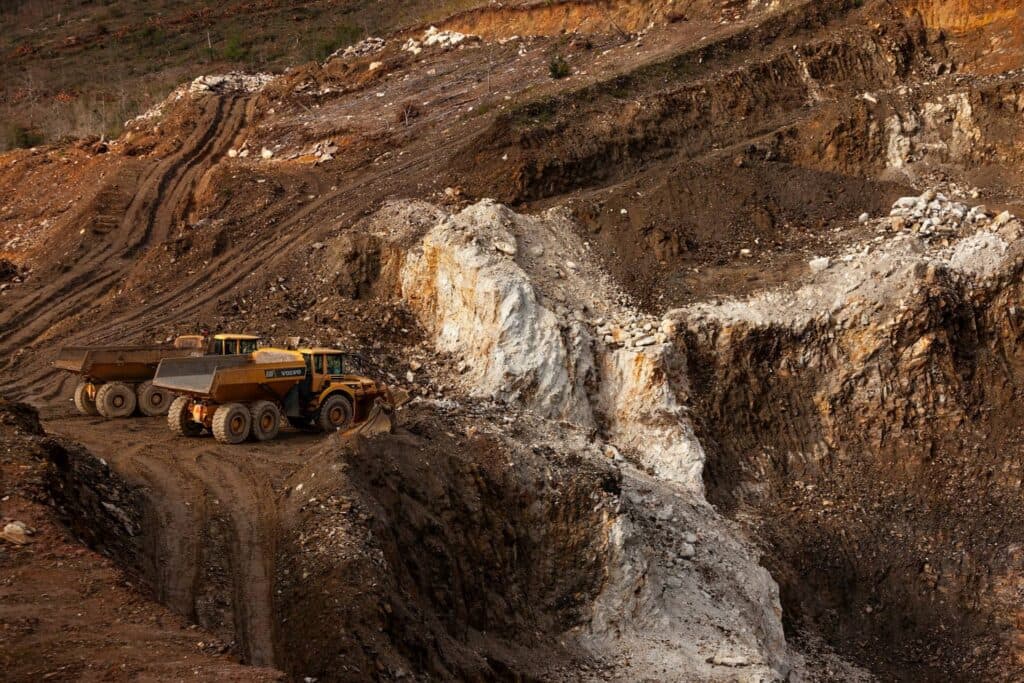
Cínovec was meant to be the salvation from dependence on China: domestic lithium, thousands of jobs, billions for public budgets, trillion-crown value. The reality in 2025 is delayed plans, infrastructure subsidies and the question of whether mining can get under way on the hill at all without massive state support.
On the steep hill between Dubí in northern Czechia and Cínovec, formerly a busy border crossing between Czechia and Germany, and further along the road to Saxony’s Altenberg, it is quiet for most of the day. Lorries have moved to the motorway, while the stalls, pimps and sex workers that made the then E55 a Central European symbol of street prostitution have disappeared. In the early 1990s, the last tin mines here closed and the Ore Mountains mining region, where ores had been extracted since the Middle Ages, began to live off tourism.
A reminder of old times is that something occasionally collapses into the ground somewhere. In summer, a hole appeared in the road in the centre of Zinnwald, just across the border from Cínovec. At first it was the size of a manhole cover and in mid-July still looked harmless. Then it began to widen, and by September it had become a proper excavation pit. Half the road in front of the old school eventually had to be closed, and in October the pit was surrounded by construction fencing and tarpaulins.
Underground like Swiss cheese
The German authority dealing with mining legacy issues removed a decades-old concrete plug from the ground and found that surface water had washed away the fill material and created cavities at depth. An old mine passage, which had already been reinforced once, had collapsed again after years.
The Cínovec hill, divided into two parts by the Czech-German border, is riddled with old mine workings. Tin and tungsten were mined here for centuries, and miners left behind numerous shafts. Some are not shown on any mining maps.
“Underground here is like Swiss cheese,” says natural scientist and local activist Jens Weber. “A layer around one hundred metres below the surface looks like Swiss cheese — full of undocumented old shafts. So we do not know exactly where they all are.”
Elsewhere, a hole in the road would not cause such a stir. But here, on a perforated hill that is meant to help save Europe from dependence on China, it is a different story.
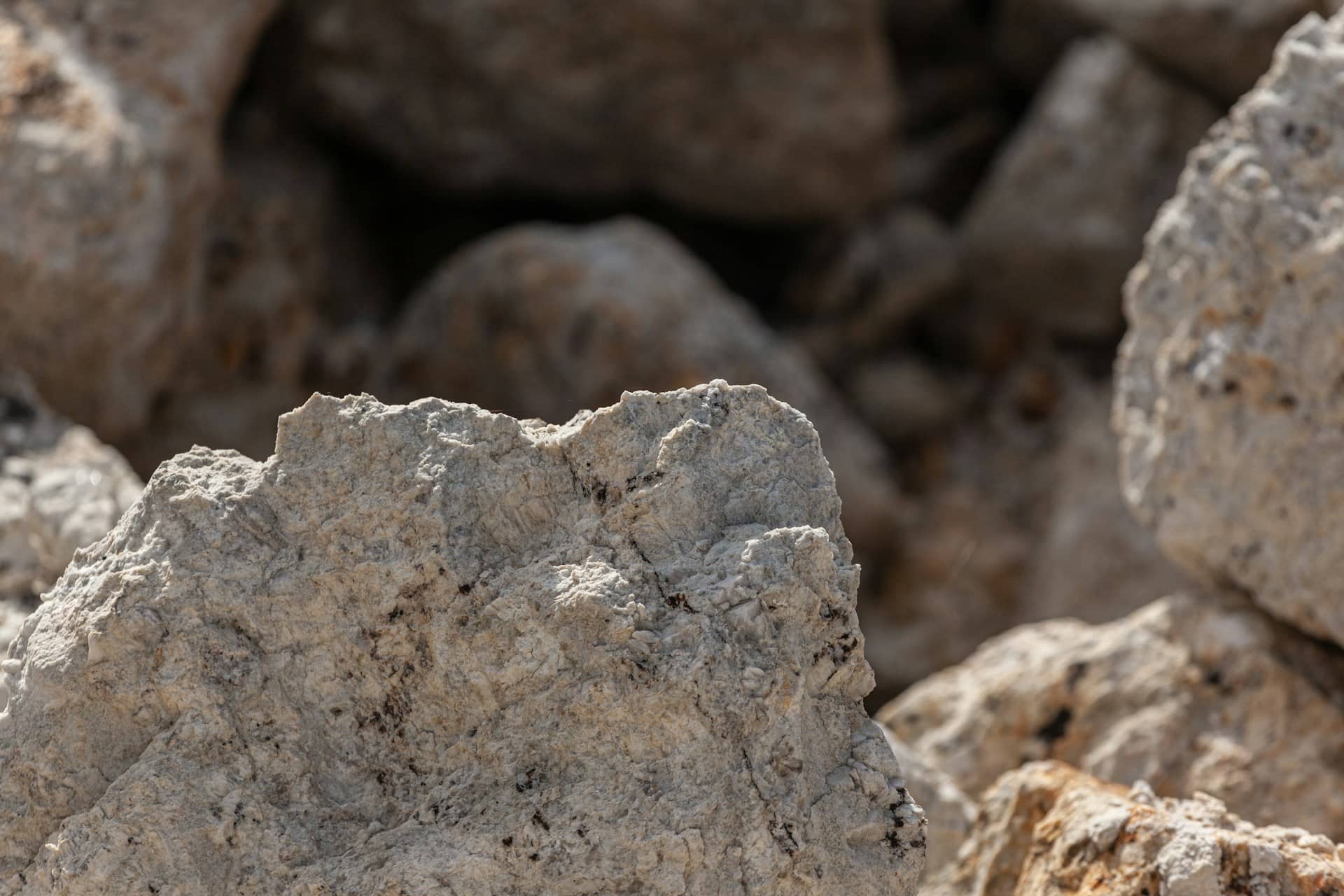
Beneath Cínovec and Zinnwald, estimates put more than one million tonnes of pure lithium locked in the local mineral zinnwaldite. In the hunt for the light metal needed to make electric vehicle batteries, an almost unimaginable amount of rock could be extracted from deep within the hill. And that is precisely what many locals fear.
“At the outset, the mining company promised to maintain a distance of around 60 or 80 metres below the layer containing the old shafts,” Weber says. “And now the project plans for only 20 metres, and they want to blast large chambers in the hill.”
Together with his wife Britta, he is among the most prominent opponents of the mining project. They helped found the Grüne Liga Osterzgebirge initiative, which highlights environmental impacts. Britta Weber comes from the lignite mining region of Brandenburg and has experienced what it means to surrender a landscape to mining.
“I grew up in a village that was due to be razed several times because of lignite,” she says. “But the neighbouring village where I went to school was eventually demolished. I know what I have, and I know what I do not want. After 30 years of living here in the Ore Mountains, I do not want to go through it again,” she explains.
The hill remains quiet
While opposition is growing around Zinnwald, nearby Altenberg is betting on mining revenues. “Up to €2.3 billion in corporate income tax could flow to us if the company mines for 30 to 40 years,” André Barth of the AfD, the town’s acting mayor, recently told locals. For the indebted town, he said, it could be a path out of debt.
At the same time, he admits that residents and tourists would have to get used to a giant pile of waste left after zinnwaldite mining. “Whether it would be a good calling card for a recreational area is open to debate,” he adds.
As lithium prices have fallen in recent years, plans on both the German and Czech sides have expanded in order to make mining worthwhile at all. The German side originally envisaged extracting half a million tonnes of ore annually; under plans from March, this has risen to roughly seven times as much. The Czech project has also grown: from a former 1.7 to 2.2 million tonnes annually to 3.2 million. Together, this would amount to up to 6.7 million tonnes of ore a year.
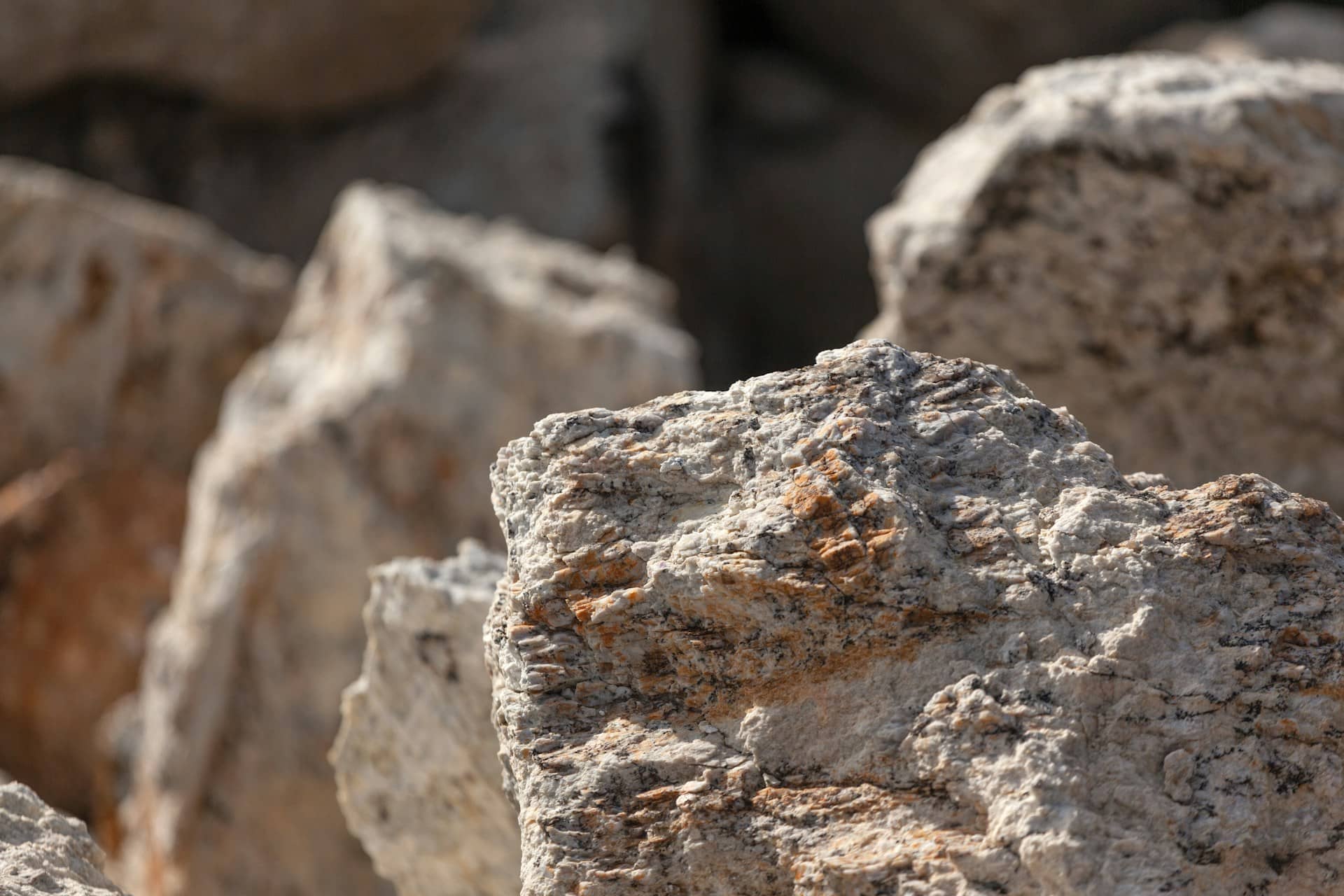
Zinnwaldite is low in lithium. Extracting lithium from it requires large amounts of energy, water and chemicals. And at the end, a mountain of residue remains. If everything goes as expected, around seven million tonnes of ore could produce about fifty thousand tonnes of lithium hydroxide or carbonate annually — chemicals used to make battery cells. That quantity would be enough for approximately 1.5 million electric cars.
Together with another major project at Jadar in Serbia, Cínovec could provide Europe with at least partial independence from lithium and battery imports. These two sites are now among the few major European lithium sources under development, at a time when Europe accounts for less than 0.1 percent of global mining and China controls more than three quarters of the entire supply chain.
On the Czech side, state-controlled energy group ČEZ joined the project in 2019 through Geomet, in which it bought a majority stake. The remaining 49 percent is held by Australian company European Metals Holdings (EMH). On the German side, Frankfurt-listed Zinnwald Lithium aims to launch lithium mining and processing.

Until recently, top-ranking politicians travelled to the Ore Mountains because of lithium. Czech Prime Minister Fiala visited, as did German Chancellor Scholz twice, once with Serbian President Vučić. There was talk of a huge opportunity for the region, thousands of jobs and trillions of crowns hidden beneath the surface.
But by autumn 2025, dreams of extraordinary profits have vanished, and the Cínovec hill remains quiet for now. Key studies continue to be postponed, mining plans are growing on paper, as are applications for subsidies. And questions are mounting as to why a project that was meant to deliver major profits ultimately needs subsidies just to get started.
The end of euphoria
Little remains of the politicians’ euphoria. When ČEZ entered Cínovec in April 2020, lithium was on the rise and the world expected an electric vehicle boom. In 2022 and still at the start of 2023, prices soared to astronomical levels and the project looked like an economic bonanza: EMH shares broke records, while preliminary studies by their neighbours at Zinnwald Lithium also celebrated the prospect that money invested in the German part of the hill would multiply several times over.
On the Czech side, the “definitive feasibility study” was supposed to be completed — after several delays — by Christmas 2023. It is essentially a blueprint for how lithium mining and processing should work from a technological and economic perspective. That did not happen. More announcements of delays followed, and at ČEZ’s annual general meeting this June, the latest deadline given was the end of this year.
ČEZ explained the repeated postponements by the need to revise plans because of opposition from affected municipalities.
Under the plans, the mined ore is to be crushed and transported by cableway to Újezdeček, a small municipality near Teplice around seven kilometres away. A processing plant — essentially a large lithium chemical factory — was originally to be built there in the Dukla industrial zone. Geomet had pre-arranged the purchase of land there for nearly one billion crowns.
Public presentations in the surrounding municipalities — Dubí, Teplice and nearby Košťany — were quite heated. Residents whose homes would in some cases stand only hundreds of metres from the planned plant gradually learned what processing millions of tonnes of ore entails.
“On one occasion, Geomet people mentioned sulphuric acid — that they would need to transport some forty to fifty thousand tonnes of it annually,” recalls Újezdeček mayor Stanislav Molnár. “That almost caused panic in the hall.”
Representatives of ČEZ and Geomet long insisted that there was no alternative. They assessed more than 20 sites, but none had the necessary parameters. Some lacked sufficient space, others rail connections or stable ground.
But money was also at stake. In a non-public analysis, they warned that an option involving rail transport of ore to a more distant plant, rather than a cableway to Dukla, would cost 13 to 16 billion more in transport alone over 25 years. “Speed and low costs are crucial for the project. Every delay and every cost increase can sink it,” says one of the project’s now former managers.
Millions of tonnes of material will be moved
Last year, however, Geomet backed down and announced that it would move the chemical plant to Prunéřov near Kadaň — on the site of a former coal-fired power plant. The ore is to travel seven kilometres by cableway to a new transshipment terminal at Dukla near Újezdeček, and from there continue by train for around sixty kilometres to Prunéřov.
At the same time, Geomet increased planned mining at Cínovec from the original 2.2 million tonnes to 3.2 million annually. “The volume of extracted ore had to be increased precisely because of the change in the location of the processing plant,” ČEZ said. “The larger area at Prunéřov will give us greater plant capacity, and higher output will offset the increased costs of transporting the material.”
The flow of material will be extraordinary. To produce the planned 35 thousand tonnes of lithium carbonate, the final substance for batteries, the aforementioned three million tonnes of ground zinnwaldite are to travel annually by cableway and train to Prunéřov, together with around 800 thousand tonnes of chemicals and additives. These range from energy gypsum to sodium hydroxide and sulphuric acid. There will also be large amounts of electricity, gas and water.
Around 1.5 million tonnes of chemically processed ore will return by the same route to the mine, where it will be used to backfill mined-out spaces. The remaining roughly 2.5 million tonnes annually are to end up in a storage facility at the nearby Nástup Tušimice mine. ČEZ representatives stress that this is not waste, but “material for further use”.
The project is considering recovering by-product metals in future, mainly tin and tungsten, and possibly rubidium, but these are not yet included in operational plans. Some technologists also doubt it can be achieved.
For Újezdeček, switching from a chemical plant to a large rail transshipment terminal has not brought peace to the municipality either. Locals fear noise, dust and increased traffic. “We will try to ensure it has the smallest possible impact on the municipality,” says Mayor Molnár. In a poll held before the chemical plant plan was scrapped, just one person out of four hundred respondents in the municipality supported the entire project.
The market has collapsed
For ČEZ, as the majority owner, the project’s economics are key, according to public statements. At the annual general meeting in June, deputy chairman of the board Pavel Cyrani faced a series of questions from minority shareholders on the issue. According to him, the project is “operationally profitable”, but a final decision will only be made after the definitive feasibility study is completed — that is, no earlier than the first quarter of next year.
“Taking long-term lithium prices into account, the project is profitable, but we need to clarify customer interest,” he said. Current spot prices in China are not relevant, he said; what matters is the long-term price forecast over the mine’s operating life.
But the lithium market has collapsed and, for a third year, has shown no signs of recovery. The price of a tonne of lithium carbonate has fallen from record levels of around $80 thousand in 2022 to roughly $10 thousand. Producers around the world are cutting output or closing the most expensive mines, but supply is still keeping pace with demand, which has fallen short of expectations.
What the statements of ČEZ executives imply is illustrated by the approach taken by investors on the German side of Cínovec. In spring, Zinnwald Lithium published a new preliminary study assuming a selling price for its product of around €20 thousand per tonne, and after five years of operation even more than €26 thousand — more than double today’s market level. At current prices, the project would barely break even.
Processing zinnwaldite is technically and financially demanding. Unlike the world’s most significant deposits, it is to be mined underground, and extracting lithium from zinnwaldite requires a process not operated anywhere in the world at industrial scale. Analysts at Benchmark Mineral Intelligence therefore rank both the Czech and German projects among higher-cost producers. Without subsidies, long-term contracts and higher prices, they will struggle to make money.
The German side plans to mine 3.5 million tonnes annually. Together with the Czech side, that means almost seven million tonnes of ore from a single mountain massif divided only by a state border. On both sides, virtually the same thing is being prepared in mirror image: an underground mine beneath Cínovec and Zinnwald, and a chemical plant further inland.
Water, floods and relocation
The project on the German side no longer looks as it did at the beginning either. The lithium factory was originally meant to stand near Altenberg, where Jens and Britta Weber also live. Above the access road in the middle of the local forests in the Bärenstein valley, they hung a banner reading “Hier Keine Lithium-Gier” — “Stop the lithium rush!”
Here, people are mainly afraid of water. Most water from Cínovec flows down to the German side. After rain, the local stream would turn reddish, an unwanted reminder of long-ended tin mining. In heavy downpours, it becomes a river.
“In 2002, we had to leave our house; the entire valley was under water,” Jens Weber recalls. “You simply cannot build a chemical factory in a place from which everyone has to be evacuated during floods,” he adds.
In March, Zinnwald Lithium came up with a new plan and moved the factory to Liebenau, seven kilometres away. This did not greatly reassure locals. The project has grown on paper, and it is still unclear where all the mining waste will go.
Since this year, the project on the Czech side of the hill has been in a somewhat better position. In March, Cínovec, being developed by Geomet, received strategic project status from the European Commission under the Critical Raw Materials Act (CRMA). The German part of the deposit did not make the list of strategic projects.
“The decision is disappointing, but it changes nothing about the essence of our business. The European battery supply chain is underdeveloped and demand for lithium will continue to grow,” responded Zinnwald Lithium chief executive Anton du Plessis.
Strategic project status brings accelerated permitting and easier access to financing. Being absent from the list may mean a more difficult path to public support and delays in approvals for the German project.
“It may save us a lot of stress. We certainly do not envy our neighbours in Czechia their situation,” Britta Weber adds on behalf of the project’s opponents, collecting comments on the German project for the local Bärenstein citizens’ initiative.
Money, but from subsidies
The Czech project is further advanced from the miners’ perspective. Geomet has received an 800 million crown contribution from the European Just Transition Fund to build infrastructure around the planned mine — a cableway, transshipment terminal and rail connection. According to the environment ministry, the subsidy aims to “ensure self-sufficiency” for Czechia and the EU in lithium mining and processing, and to prepare conditions for a “complete battery supply chain”.
For a long time, there was talk that an investor in a battery-production “gigafactory” would come with the mine and chemical plant. That did not happen. ČEZ says it is still looking for a technology partner for the construction and is negotiating with potential lithium customers.
The Just Transition Fund subsidy may not be the last. ČEZ executives have indicated that they will seek money from both Czech and European budgets. “We will use all subsidy schemes that are available,” Pavel Cyrani confirmed at the annual general meeting in June. He did not comment on whether the project would be profitable without public support. He said he was waiting for the feasibility study.
According to Kamila Vítek Derynková, chair of the Cinvald association, the approved subsidy is problematic. Her association has long highlighted the risks of mining at Cínovec. The fund is meant to help former coal regions diversify their economies. But in this case, Kamila Vítek Derynková says, it is effectively support for another form of mining — only lithium will replace coal. “In my view, this circumvents the purpose for which the transition fund was created in the first place,” she explains.
The subsidy comes with several conditions, and ČEZ and Geomet must sprint. By the end of the year, they must submit complete documentation for an environmental impact assessment, the so-called “major EIA”. In summer, the environment ministry decided that Geomet could not proceed piecemeal using a salami-slicing approach and had to apply for an assessment of the project as a whole — mining, transport and processing. It must obtain approval by the middle of next year or risk having to repay the subsidy.
From trillions to security
The arguments in favour of mining at Cínovec have changed and shifted significantly. While politicians on both sides of the border once promised money and jobs, today the focus is mainly on geopolitics and raw material security.
The European Union is almost entirely dependent on lithium imports. China now controls more than three quarters of the mining and processing of critical raw materials, including advanced battery production. And tensions are rising. This autumn, Beijing made exports of the rare elements gallium, germanium and antimony more difficult; these are crucial, for example, to semiconductor production. It was a direct response to trade restrictions and tariffs imposed on China by the United States under Donald Trump. In Europe, this raised serious concerns about shortages of some raw materials not only for carmakers, but also for the defence industry.
In this situation, the European Commission also included the controversial lithium mine in Serbia among strategic projects. International mining giant Rio Tinto is pushing the plan to mine lithium in the Jadar river valley. It already triggered mass protests by tens of thousands of people in Serbia in 2021.
Under public pressure, the Serbian government backed away from mining, but revived the project last summer with European Union support. Then this June, like Cínovec, it received strategic project status despite ongoing protests, police violence against activists, and warnings from Serbian academics and non-governmental organisations about environmental and social impacts.
“Europe has taken off its gloves and shown us that it only cares about business interests and profits,” Zlatko Kokanović of the local Ne Damo Jadar initiative commented on the European decision.
For Europe, it is a dilemma. It needs lithium for the green transition and the electrification of the economy, yet risks damaging its own reputation and betraying the values it officially upholds — democracy, transparency and the rights of local communities — in the rush for raw materials.
For Czechia and Germany, the fundamental question remains: are these projects worthwhile at all? Lithium prices are low, zinnwaldite processing technology has not been proven at industrial scale, and the economics may depend on public support and subsidies.
The atmosphere surrounding the Czech project has also changed markedly. When Prime Minister Petr Fiala came to the Ore Mountains two years ago, local mayors say he spoke of two to three trillion crowns and of how lithium would kick-start and transform the Czech economy. But that has vanished like morning mist over Cínovec.
Today, mayors and representatives of the Ústí Region say their meetings with Geomet show that the company is operating in cost-saving mode and is very sparing with any promises. “When you consider how much will be mined, how much lithium it will produce and how few electric cars we have in Czechia, the question is whether it would not be better to import it than let a third of the region be destroyed because of it,” says Újezdeček mayor Stanislav Molnár.
The production of this report was supported by a grant from the Investigative Journalism for Europe (IJ4EU) fund.