20 October 2026, 15:34
Loading...
What technologies ensure sufficient electricity at the Czech Self-sufficient House? (1/2)
Michal Klečka
11 July 2022, 13:15
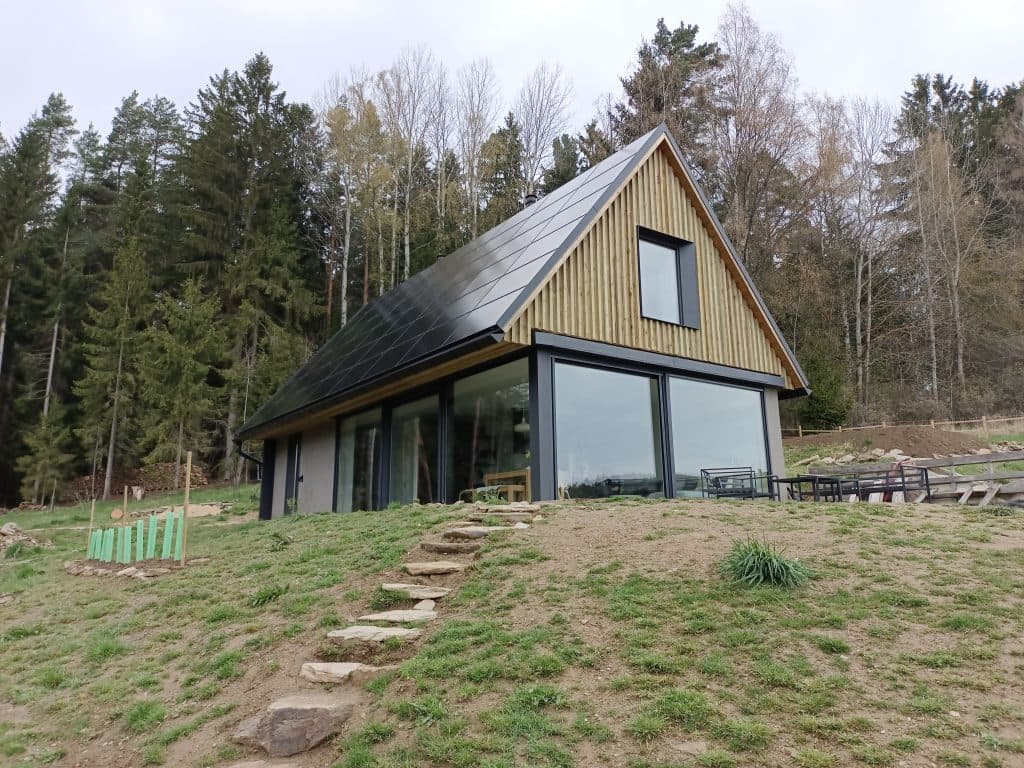
A follow-up to the story of the Czech Self-sufficient House, told by project initiator Pavel Podruh. The technical perspective is provided by Michal Klečka, who is behind the designs for energy self-sufficiency.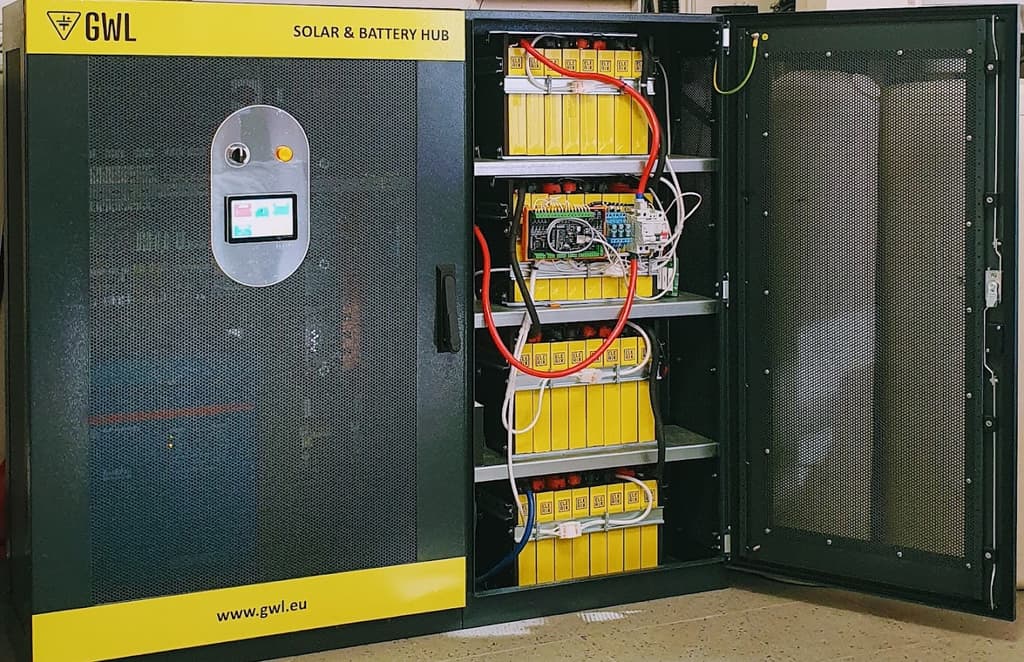
This time, we will focus on a more detailed description of the technologies used and the house’s technical solution. We will describe which solar panels, inverters and batteries we chose and why. We will reveal how long the house can run on batteries alone and how we provide backup for critical components.
Selecting solar power plant and storage technologies
Solar panels or solar tiles? Half-cut, PERC or “shingled” solar modules? Branded European or no-name Chinese solar panels? Lead-acid, vanadium redox or lithium batteries? BMZ or Pylontech? LG, Fronius, SMA, Victron, Solax, GoodWe inverters and controllers, or Chinese ones from AliExpress?
These were all questions we had to decide, and each expert promoted only “their technology” as the sole correct choice. We set the following criteria as relevant for selecting components and technologies:
- a standardised, time-tested solution at a reasonable price (solar tiles were ruled out),
- maintenance-free operation, easy replacement and serviceability (vanadium redox batteries were ruled out)
- resistance to fire and explosion (batteries based on NMC and LiPo chemistry were ruled out)
- the lowest possible toxicity of the solutions used (batteries based on cadmium, lead, GEL, VRLA and sulphuric acid in general were ruled out)
- an emphasis on technically advanced solutions that set global trends (lithium batteries received extra points)
- electronic components, such as DC/AC inverters and controllers, must have strong commercial and technical support on the Czech / European market, offering the prospect of long-term support (we excluded Chinese inverter brands; extra points went to brands with development departments and headquarters in Europe)
- there must be a sufficient number of designers at the given location and time who work with the brand / system and its combinations, thereby ensuring natural competition (of opinions, ideas and prices).
Which batteries should be used for a self-sufficient house?
The key criteria for selecting batteries for energy storage were safety, lifespan and price. Although non-lithium batteries are still occasionally used (such as gel or sulphuric acid lead-acid, nickel-cadmium, nickel-metal-hydride and nickel-iron batteries), we concluded that these are outdated technologies for which it is becoming increasingly difficult to find justification or manufacturers.
Lithium iron phosphate batteries are now the most widely used in stationary storage and industrial electric mobility. They have the worst weight-to-capacity ratio, but that does not matter to us in a house. They are relatively inexpensive to manufacture, champions in terms of lifespan (around eight thousand cycles or more), and can charge and discharge very quickly. In the event of a short circuit / overcharge, there is no risk of fire or explosion. This technology ultimately won.
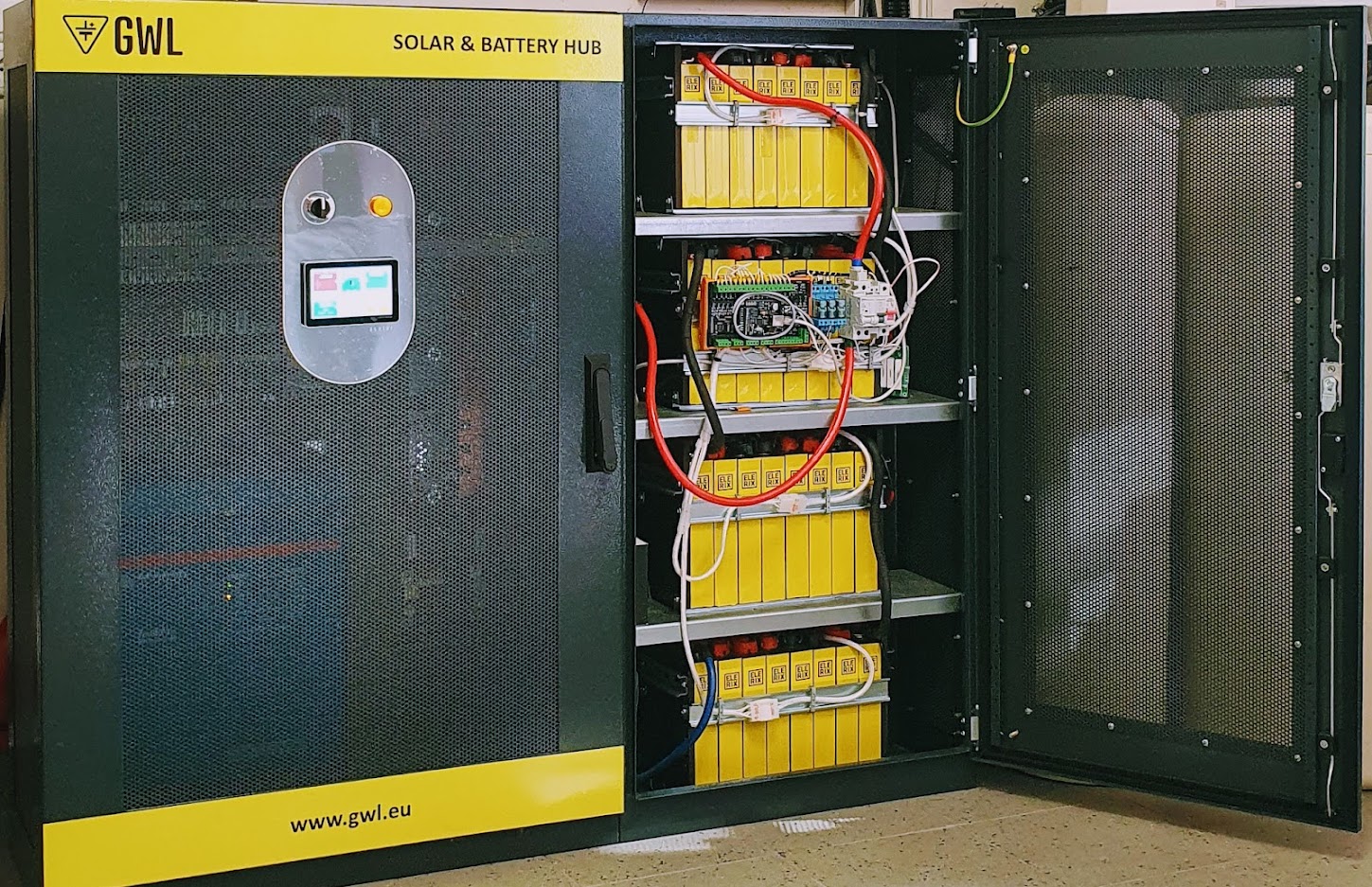
GWL battery hub made up of LiFePO4 cells. Illustrative photo.
Winston LiFePO cells came out on top
Supplier GWL a.s. proposed a battery made up of 20 ThunderSky Winston lithium iron phosphate cells. Each cell has a capacity of 400Ah (ampere-hours) and a voltage of 3.3V (volts). The series arrangement therefore gives us a battery with a voltage of 55V and a capacity of approximately 20 kWh. With economical operation of the house, for which we plan consumption of up to 3 kWh per day, this provides a reserve for seven days of operation without a single ray of sunlight. Moreover, it can absorb the photovoltaic system’s peak output (15 kW), as it can charge at up to 1C (20 kW in our case) and discharge up to three times faster. No other battery comparable in price and size on the market at the time (2018) could offer this, and likely still cannot.
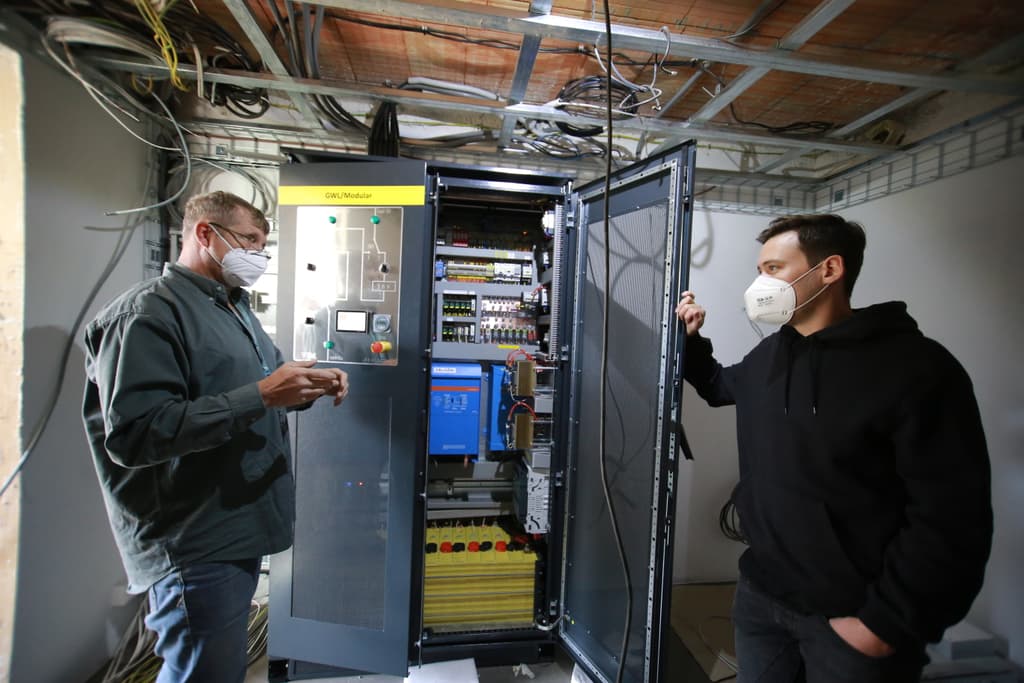
The battery can be dismantled and serviced in the future, and a faulty cell can be replaced if necessary. According to the service manual, any skilled electrician can do this. Although the LiFePO4 type is relatively space-demanding, we managed to select cell dimensions that fit in the bottom of the switchboard. This is also an advantage of modular batteries made from prismatic cells: it is almost always possible to find a solution with suitable dimensions.
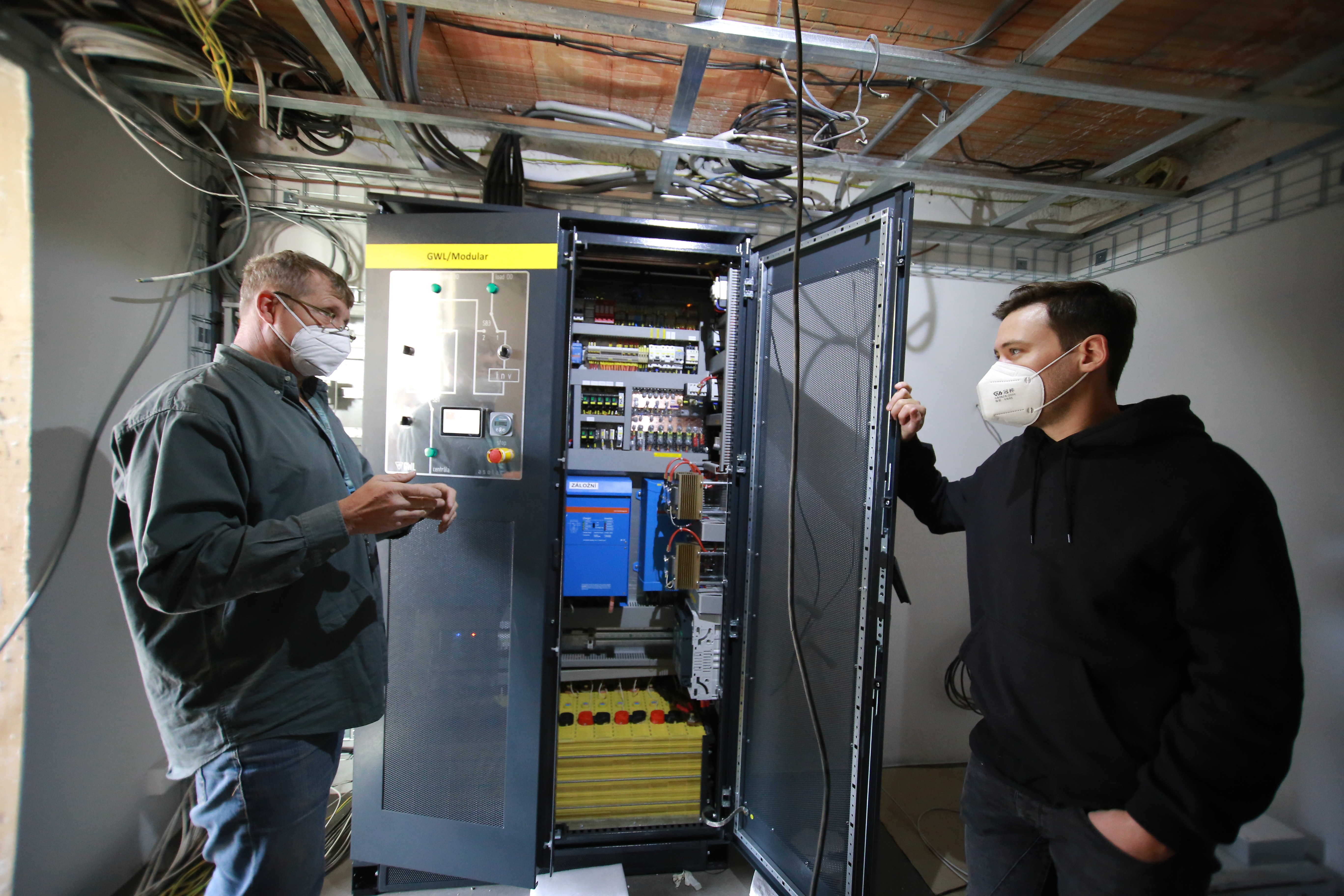
Installation of battery storage in the self-sufficient house. Source: Pavel Podruh archive
The battery’s guaranteed lifespan is around eight thousand charging cycles. At average use of one cycle per week, this means a lifespan of more than 100 years. GWL equipped the battery with an ELERIX protection and safety system (BMS). This too is fully universal, using only an analogue control system for the other components, while an additional module for remote battery monitoring via the internet can be connected to it. It can be replaced with another system at any time or moved to another battery.
Solar panels or tiles?
Solar roof tiles are today’s hit on social media and in the media, especially thanks to Elon Musk and his company TESLA. In reality, however, they are used very little compared with conventional solar panels, mainly because of their roughly six times higher price – 1 kWp costs around 1800 EUR, while conventional solar panels can be bought for around 300 EUR. That settled the question for us :-)
Selecting the inverter and solar panel manufacturer
Which solar panels?
Technically minded readers can find details, for example, in this publication. We went through it and would summarise it for others as follows: if you are buying from a specialist company with a track record, tradition and good references, choose according to current availability, price per Wp, dimensions and desired appearance. Even a few millimetres in a solar panel’s width can ultimately determine how many will or will not fit on the roof. For us, for example, all-black panels were a priority – they are not much more expensive than black-and-white-and-silver checkerboard designs, and they look significantly better on the roof.
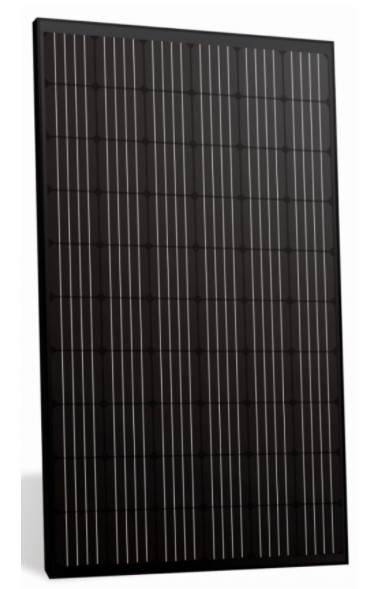
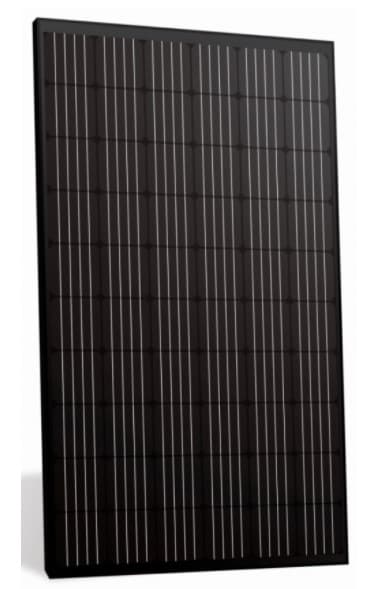
The final selected Elerix 320Wp solar panel (mono, PERC, all-black) from GWL for the Self-sufficient House
The Self-sufficient House is equipped with a total of 48 Elerix panels with a combined output of 15 360 Wp. Under optimal conditions, one panel produces 33.5V of direct current voltage and 9.5A of current. If no current is drawn from the panels, their open-circuit voltage can be as high as 41V. Conversely, when a panel is short-circuited (meaning its voltage is almost zero), the panels can supply up to 10A of current.
Which inverters and controllers?
Components that can adapt the voltage from solar panels to the voltage in the battery and household sockets are called controllers and inverters. We originally proposed using fully universal, no-name “Chinese” inverters and controllers with no built-in intelligence or ability to communicate with their surroundings. This is excellent for the future possibility of replacement and for replicating the entire solution in different places and at different times, but it requires higher-level intelligence – which we wanted to entrust to the TECOmat system. However, we ultimately rejected it for the reasons described in previous instalments (because of smart homes with stupid problems), and so had to find another solution.
The criteria were the product’s technical sophistication, robust construction, a manufacturer based in Europe, and sufficient references and track record. We considered many brands and manufacturers, but ultimately Victron Energy won thanks to its excellent technical support in Czechia, stock availability and reasonable price.
Why Victron?
Its comprehensive system of controllers and inverters has basic built-in intelligence, while also allowing strictly analogue control. This avoids the so-called “vendor lockup” effect, where in the future it is impossible to replace a faulty / unsuitable component with a similar one from another manufacturer simply because it is controlled by / controls another part using proprietary closed data communication.
All Victron Energy components are standalone, interchangeable and replaceable with others. Their robust construction is evident not only from a simple look at the printed circuit board and the components used, but also from their main application – for more than 20 years, they have been installed reliably and without problems on seagoing vessels, an extreme environment of cold, heat, humidity and salty air.
MPPT controllers
For the 48 panels with an output of more than 15 kWp, we plan to use three separate MPPT controllers. On the one hand, one powerful enough to process energy from all the panels at once is not currently manufactured, and on the other hand, we would not want this anyway for safety reasons. If it failed, the entire house would be left with almost no energy supply. This way, we have triple redundancy – even one of the three controllers can provide the house with enough energy for operation and battery charging.
One controller therefore processes the direct-current voltage from a group of 16 panels (48 / 3 = 16). Each group of 16 panels is further divided into four panels connected in series (known as strings, voltage around 145V), and these four groups are connected in parallel, supplying up to 38A of current to the controller.
What exactly does an MPPT controller do?
Readers familiar with electrical engineering probably know, or have already noticed, that a solar panel is a current source. That is, at a certain constant light intensity, it supplies almost the same current regardless of the load connected to it and how much the voltage at its output is reduced. And since power equals current multiplied by voltage, it is clear that the best output is achieved at the highest voltage. But how can it be maintained at the output?
This is why we almost always install some form of stabiliser or controller between solar panels and an appliance. Regardless of irradiance and the current demand (resistance) of the connected appliance, it stabilises the panel voltage at its ideal value (stated on the panel label), and if it drops even slightly, it immediately limits the current supplied in real time so that the voltage does not fall further (and vice versa). This is called the “MPPT function”, and it enables us to achieve maximum output from the system.
The self-sufficient house can withstand an inverter failure
Inverters can in turn convert direct-current voltage (12 to 60V) into 230V / 50 Hz alternating current, for which all household appliances are designed. They are connected to batteries or solar panels on one side and to a standard electrical switchboard on the other, in place of the 230V grid connection. We chose a combination of these three inverters:
- One large 10 kW unit, which will operate from spring to autumn and can easily power all common appliances in the house.
- A second, 5 kW unit, which will operate mainly from autumn to spring and is sufficient to power essential appliances. Its advantage is significantly lower standby consumption, making it suitable for days when energy is in short supply.
- A third unit rated at just 1200W, which powers critically important appliances (lighting, alarm, cameras, internet, water pump, boiler circulation pump) and has such low self-consumption that it can run almost indefinitely even on days without sunshine, when we obtain energy only from diffused and reflected light (overcast weather, fog…).
Advantages of this three-way combination:
- If the 5 or 10 kW inverter fails, the system can operate almost without limitation on the other one. Switching is mechanical, using a single manual lever on the switchboard.
- When powering a high-load appliance (welder, wood dryer, ceramic kiln, electric vehicle charging station), both inverters can be synchronised to provide the appliance with a 15 kW supply. Again, this is done by manually switching a mechanical lever switch.
- While in summer mode the large inverter’s 120W standby consumption does not bother us, in winter we cannot afford to lose 3 kWh “somewhere in the wires”. Switching to the 5 kW inverter saves us at least 1.5 kWh per day.
- In overcast or foggy conditions, or when there is a thick layer of snow on the roof, both inverters can be switched off and only the little 1200W unit used. Its standby consumption is around 5W, so it is completely negligible.
The next article on the Self-sufficient House will also provide a more detailed description of the DC switchboard. We will look at how we heat the house and how we generate electricity for heating when the sun is not shining. There will also be other interesting findings from testing and fine-tuning the technologies used.
Translation disclaimer
This article is a machine translation of the Czech original and has not yet been fully reviewed. In case of any doubt, please refer to the Czech version.
Sdílejte článek prostřednictvím:
You might also like
20 October 2026, 12:55
20 October 2026, 10:49
20 October 2026, 06:13