20 October 2026, 15:34
Loading...
What to watch out for with a home solar power system: the Czech Self-Sufficient House example
Michal Klečka
21 April 2022, 14:40
A loose continuation of the story of the Czech Self-Sufficient House, told by the project’s initiator, Pavel Podruh. The technical perspective is provided by Michal Klečka, who is behind the designs in the field of energy self-sufficiency. This time, the article focuses on the basic concepts and rules leading to safe, technically and economically rational energy self-sufficiency.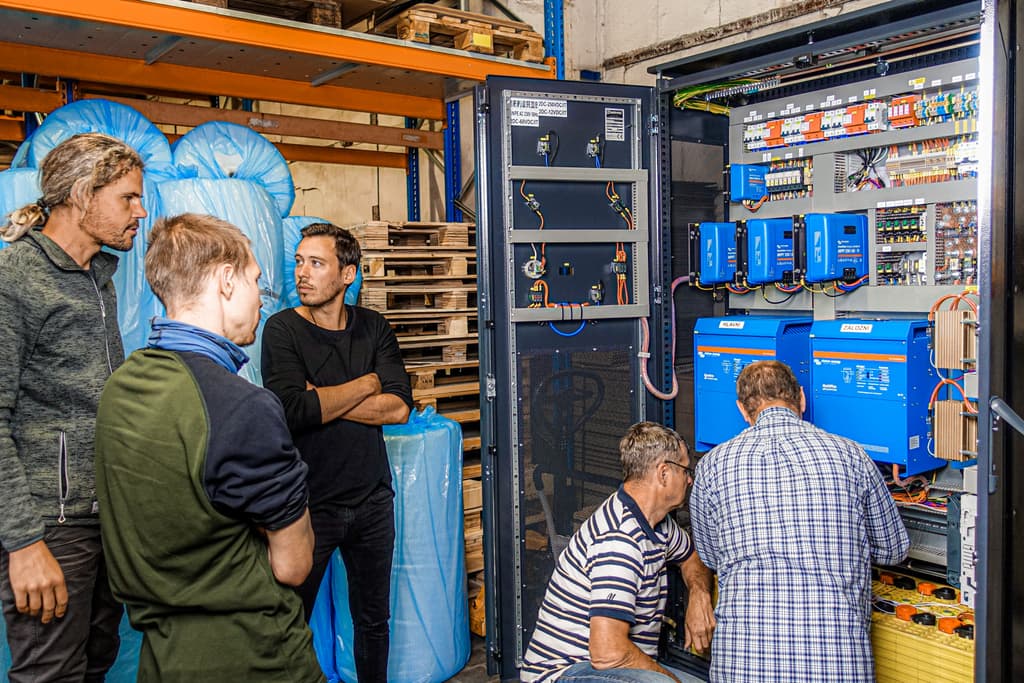
All considerations that led to the rules and concept described below are based on the fundamental local and technological conditions of the Czech Self-Sufficient House, which were presented in the previous instalment.
At the beginning of the collaboration between GWL and Pavel Podruh in 2016, a concept was established for approaching the entire solution using modern “smart” technologies that enable sophisticated energy consumption management. Over time, however, the authors came to realise that the best approach to energy management would be to leave responsibility to people. Put simply, Michal and Pavel changed the project’s philosophy from a super-intelligent house (with potentially stupid problems) to a stupid house with certainly smart residents. They rejected the path of building a system that would take full responsibility for energy management.
The concept of educating the house’s residents therefore prevailed. What does the project’s founder say about it?
“We established simple rules for how people living in the house should make decisions based on the information available to them. The system only makes recommendations, in the form of simple symbols – a percentage indicator and a classic battery traffic light. Only when the user does not respond to the warning does the system launch a ‘self-preservation’ algorithm, which shuts down everything non-essential and thus saves itself.”
Conceptual framework
The basic elements of the concept we ultimately arrived at are summarised in the following points.
- Repeatability - we are designing a system that can be replicated easily. It is easy to understand and document, uses widely available components and contains no specialised know-how. The cost of the system must be reasonable in relation to the price of the entire property and comparable to the cost of a conventional electrical installation connected to the distribution grid.
- Simplicity - installation, commissioning and servicing must be manageable by any local electrician who will be available when needed.
- Robustness - the system is resilient to component failures and rough handling by users. We implement everything using the N+1 system known from the electricity transmission grid, meaning that the failure of one component must not cause the system as a whole to fail, i.e. lead to a blackout.
- Repairability - we use only components that are widely available and can be replaced with a similar component from another manufacturer. Proprietary products listed in the catalogue of a single manufacturer are excluded from the outset, or may only be a supplementary part of the system and the system must not depend on them.
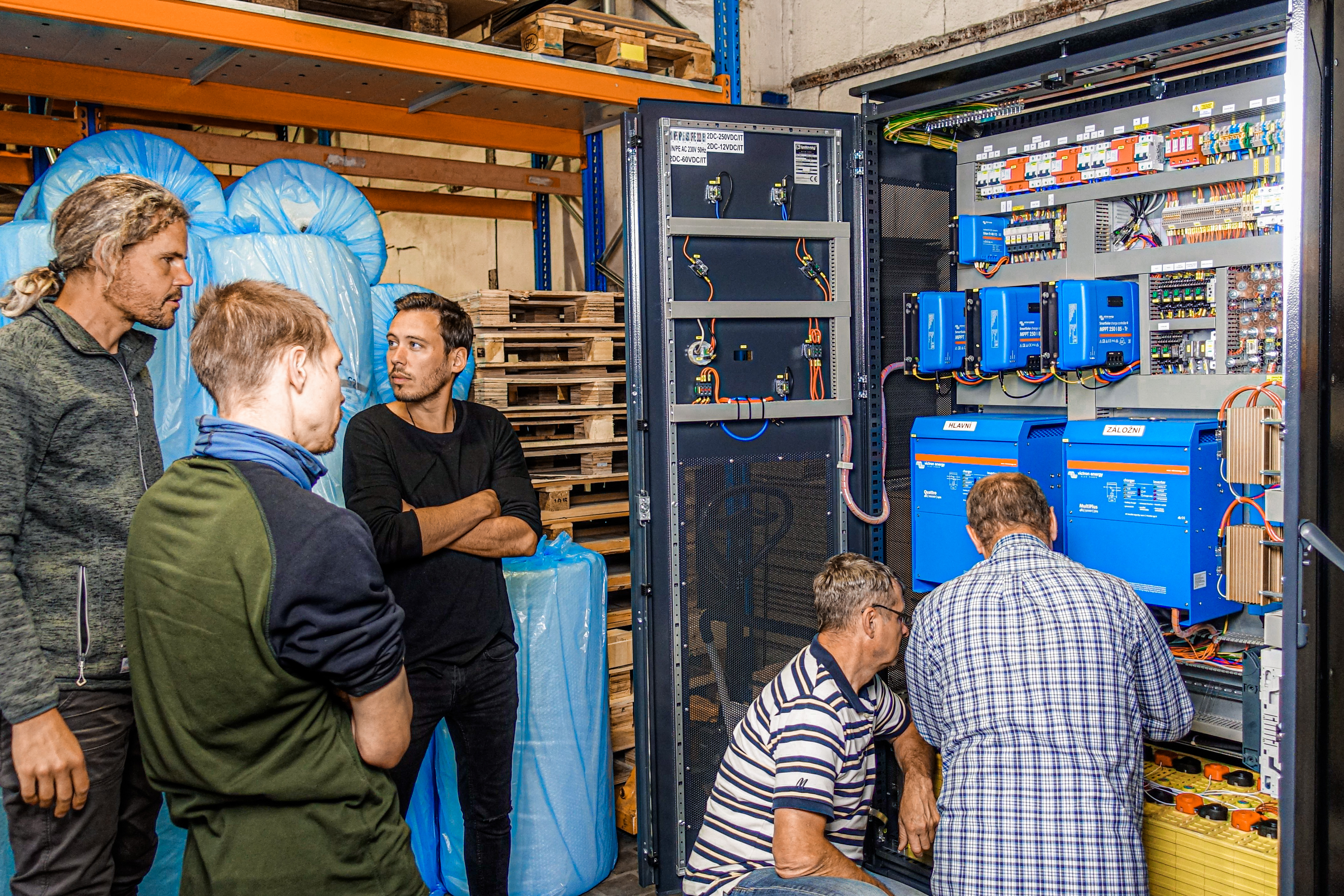
Applying the concept in practice - a simple, robust and easily repairable battery storage solution. Source: Pavel Podruh’s archive.
- Service life - we assume that the system will still operate at a time when its authors, investors and suppliers are no longer available for various reasons. We do not want to put its future owners and operators in a situation where they would be unable to maintain, expand, repair or operate the system.
- Purposefulness - we are building an off-grid system because it is purposeful and sensible in the given place and at the given time. Not out of defiance, nor to show at all costs that it can be done. If we found that a conventional / hybrid approach was better, we would switch in that direction.
- Relationship with the surroundings - energy is not just electricity. The entire energy system of the house must work in mutual symbiosis; a stable electricity supply is only a necessary prerequisite, not the goal. The other systems – namely heat supply, drinking and utility water, ventilation and communications – must support, respect and complement one another.
- Availability of local energy sources - the system uses sources that are commonly available in the area. That is, a sufficiently large south-facing area for solar modules, a local source of drinking water, a large drainage area as a source of utility water, and sufficient woody biomass as a fuel source.
- Aesthetics and compactness - nobody will buy an ugly thing that they will be tripping over everywhere. In a small house of up to 100 m2, the energy system cannot take up more than a small utility room of a few square metres.
- Modesty - we assume that the house’s resident is able to respond to the current energy situation and reduce their consumption.
- Carbon restraint - we will not use energy sources that increase the concentration of CO2 in the atmosphere over the long term (coal, gas…), otherwise negatively affect the environment (nuclear power), or support countries and regimes that are not our strategic allies (nuclear power, gas…).
Safety
We address it from two perspectives – resilience against blackouts and the protection of health and property. Neither is a given.
The right balance of the number of solar panels, battery capacity, the total power draw of appliances and the logic governing their operation will ensure that the house never runs completely out of energy. In other words, water will always run, and there will be heat and light.
The right choice of technologies will in turn ensure that the house does not become a site with an increased fire risk, that no toxic gases or vapours escape from the batteries, and that no fire or release of toxic substances into the surroundings occurs in the event of any accident.
We address blackout resilience through:
- The N+1 rule, meaning that the failure or malfunction of any component or element of the energy system does not cause an overall system failure.
- Proper energy management, in which the system knows the current amount of energy produced and consumed, the charge in the battery, and accordingly manages energy flows and recommends appropriate behaviour to residents.
- Sufficient power and capacity reserves in all elements of the system.
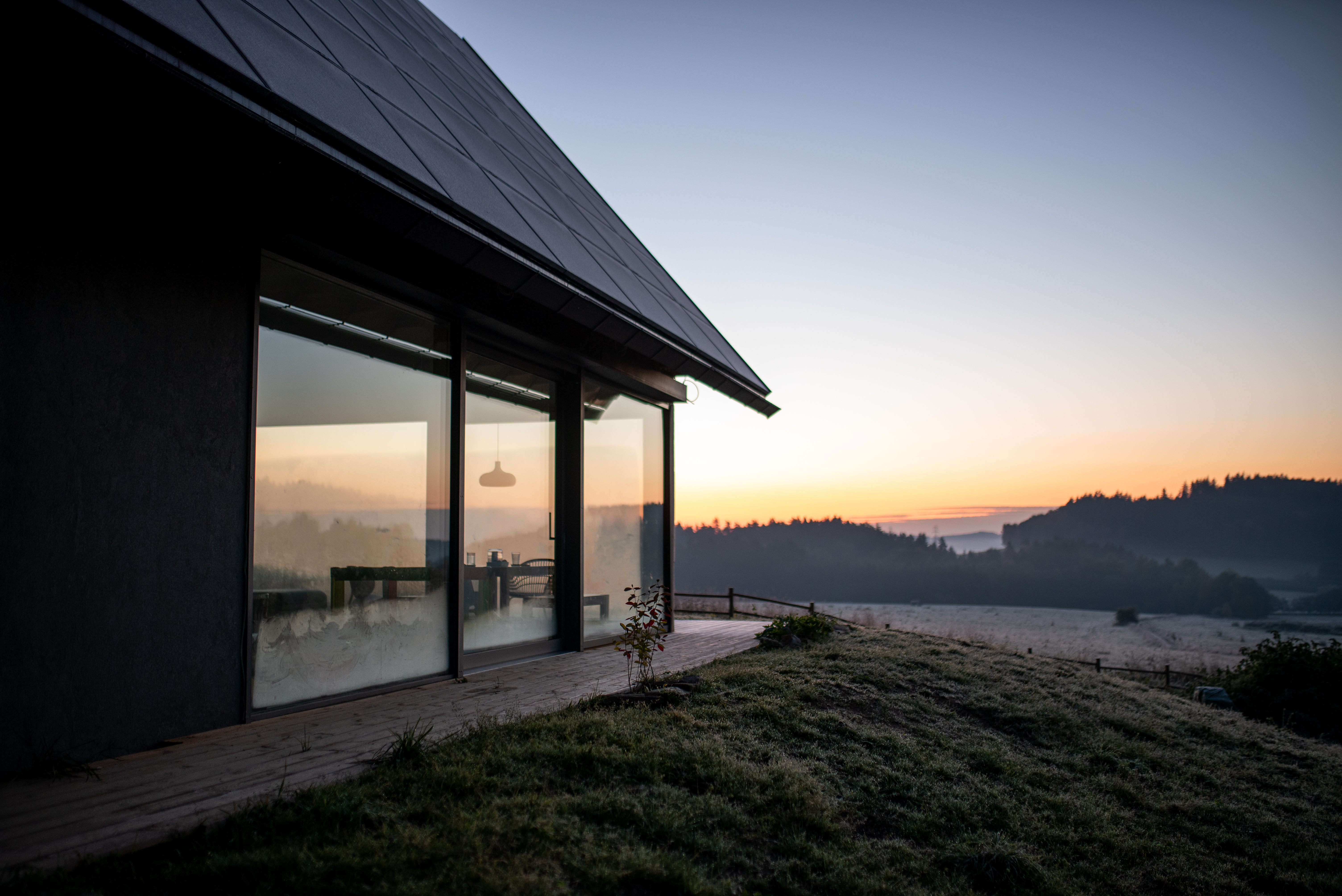
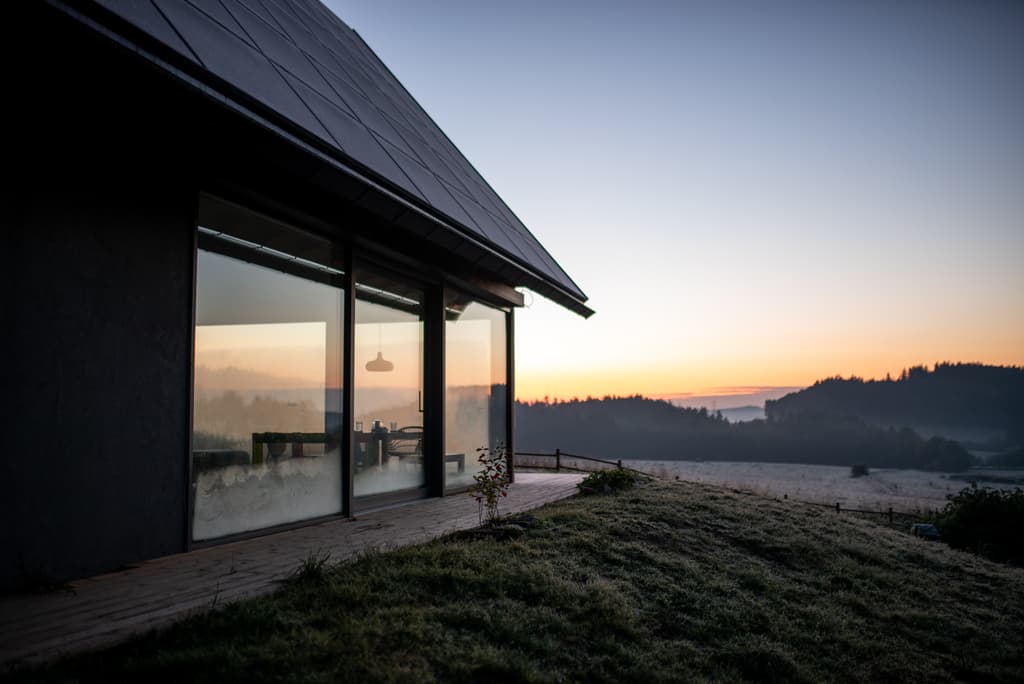
Self-sufficient house. Illustrative photo. Author: Jiří Hloušek.
The N+1 rule
If any element of the system can fail or malfunction, it must be backed up by a second, reserve one. This applies to all groups of solar panels, power and charging controllers, inverters, circuit breakers, solid-state relays, and heat and hot-water sources.
This does not apply to elements where failure or malfunction is statistically excluded or makes no sense from an investment perspective. An example is the main battery, which can theoretically fail (this happens about once every 500 years), but its price is so high that in the event of a failure it is more cost-effective to rent a hotel for a week than to have a second spare one. Even so, we back it up – with a petrol generator :-).
Power and capacity reserve
Solar panels are now so cheap and efficient that it pays to install as many as space and aesthetics allow. We can make good use of every additional panel in winter, and they do not bother us in summer. In our case, we use the entire southern side of the roof, i.e. around 77 m2 / 15 kWp. It is not easy to place more on the plot and the building.
The battery is different – it is very capital-intensive, so it pays to calculate carefully how much we actually need. If it is too small, it will not provide a reserve for those hours and days when the sun does not shine. If it is too large, we will not have enough energy to charge it in winter and will therefore have “thrown money down the drain”.
The next instalment of the series will focus on a more detailed description of the technologies used and the house’s technical solution – we will describe which solar panels, inverters and batteries we chose and, above all, why; what we do with surplus electricity; how we heat the house; how we secure electricity even in winter; and other interesting details. You will also see real photographs of the utility room and technologies, as well as basic block diagrams of the switchboard, heating and water management systems.
Translation disclaimer
This article is a machine translation of the Czech original and has not yet been fully reviewed. In case of any doubt, please refer to the Czech version.
Sdílejte článek prostřednictvím:
You might also like
20 October 2026, 12:55
20 October 2026, 10:49
20 October 2026, 06:13